
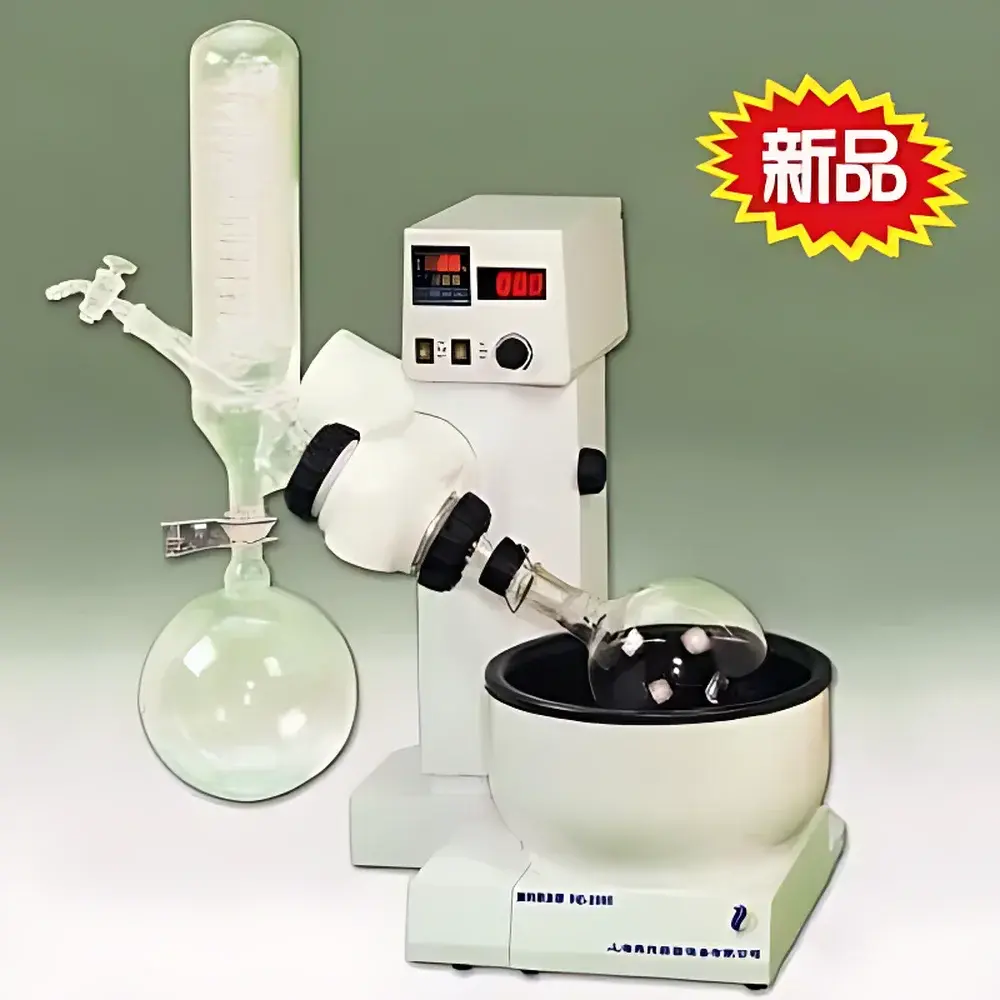
Yarong RE3000A Rotary Evaporator
| Brand | Yarong |
|---|---|
| Origin | Shanghai, China |
| Model | RE3000A |
| Rotational Speed Range | 20–200 rpm |
| Heating Bath Temperature Control Range | Ambient to 90 °C (digital display) |
| Heating Bath Power | 1.4 kW |
| Total Power Consumption | 1.5 kW |
| Voltage | 220 V AC, 50/60 Hz |
| Lift Range | 0–150 mm (motorized, rapid auto-lift) |
| Bath Material | PTFE-coated stainless steel with fully enclosed heater |
| Evaporation Tube Diameter | Large-bore vapor pathway for enhanced solvent throughput |
Overview
The Yarong RE3000A Rotary Evaporator is a precision-engineered benchtop system designed for efficient, reproducible solvent removal and concentration of heat-sensitive samples under reduced pressure. Operating on the principle of rotary evaporation—where sample rotation increases surface area, simultaneous vacuum lowers boiling points, and controlled bath heating supplies precise thermal energy—the RE3000A delivers consistent performance across organic synthesis, natural product isolation, pharmaceutical R&D, and analytical sample preparation workflows. Its modular architecture integrates a digitally controlled heating bath, motor-driven rotation, programmable vertical lift mechanism, and a high-efficiency vertical condensation system—all constructed to meet the mechanical and thermal stability requirements of routine laboratory purification tasks.
Key Features
- Digital rotational speed control (20–200 rpm) with LED display ensures accurate, repeatable rotation rates critical for film formation and evaporation kinetics.
- Motorized vertical lift system with 0–150 mm travel range enables rapid, hands-free adjustment of flask immersion depth—reducing operator fatigue and improving process repeatability.
- PTFE-coated stainless-steel heating bath with fully enclosed 1.4 kW heating element provides uniform thermal distribution and corrosion resistance against acidic or basic solvents.
- Integrated digital temperature controller with real-time water bath temperature readout (ambient to 90 °C) supports precise thermal management in compliance with method-defined protocols.
- Vertical dual-reflux standard-taper ground-glass condenser—fabricated from borosilicate glass rated for sustained operation up to 200 °C—offers high condensation efficiency and minimal carryover.
- Large-diameter vapor pathway minimizes flow resistance and enhances mass transfer, particularly beneficial during high-volume or low-volatility solvent evaporation.
- Compact, ergonomic design with rocker-style tactile buttons and intuitive interface simplifies daily operation without compromising safety or serviceability.
Sample Compatibility & Compliance
The RE3000A accommodates standard ground-glass jointed flasks (typically 1 L, 2 L, or 5 L capacity) and is compatible with common organic solvents—including acetone, ethanol, ethyl acetate, dichloromethane, and hexane—as well as aqueous and mildly corrosive mixtures. All wetted parts are chemically inert (borosilicate glass, PTFE, and stainless steel), supporting use under ISO 8573-1 clean air classifications when paired with appropriate vacuum pumps and cold traps. While not certified to IEC 61010-1 or UL 61010B out-of-the-box, the unit conforms to general electrical safety expectations for Class I laboratory equipment operating at 220 V AC. Users implementing the RE3000A in regulated environments (e.g., GLP or GMP labs) are advised to validate temperature accuracy, rotational stability, and vacuum integrity per internal SOPs aligned with ASTM E29 or ISO/IEC 17025 guidelines.
Software & Data Management
The RE3000A operates via embedded microcontroller logic with no external software dependency. All operational parameters—including setpoint temperature, actual bath temperature, rotational speed, and lift status—are displayed locally via integrated LED indicators. No data logging, USB export, or network connectivity is provided; however, the unit’s stable analog control architecture ensures long-term reliability and minimal calibration drift. For laboratories requiring audit trails or electronic records, integration with third-party environmental monitoring systems (via optional 4–20 mA or 0–10 V analog outputs, if available on custom configurations) may be implemented subject to local validation protocols. The absence of cloud-based firmware or remote access aligns with IT security policies common in regulated research institutions.
Applications
- Solvent recovery and concentration of reaction mixtures in synthetic organic chemistry.
- Purification of natural extracts (e.g., essential oils, alkaloid fractions) without thermal degradation.
- Preparative-scale removal of volatile solvents prior to lyophilization or crystallization.
- Routine sample workup in QC/QA labs supporting pharmacopeial methods (e.g., USP <467> residual solvents).
- Environmental analysis workflows involving EPA Method 3510C (separation of extractable petroleum hydrocarbons).
- Academic teaching laboratories where robustness, ease of maintenance, and intuitive operation are prioritized.
FAQ
What is the maximum recommended flask size for the RE3000A?
The system is optimized for 1 L to 2 L round-bottom flasks using standard 24/40 or 29/32 ground-glass joints. Use of larger flasks may compromise rotational balance and condenser efficiency.
Can the RE3000A operate under deep vacuum (e.g., <10 mbar)?
Yes—when paired with a suitable two-stage vacuum pump and cold trap, the sealed glass train maintains stable operation down to ~5 mbar, though optimal evaporation rates are typically achieved between 10–50 mbar depending on solvent volatility.
Is the heating bath temperature calibrated traceable to NIST standards?
Factory calibration is performed using reference thermometers; end-user recalibration is supported via accessible bath sensor terminals and standard PT100-compatible instrumentation.
Does the unit include vacuum regulation or pressure control?
No—vacuum control must be managed externally via a separate vacuum regulator or controller; the RE3000A features only a vacuum inlet port and sealed vapor path.
What maintenance intervals are recommended for long-term reliability?
Inspect ground-glass joints and O-rings monthly; lubricate lift mechanism bearings every 6 months; verify bath temperature accuracy quarterly using a calibrated immersion probe.



