
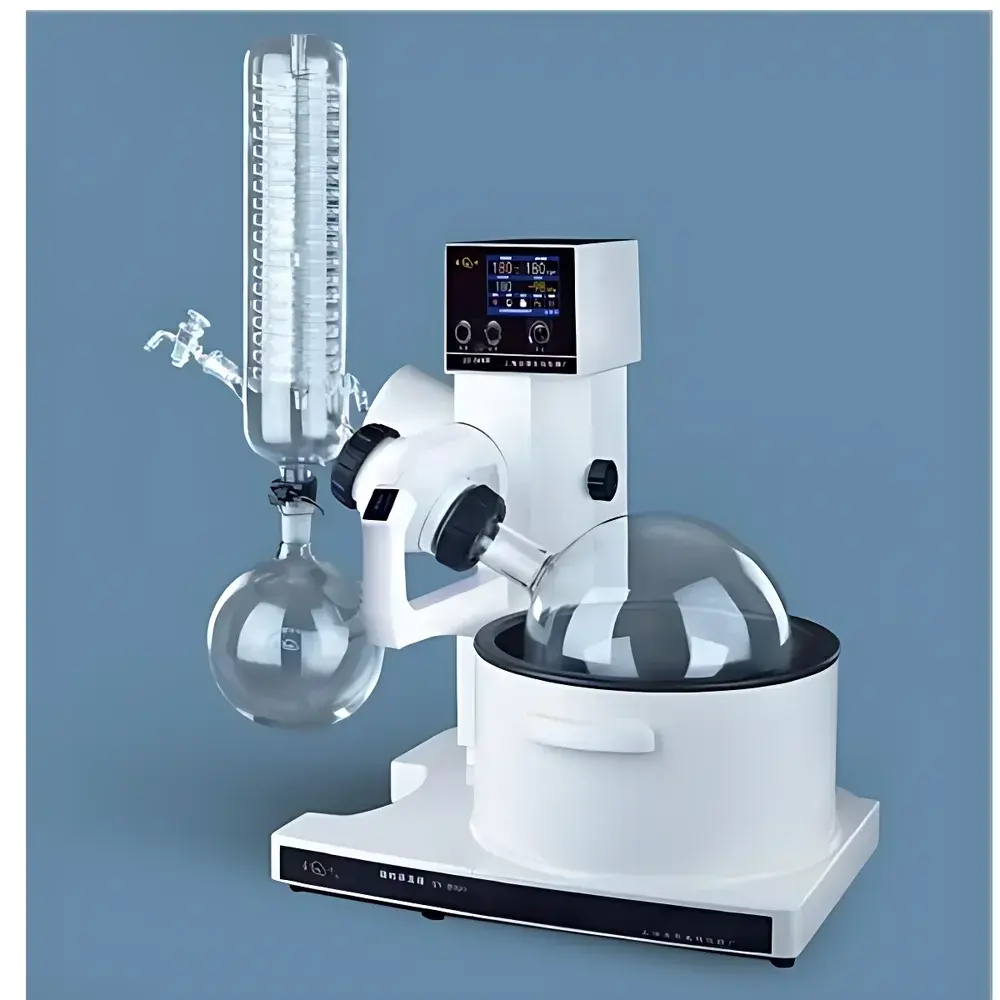
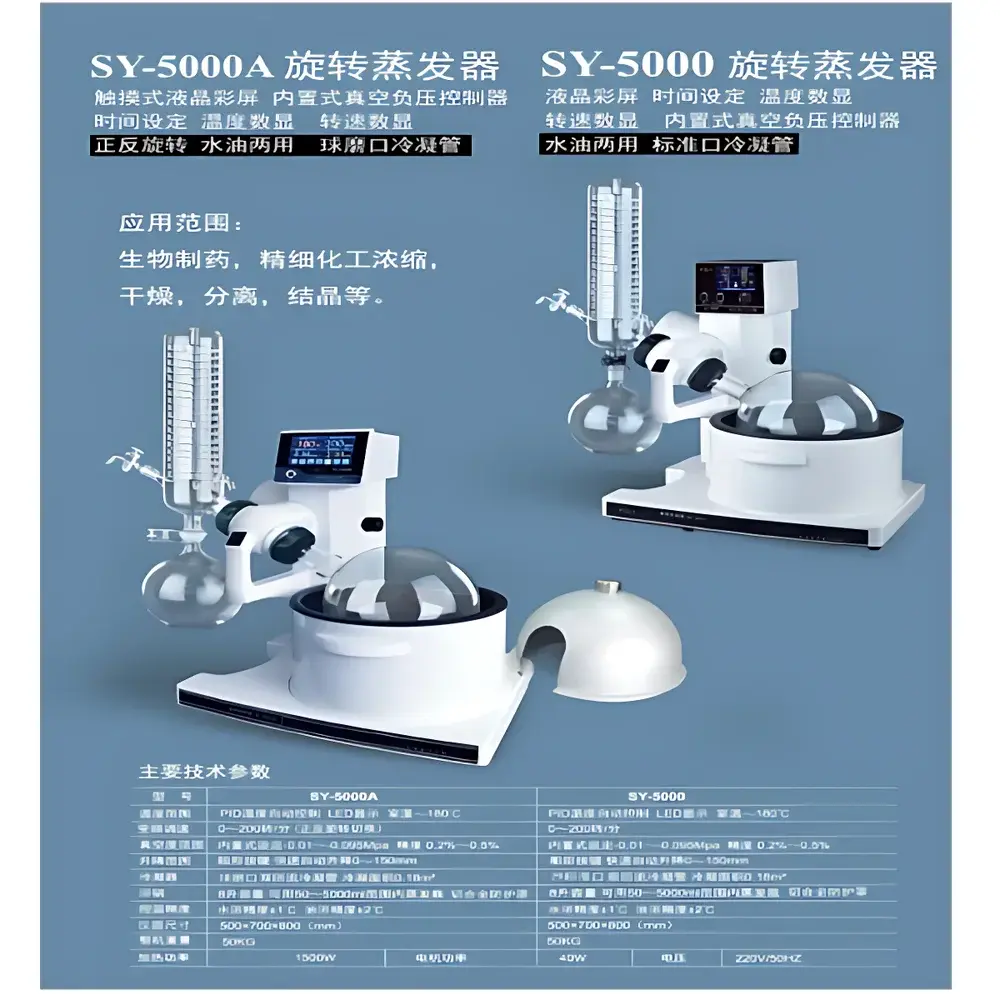
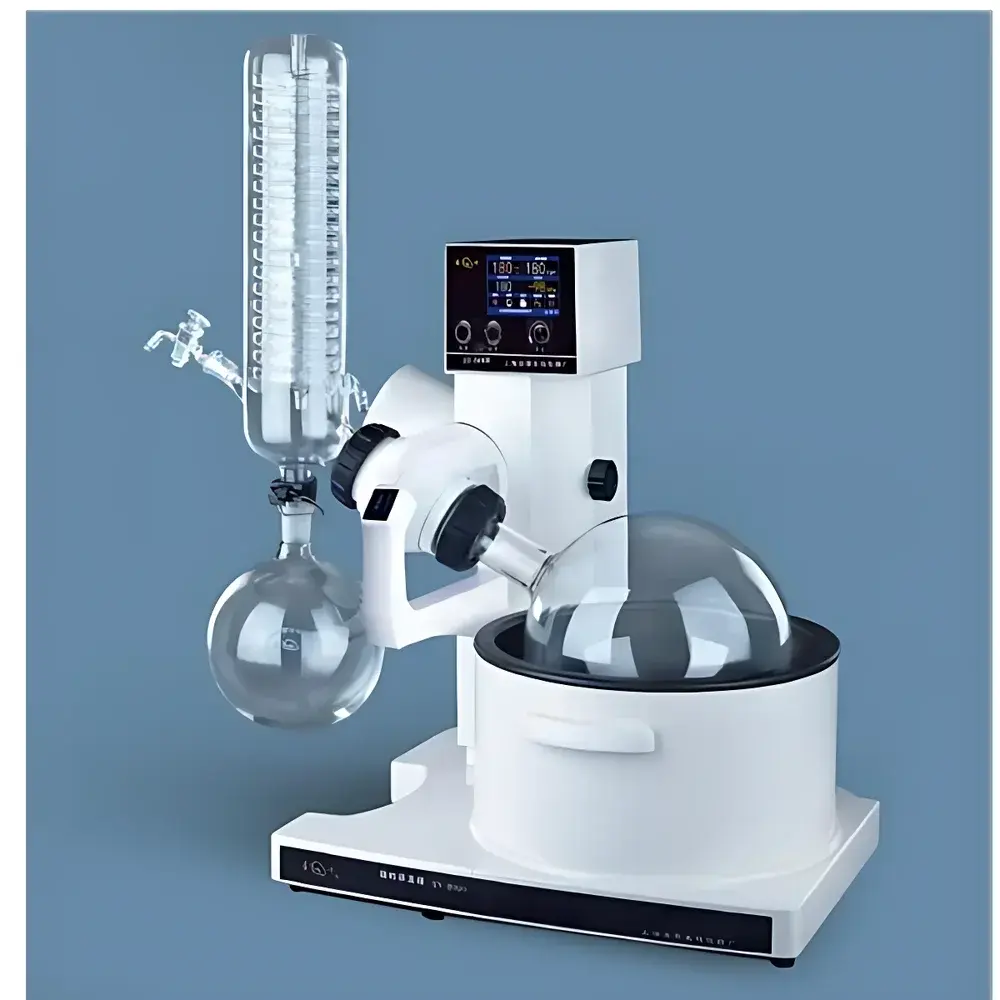
Yarong SY-5000 Benchtop Rotary Evaporator (Standard Configuration)
| Brand | Yarong |
|---|---|
| Origin | Shanghai, China |
| Manufacturer Type | Authorized Distributor |
| Country of Origin | China |
| Model | SY-5000 |
| Heating Bath Temperature Range | Ambient to 180 °C |
| Bath Capacity | 8 L |
| Evaporation Flask Compatibility | 2–5 L |
| Rotational Speed Range | 0–200 rpm |
| Heating Bath Material | PTFE-Composite Coated Aluminum |
| Lift Mechanism | Motorized Rocker-Type Vertical Adjustment (0–150 mm Travel) |
| Temperature Control Accuracy | ±1 °C (water), ±2 °C (oil) |
| Vacuum Range | –0.01 to –0.095 MPa |
| Vacuum Stability | ±0.2–0.5% of full scale |
| Evaporation Rate (H₂O) | ≥1.2 L/h |
| Power Supply | 220 V AC, 50 Hz |
| Overall Dimensions (W×D×H) | 500 × 700 × 800 mm |
Overview
The Yarong SY-5000 Benchtop Rotary Evaporator (Standard Configuration) is a dual-mode heating bath system engineered for precise, repeatable solvent removal under reduced pressure in research laboratories, quality control environments, and pilot-scale synthesis workflows. It operates on the fundamental principle of rotary evaporation: simultaneous rotation of a sample-containing flask under vacuum lowers its boiling point while increasing surface area exposure, thereby accelerating gentle and efficient solvent recovery without thermal degradation. The SY-5000 integrates a digitally controlled, PTFE-composite coated heating bath capable of both water- and oil-bath operation—enabling stable temperature regulation from ambient up to 180 °C. Its robust aluminum-and-engineered polymer chassis supports motorized vertical lift (0–150 mm), digital rpm and temperature readouts, and a sealed vapor path designed to minimize cross-contamination and maximize long-term vacuum integrity.
Key Features
- Motorized rocker-type lift mechanism with precise 0–150 mm travel range, enabling rapid and reproducible positioning of flasks during setup or solvent transfer.
- Dual-mode heating bath (water/oil) with PTFE-composite internal coating for corrosion resistance, easy cleaning, and uniform thermal distribution across the 8 L bath volume.
- Digital temperature control with independent display for bath setpoint and real-time reading; accuracy of ±1 °C (water) and ±2 °C (oil) ensures compliance with method-driven protocols requiring thermal consistency.
- Rotational speed digitally adjustable from 0 to 200 rpm with LED display—optimized for viscosity-dependent evaporation kinetics and film stability across diverse solvents and sample matrices.
- Vapor pathway constructed from integrated PTFE-composite sealing components, thermally stabilized and chemically inert, offering extended service life and minimal maintenance intervals.
- Integrated vacuum monitoring capability supporting stable operation within –0.01 to –0.095 MPa range, with inherent stability tolerance of ±0.2–0.5%—suitable for use with standard lab-grade vacuum pumps and controllers.
Sample Compatibility & Compliance
The SY-5000 accommodates standard ground-glass jointed evaporation flasks ranging from 2 L to 5 L, making it compatible with common ISO-standard rotary evaporator accessories (e.g., 24/40, 29/32 joints). Its sealed vapor train and inert PTFE-composite surfaces ensure compatibility with moderately aggressive organic solvents (e.g., acetone, ethyl acetate, dichloromethane), alcohols, and aqueous buffers. While not certified to UL/CE or IEC 61010-1 out-of-the-box, the instrument’s construction adheres to baseline electrical safety conventions for laboratory benchtop equipment operating at 220 V/50 Hz. When operated within validated SOPs—including routine calibration of temperature sensors and vacuum transducers—the SY-5000 supports GLP-aligned documentation practices and can be incorporated into GMP-relevant workflows where solvent removal steps require traceable, consistent parameters.
Software & Data Management
The SY-5000 operates as a stand-alone analog-digital hybrid instrument with no embedded microprocessor or network interface. All operational parameters—rotational speed, bath temperature, and lift position—are manually configured and monitored via front-panel digital displays and tactile controls. No proprietary software, data logging, or remote interface is included in the standard configuration. However, the unit’s analog outputs (if retrofitted with optional third-party signal converters) may be integrated into centralized lab data acquisition systems compliant with FDA 21 CFR Part 11 when paired with validated external hardware and audit-trail-enabled software platforms. Routine maintenance logs, calibration records, and usage history must be maintained externally per institutional quality management requirements.
Applications
- Concentration and recovery of heat-sensitive natural product extracts (e.g., terpenoids, alkaloids) in phytochemistry and nutraceutical R&D.
- Solvent exchange and intermediate drying in synthetic organic chemistry, including Grignard and lithiation reactions requiring anhydrous conditions.
- Removal of low-boiling solvents (e.g., hexane, diethyl ether) prior to lyophilization or analytical injection in pharmaceutical QC labs.
- Preparative-scale purification workflows involving column chromatography fractions, where batch-wise solvent stripping improves throughput versus static evaporation.
- Teaching laboratory use in undergraduate chemistry curricula, supporting hands-on instruction in vacuum techniques, phase behavior, and separation science principles.
FAQ
Is the SY-5000 compatible with vacuum controllers that support programmable ramping?
Yes—its vacuum inlet accepts standard 10–16 mm O.D. tubing and interfaces seamlessly with external vacuum regulators and PID-controlled vacuum pumps.
Can the heating bath be used exclusively with silicone oil above 100 °C?
Yes—the PTFE-composite coating and sealed heating elements are rated for continuous operation up to 180 °C using high-stability silicone or mineral oils.
Does the unit include a condenser and collection flask?
No—the SY-5000 Standard Configuration includes only the main evaporator body, heating bath, motorized lift, and rotating assembly; condensers, cold traps, and receiving flasks are selected separately based on application needs.
What is the recommended maintenance interval for the PTFE vapor seal?
Under normal use with non-aggressive solvents, visual inspection every 200 operating hours and replacement every 12–18 months is advised to maintain optimal vacuum integrity.
Is calibration documentation provided with the instrument?
Factory calibration certificates are not included by default; users are responsible for initial verification of temperature and rotational speed accuracy using NIST-traceable reference standards prior to first use.



