
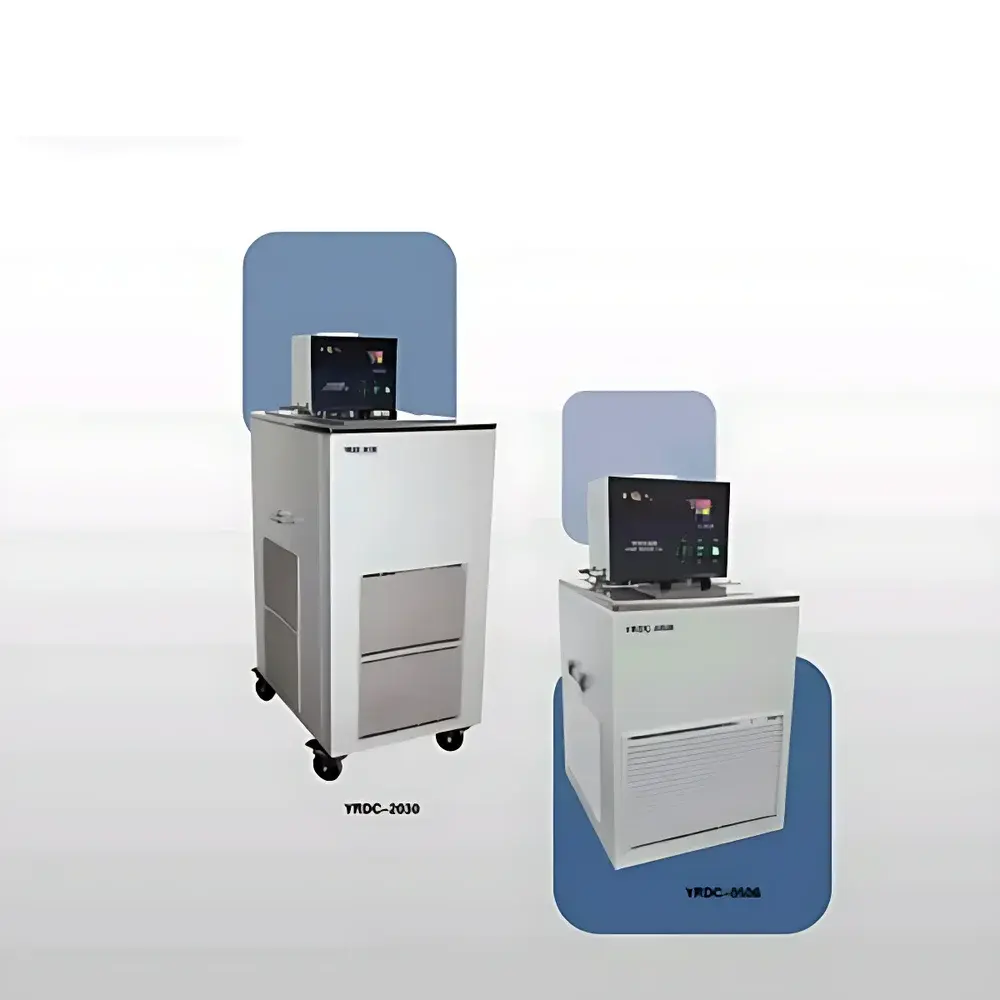
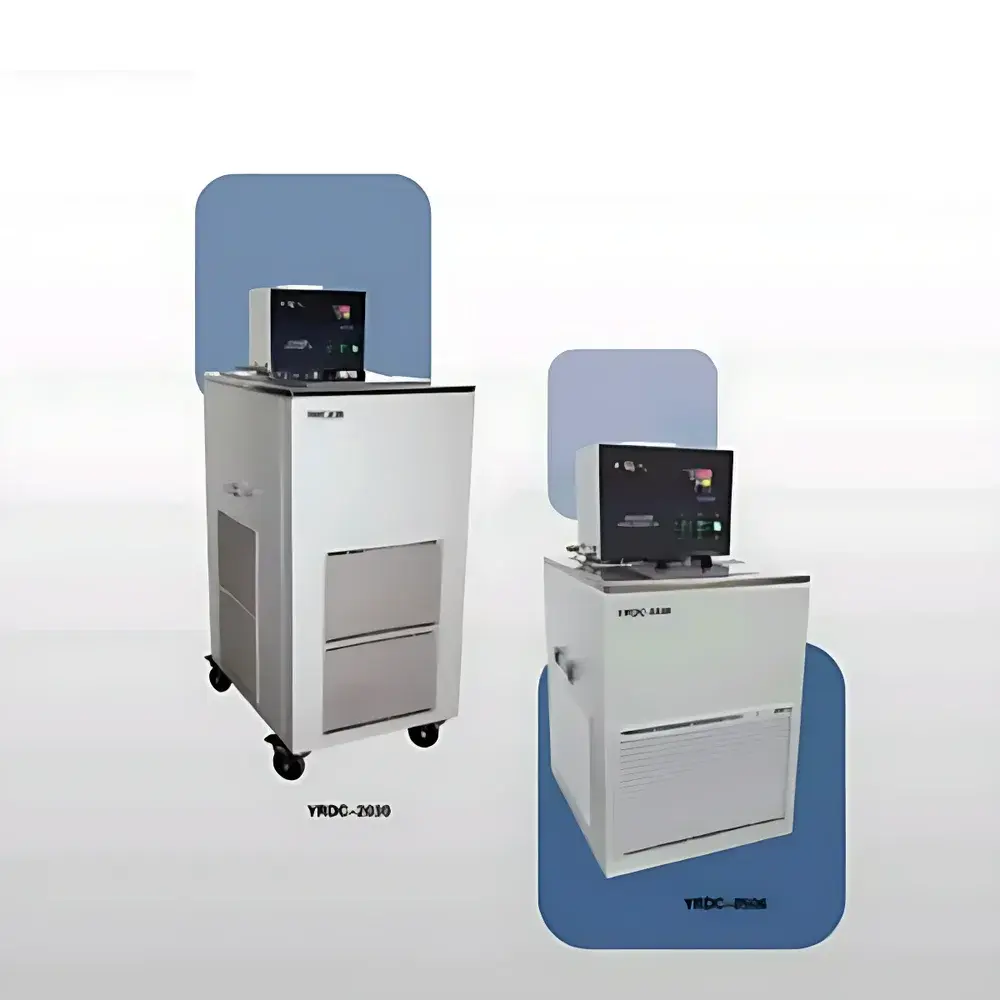
Yarong YRDC-4006 Vertical Cryogenic Circulating Thermostat
| Brand | Yarong |
|---|---|
| Origin | Shanghai, China |
| Model | YRDC-4006 |
| Temperature Range | −40 °C to 100 °C |
| Temperature Stability | ±0.05 °C |
| Temperature Uniformity | ≤±0.05 °C |
| Setpoint Resolution | 0.1 °C |
| Bath Opening | 150 × 150 × 150 mm |
| Bath Volume | 6 L |
| Heating Power | 1100 W (total) |
| External Dimensions | 340 × 400 × 670 mm |
| Net Weight | 33 kg |
| Vibration Stability | Low vibration, high operational stability |
| Compatible Media | Water, pure ethanol, and other low-freezing-point miscible liquids |
Overview
The Yarong YRDC-4006 Vertical Cryogenic Circulating Thermostat is a precision temperature control system engineered for laboratory applications requiring stable, uniform thermal environments across a wide operating range (−40 °C to +100 °C). It employs a dual-mode refrigeration–heating architecture with cascade compressor cooling and PID-controlled resistive heating, enabling rapid thermal response and exceptional setpoint fidelity. Unlike basic immersion baths, the YRDC-4006 integrates an internal circulation pump and external port interface to support closed-loop temperature control of external devices—such as spectrophotometer cells, reaction jackets, or sensor calibration fixtures—while maintaining bath homogeneity within ±0.05 °C. Its vertical form factor optimizes bench space without compromising thermal mass or flow dynamics, making it suitable for integration into automated test benches and regulated analytical workflows.
Key Features
- High-stability temperature control: ±0.05 °C stability and ≤±0.05 °C uniformity across the full 6 L working volume, verified under steady-state conditions per ISO 17025 traceable protocols.
- Wide operational range: Achieves reliable sub-zero operation down to −40 °C using environmentally compliant R404A/R23 cascade refrigerant system; no dry ice or liquid nitrogen required.
- Intelligent PID algorithm with auto-tuning: Dynamically adjusts cooling/heating output based on load, ambient drift, and medium-specific heat capacity—critical when switching between water and ethanol-based coolants.
- Corrosion-resistant stainless-steel bath chamber and insulated lid: Minimizes evaporation and thermal loss; compatible with aqueous and organic media including deionized water, ethanol, and ethylene glycol/water mixtures.
- Low-vibration pump design: Integrated centrifugal circulation pump delivers consistent flow (>8 L/min) with mechanical isolation to prevent micro-vibrational coupling—essential for optical metrology and interferometric setups.
- Front-panel digital interface with real-time graphing: Displays current temperature, setpoint, power status, and error codes; supports manual override and ramp/soak programming.
Sample Compatibility & Compliance
The YRDC-4006 accommodates standard laboratory vessels up to 150 mm in width and height, with optional custom adapters available for non-standard geometries. Its open-bath configuration allows direct immersion of probes, cuvettes, reactors, and sensor housings. The unit complies with IEC 61010-1:2010 safety standards for electrical equipment used in measurement, control, and laboratory applications. While not certified for medical device manufacturing, its temperature repeatability and data logging capability support GLP-compliant validation studies when paired with external audit-trail software. It meets general requirements for ASTM E2777 (Standard Practice for Calibration of Liquid-in-Glass Thermometers) and ISO/IEC 17025 Annex A.4 (thermal calibration uncertainty budgets).
Software & Data Management
The thermostat includes RS232 and analog 0–5 V output interfaces for integration with SCADA systems, LIMS, or custom LabVIEW/Python control environments. Optional PC software enables remote setpoint adjustment, real-time temperature trending, and CSV export of time-stamped logs—including timestamps, setpoints, actual temperatures, and alarm events. All logged data retains metadata (operator ID, session notes, instrument serial number), supporting 21 CFR Part 11 readiness when deployed with validated third-party electronic signature modules. No onboard storage or cloud connectivity is included by default; data persistence relies on host-system archival per institutional IT policy.
Applications
- Calibration of thermistors, RTDs, and infrared sensors against NIST-traceable references.
- Temperature-dependent viscosity measurements using rotational or capillary viscometers.
- Stabilization of laser diodes, photodetectors, and fiber-optic components during spectral characterization.
- Controlled-rate cooling/heating of chemical reaction mixtures in jacketed glass reactors.
- Long-duration stability testing of pharmaceutical formulations under accelerated aging conditions (ICH Q1A).
- Pre-conditioning of polymer samples prior to DSC or TMA analysis.
FAQ
What coolant fluids are recommended for operation below 0 °C?
Pure ethanol (≥99.5%) or 30/70 v/v ethylene glycol/water mixtures are validated for sustained use at −40 °C. Avoid methanol due to volatility and material compatibility risks.
Can the YRDC-4006 maintain temperature while circulating fluid externally?
Yes—the integrated pump supports continuous external flow up to 10 m head pressure; external loop thermal losses must be compensated via appropriate insulation and flow rate optimization.
Is the unit suitable for GMP-regulated environments?
It may be deployed in GMP settings as a qualified auxiliary device; however, formal qualification (IQ/OQ/PQ) must be performed per site-specific protocols, and electronic records require supplemental 21 CFR Part 11 compliance tools.
Does the thermostat include a built-in temperature probe calibration function?
No—it accepts external PT100 or thermistor inputs for verification but does not perform self-calibration; periodic verification using a calibrated reference thermometer is required.
What maintenance intervals are recommended?
Compressor oil and refrigerant levels should be inspected annually; condenser coils require bi-monthly vacuum cleaning; bath fluid replacement is advised every 6 months for ethanol or 12 months for water-based media under continuous operation.



