
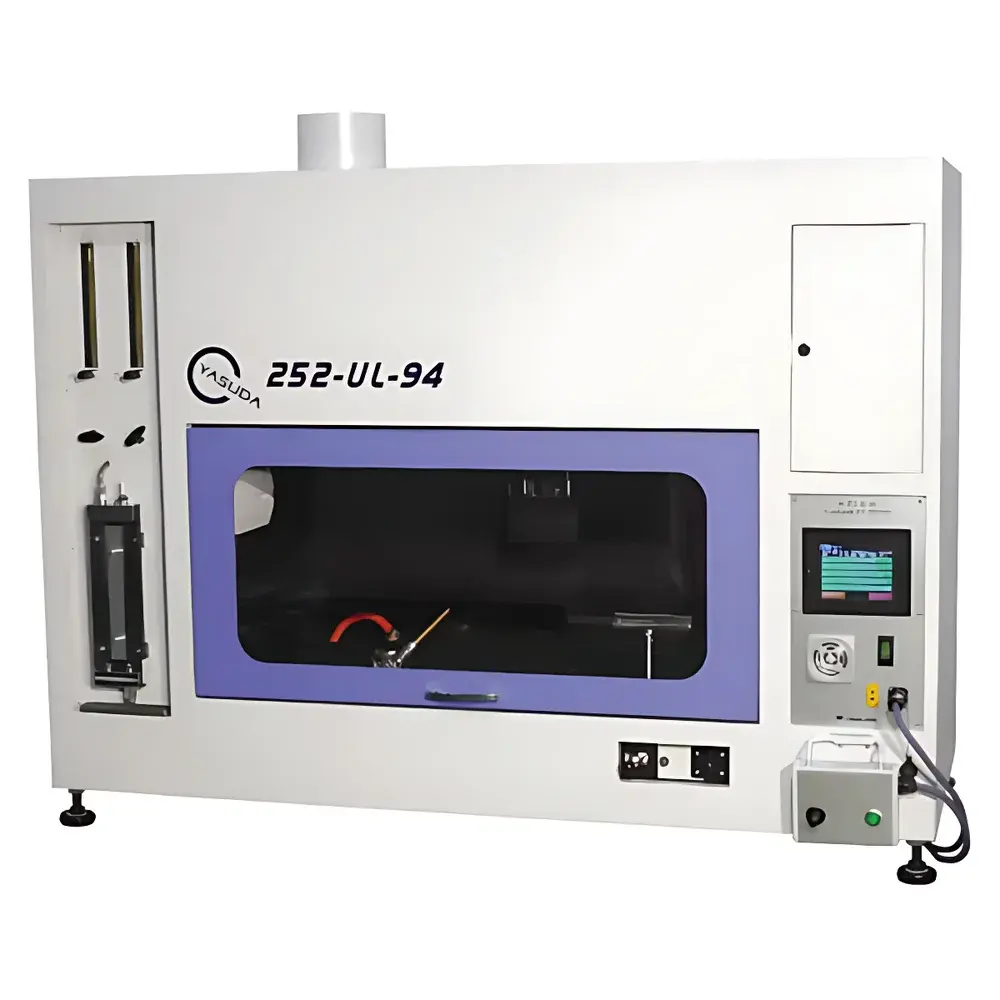
Yasuda No.252-UL-94 Plastic Flammability Test Chamber
| Brand | Yasuda |
|---|---|
| Origin | Japan |
| Model | No.252-UL-94 |
| Applicable Standards | UL 94, JIS K6911, ASTM D635, D3801, D4804, D5025, D5207, ISO 1210 |
| Burner Positioning | Manual external lever actuation |
| Built-in Calibration Fixture | Yes |
| Configuration | Horizontal and Vertical Combustion Modes |
Overview
The Yasuda No.252-UL-94 Plastic Flammability Test Chamber is a precision-engineered instrument designed for standardized assessment of polymer ignition resistance and flame propagation behavior under controlled laboratory conditions. It operates in strict accordance with internationally recognized fire safety test protocols—including UL 94 (Standard for Safety of Polymeric Materials – Burning Characteristics), ISO 1210 (Plastics — Determination of the Burning Behaviour of Horizontal and Vertical Specimens in a Small Flame), and multiple ASTM standards (D635, D3801, D4804, D5025, D5207). The system employs a calibrated Bunsen-type burner delivering a defined propane or methane flame (typically 20 mm height, ±1 mm tolerance) to expose conditioned plastic specimens in either horizontal (HB classification) or vertical (V-0, V-1, V-2, 5V classifications) orientations. Its mechanical architecture ensures repeatable flame application duration (10 s or 30 s per exposure cycle), precise specimen mounting geometry, and thermally stable combustion chamber environment—critical parameters for achieving inter-laboratory reproducibility required in regulatory submissions and material qualification workflows.
Key Features
- Dual-mode configuration supporting both horizontal and vertical flame exposure per UL 94 and ISO 1210 test sequences
- Manually actuated external lever mechanism for accurate, backlash-free burner positioning—enabling rapid transition between flame-on and flame-off positions without realignment
- Integrated calibration fixture compliant with UL 94 Annex A and ISO 1210 Clause 6.2, facilitating routine verification of flame height, tip temperature, and burner alignment prior to each test series
- Stainless steel combustion chamber with observation window and forced ventilation exhaust interface (compatible with standard lab fume hood connections)
- Specimen holder assembly engineered for dimensional compliance with UL 94 specimen requirements (125 × 13 × 3.2 mm for vertical tests; 125 × 13 × 3.2 mm or 125 × 13 × 1.6 mm for horizontal tests)
- No electrical automation—designed for manual operation to minimize electromagnetic interference and ensure deterministic timing control during flame exposure intervals
Sample Compatibility & Compliance
The No.252-UL-94 accommodates rigid and semi-rigid thermoplastic and thermoset specimens within defined thickness tolerances (1.6 mm and 3.2 mm per UL 94). It supports conditioning per ASTM D618 (standard laboratory atmosphere: 23 °C ± 2 °C, 50 % RH ± 5 % RH) and post-conditioning handling per ISO 291. All structural components meet Japanese Industrial Standard JIS Z 8901 for optical-grade viewing panels and JIS G 4305 for austenitic stainless steel chamber construction. The apparatus itself does not require CE marking or UKCA certification as it functions as a non-powered mechanical test platform; however, its operational outputs are fully traceable to NIST-traceable flame calibration references when used with certified gas flow meters and thermocouples.
Software & Data Management
This is a manually operated mechanical test chamber with no embedded microcontroller, touchscreen interface, or digital data logging capability. Test execution follows documented procedural checklists aligned with GLP (Good Laboratory Practice) principles. Users record flame application time, afterflame time, afterglow time, drip ignition status, and char length manually on standardized UL 94 data sheets. For laboratories operating under FDA 21 CFR Part 11 or ISO/IEC 17025 accreditation, handwritten records must be contemporaneous, signed, and archived with specimen identification, environmental monitoring logs, and calibration certificate copies. Digital transcription (e.g., into LIMS or ELN systems) is performed post-test and subject to second-person verification.
Applications
- Qualification of polymeric enclosures for consumer electronics per UL 60950-1 / IEC 62368-1
- Material screening for automotive interior components under FMVSS 302 and ISO 3795
- Supporting regulatory dossiers for medical device housing materials (ISO 10993-1 biological evaluation context)
- Internal R&D validation of flame-retardant additive packages in ABS, PC, PP, and PA formulations
- Third-party certification testing for UL Recognition or CSA Component Acceptance
- Academic research on pyrolysis onset kinetics and char layer formation mechanisms in halogen-free flame-retarded polymers
FAQ
Does the No.252-UL-94 include automatic timing or flame control?
No. It relies on operator-controlled manual timing using a certified stopwatch and lever-actuated burner positioning to comply with the intentional simplicity mandated by UL 94 Clause 7.2.
Is propane the only approved fuel gas?
Propane is specified in UL 94 and ISO 1210; methane may be used if validated per ASTM D5025 Annex A and documented in the lab’s SOP.
Can this unit be integrated into an automated test cell?
Not natively—the design intentionally omits electrical interfaces or programmable logic. Integration would require external robotics and custom safety interlocks, voiding UL 94 conformance unless re-validated by a Nationally Recognized Testing Laboratory (NRTL).
What maintenance is required between tests?
Burner tip cleaning with non-metallic tools after every 10 cycles, annual verification of chamber airflow uniformity, and biannual recalibration of the built-in flame height gauge against NIST-traceable calipers.
Does Yasuda provide test report templates compliant with ISO/IEC 17025?
Yes—generic report templates aligned with ISO/IEC 17025 Clause 7.8.2 are available upon request from authorized distributors, though final report issuance requires laboratory-specific validation and accreditation scope alignment.



