
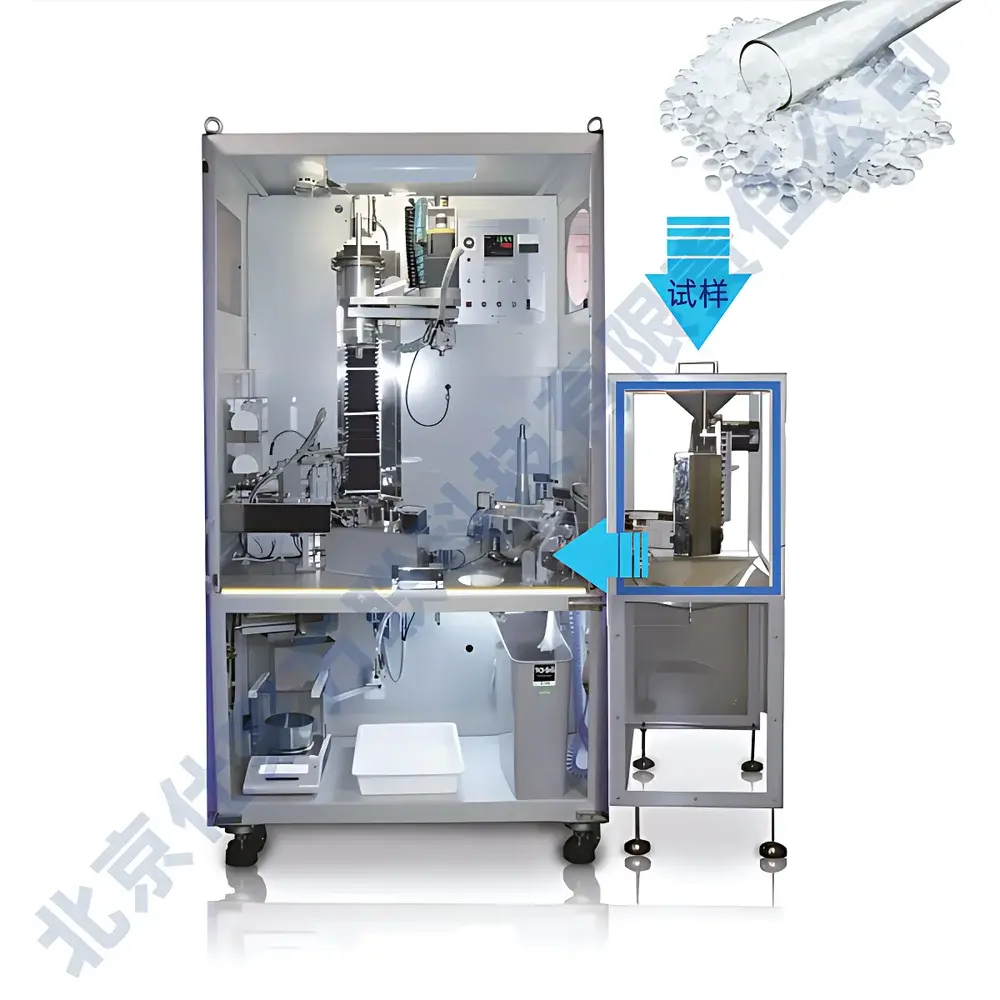
Yasuda DHS Advanced Laboratory Melt Flow Indexer (MFR & MVR Modes)
| Brand | Yasuda |
|---|---|
| Origin | Japan |
| Model | DHS (Laboratory Version) |
| Application | Offline Lab Use |
| Test Methods | ASTM D1238, ISO 1133, GB/T 3682, GB/T 9643, JIS K7210 |
| Automation Level | Fully Automated Sample Loading, Weight Switching, Melt Extrusion, Gravimetric MFR Calculation, and Self-Cleaning Cycle |
| Compliance | GLP-ready architecture with audit-trail-capable software logging |
Overview
The Yasuda DHS Advanced Laboratory Melt Flow Indexer is a precision-engineered gravimetric instrument designed to determine the Melt Flow Rate (MFR) and Melt Volume Rate (MVR) of thermoplastic polymers under standardized thermal and mechanical conditions. Operating on the fundamental principle of extrusion rheometry—where molten polymer is forced through a calibrated die under controlled temperature and applied load—the DHS system adheres strictly to the physical definitions outlined in ISO 1133-1 (gravimetric MFR), ISO 1133-2 (volumetric MVR), ASTM D1238 (Procedure A for MFR, Procedure B for MVR), and national standards including GB/T 3682, GB/T 9643, and JIS K7210. Unlike conventional benchtop indexers requiring manual sample loading, timing, and cutting, the DHS integrates electro-mechanical actuation, high-stability PID temperature control (±0.2 °C over 150–450 °C range), and closed-loop force application to deliver repeatable, operator-independent results. Its laboratory-offline configuration enables deployment in QC labs, R&D facilities, and contract testing environments where regulatory traceability and method flexibility are essential.
Key Features
- Fully automated workflow: robotic sample cup handling, programmable weight selection (standard masses from 0.325 kg to 21.6 kg), synchronized piston drive, and automatic melt extrusion timing
- Dual-mode operation: seamless switching between MFR (mass-based, g/10 min) and MVR (volume-based, cm³/10 min) without hardware reconfiguration
- Integrated microbalance with ±0.001 g resolution for direct gravimetric calculation per ISO 1133-1 Annex A
- Self-cleaning cycle using pre-programmed purge sequences and optional nitrogen-assisted residue removal to minimize cross-contamination
- Modular die assembly with interchangeable capillaries (e.g., 2.095 mm diameter × 8.000 mm length) compliant with ISO 1133 Table 1 specifications
- Robust thermal chamber with axial symmetry and uniform radial heat distribution, validated per ASTM D1238 Annex B temperature homogeneity requirements
Sample Compatibility & Compliance
The DHS supports a broad spectrum of thermoplastic resins—including polyethylene (PE), polypropylene (PP), polycarbonate (PC), ABS, PET, and engineering blends—with viscosity ranges corresponding to MFR values from 0.1 to 1000 g/10 min. Each test sequence records full metadata: timestamp, operator ID, material lot number, temperature setpoint, applied load, die geometry, cut interval, and raw mass/volume data. All software logs comply with ALCOA+ principles (Attributable, Legible, Contemporaneous, Original, Accurate, Complete, Consistent, Enduring, Available) and support 21 CFR Part 11-compliant electronic signatures when deployed with validated access controls. The system is routinely verified using NIST-traceable reference materials (e.g., certified PE standards with assigned MFR uncertainty ≤ ±1.2%) and meets ISO/IEC 17025 internal verification protocols for testing laboratories.
Software & Data Management
The DHS Control Suite (v4.x) provides a Windows-based interface with role-based user permissions, method templates aligned to ASTM/ISO clause numbering, and real-time graphical monitoring of piston displacement, melt pressure, and temperature stability. Raw data export is available in CSV, PDF report (with digital signature fields), and XML formats compatible with LIMS integration. Audit trails capture all parameter changes, result overrides, and calibration events with immutable timestamps. Batch reporting includes statistical summaries (mean, SD, CV%), trend charts across material lots, and automatic pass/fail flagging against user-defined specification limits. Software validation documentation (IQ/OQ/PQ protocols) is supplied for GMP-regulated environments.
Applications
- Quality control release testing of incoming polymer pellets and compounded masterbatches
- Process development support for extrusion, injection molding, and blow molding operations
- Stability assessment of polymer degradation during thermal aging or recycling cycles
- Comparative analysis of molecular weight distribution shifts via MFR/MVR ratio trends
- Regulatory submission support for medical-grade polymers (ISO 10993-12) and food-contact materials (FDA 21 CFR 177)
- Interlaboratory round-robin studies requiring inter-site reproducibility per ISO 5725
FAQ
Can the DHS perform both MFR and MVR measurements in a single run?
Yes—the system acquires both mass and volumetric data simultaneously using synchronized gravimetric weighing and optical piston displacement tracking, enabling dual-parameter output per ISO 1133-2.
Is external calibration required before first use?
The unit ships with factory calibration certificates for temperature, force, and mass subsystems; users must perform initial verification using certified reference materials prior to routine operation.
Does the software support multi-language interfaces?
English and Japanese UI languages are embedded; additional language packs require formal validation and are available upon request for regulated sites.
What maintenance intervals are recommended for daily lab operation?
Daily purge cycle execution, weekly die inspection, and quarterly thermal sensor verification per manufacturer’s Maintenance Logbook (Ref. DHS-ML-2024).
Can test methods be exported and shared across multiple DHS units?
Method files (.dhsmt) are portable and version-controlled; import/export preserves all parameters, tolerances, and compliance flags without revalidation.
Related Products






