Yasuda DHS In-Line Intelligent Melt Flow Indexer (MFR & MVR Methods)
| Brand | Yasuda |
|---|---|
| Origin | Japan |
| Model | DHS (In-Line Production Version) |
| Compliance | ASTM D1238, ISO 1133, JIS K7210, GB/T 3682, GB/T 9643 |
| Operation Modes | MFR (Mass Flow Rate) and MVR (Volume Flow Rate) |
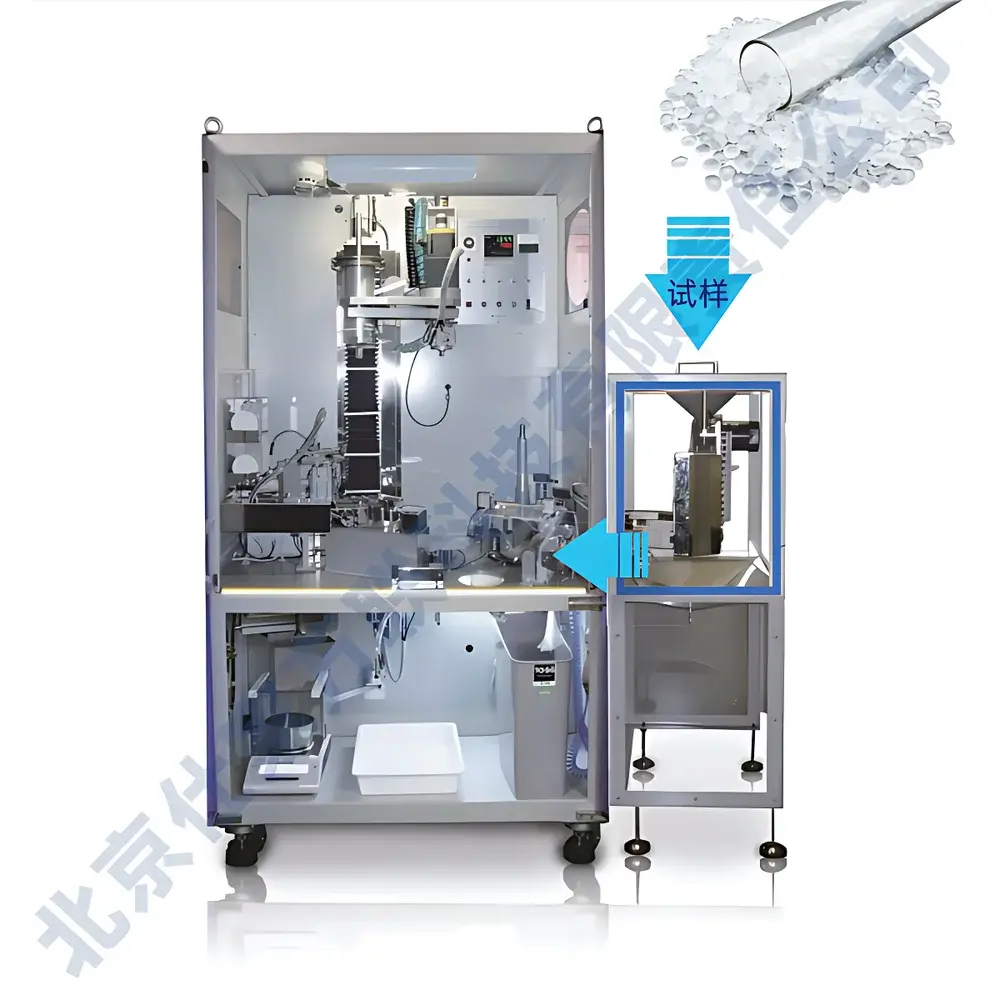
| Automation Level | Fully Automated In-Line Sampling, Loading, Weighing, Testing, and Cleaning |
| Application | Real-time Rheological Monitoring on Extrusion & Compounding Lines |
| Certification | CE-marked for industrial integration |
Overview
The Yasuda DHS In-Line Intelligent Melt Flow Indexer is an engineered solution for continuous, real-time rheological quality assurance in thermoplastic polymer production environments. Unlike conventional benchtop melt flow indexers that rely on off-line sampling and manual intervention, the DHS system integrates directly into extrusion, compounding, or pelletizing lines—enabling uninterrupted monitoring of melt flow rate (MFR) and melt volume rate (MVR) under standardized test conditions. Its operational principle follows the fundamental principles of capillary rheometry defined in ASTM D1238 and ISO 1133: a precisely controlled mass of molten polymer is forced through a standardized die under specified temperature and load conditions; MFR is derived from gravimetric measurement of extrudate mass over time (g/10 min), while MVR is calculated volumetrically using piston displacement tracking (cm³/10 min). Designed for high-reliability industrial deployment, the DHS features a thermally stabilized barrel assembly, precision-machined stainless-steel die geometry, and closed-loop PID temperature control across its operating range (typically 150–300 °C with ±0.2 °C stability).
Key Features
- Fully automated in-line sampling interface compatible with extruder die-heads or melt stream diverters—no operator intervention required during routine operation.
- Dual-mode testing capability: simultaneous support for ASTM/ISO-compliant MFR (A method) and MVR (B method) protocols within a single instrument architecture.
- Intelligent mechanical handling system: robotic sample cup loading, programmable weight-driven loading mechanism, auto-switching of standard reference masses (e.g., 2.16 kg, 5.00 kg, 10.00 kg), and integrated microbalance with <±0.001 g repeatability.
- Self-cleaning thermal cycle: post-test purge sequence using inert gas and heated die flushing to prevent cross-contamination and carbon buildup between samples.
- Ruggedized enclosure rated IP65 for dust- and splash-resistant operation in demanding factory floor environments.
- Real-time data synchronization via Ethernet/IP or Modbus TCP to PLCs, MES, or centralized LIMS platforms.
Sample Compatibility & Compliance
The DHS system accommodates a broad spectrum of thermoplastic resins including polyethylene (PE), polypropylene (PP), polycarbonate (PC), ABS, PET, and engineering polymers such as PEEK and PPS. It supports both virgin and filled compounds (e.g., glass-fiber, mineral-filled, flame-retardant grades), provided melt viscosity remains within the measurable range of standard capillary geometries (typically 0.1–1000 g/10 min MFR at reference conditions). All test procedures strictly adhere to international regulatory and quality frameworks: ASTM D1238 (Standard Test Method for Melt Flow Rates of Thermoplastics), ISO 1133-1 & -2 (Plastics — Determination of the Melt Mass-Flow Rate and Melt Volume-Flow Rate), JIS K7210, and Chinese national standards GB/T 3682 and GB/T 9643. The system architecture supports audit-ready documentation per GLP and GMP requirements, including electronic signature-capable test logs and full traceability of calibration history, environmental parameters, and raw sensor outputs.
Software & Data Management
The embedded DHS Control Suite provides intuitive configuration of test sequences, parameter presets, and alarm thresholds via a 10.1″ industrial touchscreen HMI. Raw data—including melt temperature, load application timing, piston displacement profiles, extrudate mass, and calculated MFR/MVR values—is timestamped and stored locally with optional cloud backup. Export formats include CSV, PDF reports (with customizable templates), and XML for enterprise-level integration. Software complies with FDA 21 CFR Part 11 requirements for electronic records and signatures when deployed in regulated manufacturing settings, featuring role-based access control, audit trail logging, and secure user authentication. Historical trend analysis tools enable SPC charting (X-bar/R, Cpk) directly on the unit or via OPC UA connectivity to factory analytics dashboards.
Applications
This in-line indexer serves as a critical process analytical technology (PAT) tool in polymer manufacturing facilities where batch-to-batch consistency, feedstock verification, and early detection of thermal degradation are essential. Typical use cases include: real-time validation of incoming resin lots prior to extrusion; dynamic adjustment of screw speed or barrel zone temperatures based on MFR drift; statistical process control of masterbatch dispersion homogeneity; release testing of final pellets without offline lab bottlenecks; and root-cause analysis during colorant or additive formulation changes. Its ability to deliver statistically representative measurements every 5–15 minutes significantly reduces reliance on composite lab sampling and accelerates corrective action cycles.
FAQ
How frequently can the DHS perform tests during continuous production?
Typical cycle time is 8–12 minutes per test (including sampling, stabilization, extrusion, weighing, and cleaning), enabling up to 5–7 validated measurements per hour.
Does the system require periodic recalibration?
Yes—temperature sensors and load cells must be verified quarterly per ISO/IEC 17025 guidelines; certified reference materials (e.g., NIST-traceable HDPE standards) are recommended for performance checks.
Can the DHS interface with existing SCADA or ERP systems?
Yes—native support for Modbus TCP, EtherNet/IP, and OPC UA ensures seamless interoperability with major industrial automation platforms.
What maintenance is required for long-term reliability?
Scheduled replacement of the capillary die and O-rings every 6 months (or per 500 test cycles), plus annual inspection of the piston drive mechanism and thermal insulation integrity.
Is operator training provided with installation?
Yes—Yasuda-certified engineers conduct on-site commissioning, SOP development, and hands-on operator and maintenance technician training aligned with ISO 9001 internal audit requirements.