
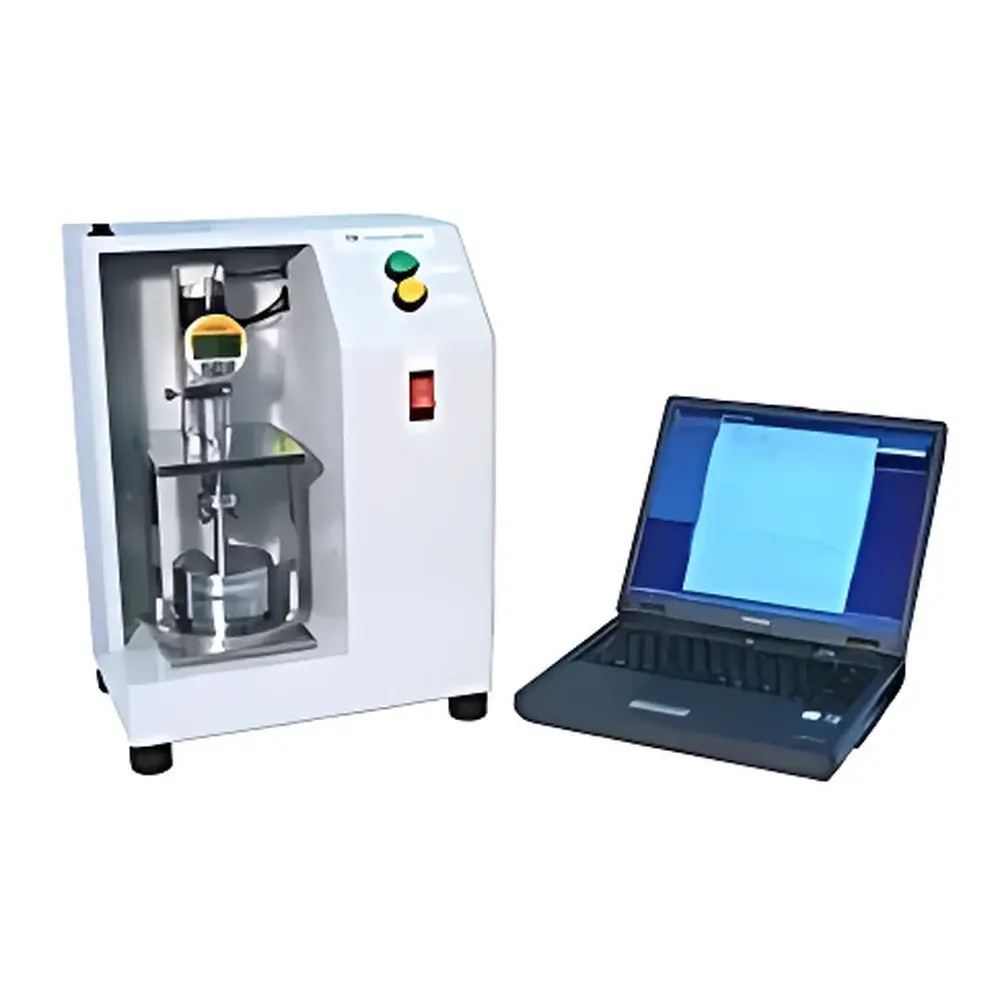
Yasuda No.105-AUTO Automatic Williams Plastometer
| Brand | Yasuda |
|---|---|
| Origin | Japan |
| Model | No.105-AUTO |
| Standards Compliance | JIS K 6249, ASTM D 926, ISO 7323 |
| Sample Geometry | Cylindrical specimen (Φ16 mm × 10 mm height, volume 2.00 ± 0.02 cm³) |
| Platen Dimensions | Upper and lower plates Φ148 mm × 12 mm thick |
| Applied Load Range | 24.5 N (2.5 kgf) to 49.0 ± 0.05 N (5.0 kgf) |
| Dial Indicator Resolution | 0.01 mm |
| Maximum Travel | 20 mm |
| Data Output | Real-time thickness-vs.-time curve on PC display |
| Software Platform | Dedicated Windows XP-compatible application |
| Power Supply | 220 V AC, single-phase, 3 A, 50/60 Hz |
| Dimensions (W×D×H) | ≈365 × 250 × 500 mm |
| Weight | ≈15 kg |
Overview
The Yasuda No.105-AUTO Automatic Williams Plastometer is a precision-controlled, electromechanically actuated instrument engineered for the standardized determination of plasticity in raw rubber, compounded elastomers, and thermoplastic materials. It operates on the fundamental principle of the Williams plastometric method: a cylindrical test specimen is compressed between two parallel, temperature-stabilized metal platens under a defined static load for a specified duration, and the resulting reduction in specimen thickness—measured with high-resolution linear displacement sensing—is used to quantify material plasticity. This method is physically distinct from Mooney viscometry or oscillatory rheometry; it reflects bulk compressive deformation behavior under low-shear, quasi-static conditions, making it especially relevant for processability assessment in calendering, extrusion, and mill mixing operations.
Key Features
- Automated load application and real-time thickness monitoring via high-accuracy digital transducer (0.01 mm resolution), eliminating manual dial reading errors and operator variability.
- Dedicated Windows XP-based control and analysis software enables synchronized acquisition, visualization, and export of time-thickness curves—supporting both single-point plasticity index calculation and full kinetic profile analysis.
- Thermally stable parallel-plate configuration (Φ148 mm × 12 mm each) ensures uniform stress distribution and minimizes edge effects during compression.
- Precisely calibrated load system delivers 49.0 ± 0.05 N (5.0 kgf) as the standard test force, with adjustable range down to 24.5 N (2.5 kgf) for extended material screening.
- Integrated specimen holder accommodates standardized cylindrical samples (Φ16 mm × 10 mm, volume 2.00 ± 0.02 cm³), ensuring strict adherence to JIS K 6249, ASTM D 926, and ISO 7323 dimensional tolerances.
- Compact benchtop architecture (≈365 × 250 × 500 mm, 15 kg) with robust cast-aluminum frame and low-vibration mechanical drive—designed for long-term stability in QC laboratories and R&D environments.
Sample Compatibility & Compliance
The No.105-AUTO is validated for use with unvulcanized natural rubber (NR), synthetic elastomers (SBR, BR, EPDM, NBR), and selected thermoplastic elastomers exhibiting measurable cold-flow behavior under static compression. Specimen preparation must follow standardized conditioning protocols (e.g., ISO 23529 for rubber sampling and preconditioning). The instrument meets metrological requirements of all referenced standards: JIS K 6249 specifies the Williams method for raw rubber plasticity; ASTM D 926 defines procedures for compounded rubber; and ISO 7323 provides international harmonization for plastometer calibration and reporting. While not inherently GLP-compliant, the system supports audit-ready documentation when paired with controlled software operation, electronic log files, and periodic verification using certified reference specimens.
Software & Data Management
The proprietary Windows XP-compatible software provides deterministic control over test initiation, duration (programmable up to 300 s), and data sampling interval (default 0.1 s). Raw displacement vs. time datasets are stored in ASCII CSV format for traceability and third-party statistical analysis. Curve fitting options include linear regression over user-defined time windows (e.g., 15–30 s) to compute the standard Williams Plasticity Index (P15 or P30). All measurement sessions are timestamped and associated with operator ID and sample ID fields. Though native support for FDA 21 CFR Part 11 is not embedded, the software architecture permits integration with external electronic lab notebook (ELN) systems for full audit trail generation in regulated environments.
Applications
- Quality control of incoming raw rubber lots against supplier specifications and internal release criteria.
- Batch-to-batch consistency evaluation during compound development and production scale-up.
- Correlation studies between Williams plasticity and downstream processing parameters (e.g., extrudate swell, calender gap setting, mill power consumption).
- Accelerated aging studies assessing plasticity loss due to pre-vulcanization or scorch onset.
- Comparative screening of plasticizer efficiency or filler dispersion effects in formulation optimization.
FAQ
What is the recommended calibration frequency for the No.105-AUTO?
Calibration of the load cell and displacement sensor should be performed annually by an accredited metrology laboratory, supplemented by daily verification using traceable gauge blocks and certified dead-weight standards.
Can the instrument operate under elevated temperature conditions?
No—the No.105-AUTO is designed for ambient-temperature testing per JIS/ASTM/ISO specifications. For hot-plasticity evaluation, dedicated heated plastometers with thermostatic platens are required.
Is Windows XP support still viable in modern IT infrastructures?
While the native software requires Windows XP SP3, many users successfully deploy it within isolated virtual machines or legacy hardware stations; Yasuda does not provide official Windows 10/11 compatibility updates.
How is specimen thickness measured—optically or mechanically?
Thickness reduction is measured via a contact-type linear variable differential transformer (LVDT) coupled to the upper platen—ensuring direct, drift-free mechanical displacement tracking without optical alignment dependencies.
Does the system include statistical process control (SPC) functionality?
The base software does not include SPC charting tools, but exported CSV data is fully compatible with industry-standard SPC platforms (e.g., Minitab, JMP, or custom Python/Pandas workflows).




