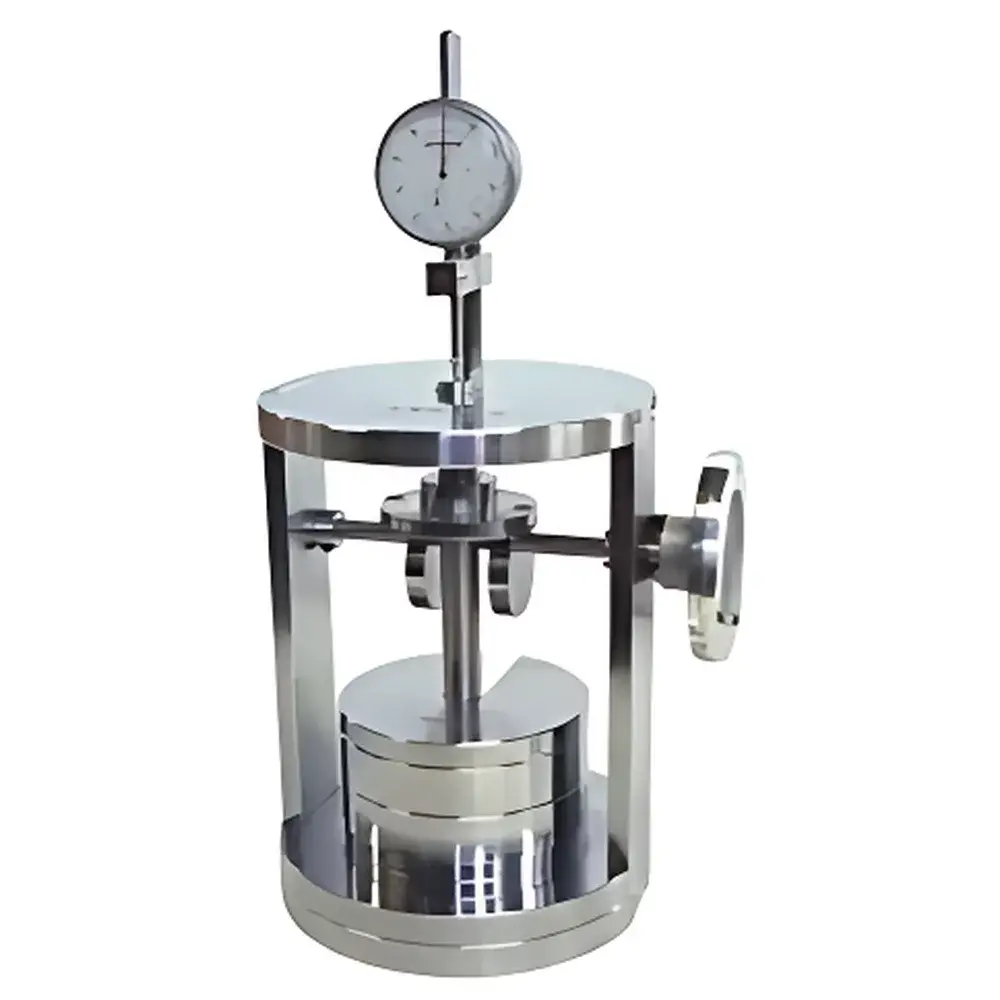
Yasuda No.105 William-Type Plastometer
| Brand | Yasuda |
|---|---|
| Origin | Japan |
| Model | No.105 |
| Compliance Standards | JIS K 6249, ASTM D 926, ISO 7323 |
| Measurement Principle | Parallel-plate compression under standardized load and dwell time |
| Output Unit | Plastometric value (dimensionless, ×100 amplification of thickness reduction) |
| Load Application | Fixed dead-weight loading system |
| Test Duration | Standardized dwell time per method (e.g., 15 s per JIS K 6249) |
| Plate Geometry | Precision-ground parallel stainless steel plates |
| Sample Thickness Range | Compatible with 10 mm × 10 mm × ~2 mm vulcanized rubber specimens |
Overview
The Yasuda No.105 William-Type Plastometer is a precision mechanical instrument engineered for the standardized determination of plasticity in vulcanized rubber compounds—particularly silicone rubber, natural rubber, SBR, and other elastomeric materials. Operating on the classical William principle, it quantifies plastic deformation under controlled compressive loading using a fixed dead-weight load applied to a specimen confined between two highly parallel, hardened stainless steel plates. The resulting thickness reduction—measured after a defined dwell period—is linearly amplified by a factor of 100 to yield the dimensionless plastometric value. This empirical yet highly reproducible method provides a critical quality control parameter for raw material consistency, compound batch verification, and pre-vulcanization process monitoring. Unlike dynamic or rotational methods, the William-type approach delivers direct, load- and time-dependent deformation data traceable to internationally harmonized test protocols.
Key Features
- High-precision parallel-plate assembly with ≤2 µm flatness tolerance across 50 mm diameter contact surface, ensuring uniform stress distribution.
- Calibrated dead-weight loading system delivering exact nominal force (e.g., 100 N per JIS K 6249), eliminating hydraulic or pneumatic drift.
- Mechanical micrometer-based thickness measurement with 0.001 mm resolution and NIST-traceable calibration certificate included.
- Thermally stable base frame constructed from aged cast iron to minimize thermal expansion effects during ambient-condition testing.
- Compliance-ready design: All mechanical components are manufactured to ISO 9001-certified processes; load application sequence adheres strictly to timing tolerances specified in ASTM D 926 (±0.5 s).
- Minimal operator dependency: Fixed-dwell timer (mechanical or optional digital variant) eliminates subjective judgment in load release timing.
Sample Compatibility & Compliance
The No.105 accommodates standard vulcanized rubber test specimens measuring 10 mm × 10 mm × (1.8–2.2) mm in thickness, cut from sheet stock per ISO 2781 or ASTM D3182. It is validated for use with silicone rubber (HTV & LSR), EPDM, CR, NBR, and NR compounds exhibiting Shore A hardness values between 30 and 90. The instrument satisfies mandatory requirements for routine QC testing under JIS K 6249 (Japanese Industrial Standard), ASTM D 926 (American Society for Testing and Materials), and ISO 7323 (International Organization for Standardization). Its mechanical architecture supports audit readiness for GLP-compliant laboratories and aligns with documentation expectations under FDA 21 CFR Part 11 when paired with verified manual record-keeping procedures.
Software & Data Management
As a fully mechanical analog instrument, the Yasuda No.105 requires no embedded firmware or proprietary software. All measurements are recorded manually into laboratory notebooks or LIMS-compatible spreadsheets. However, its output format—plastometric value as a scalar integer—is inherently compatible with statistical process control (SPC) platforms such as Minitab, JMP, or custom SQL-based QC dashboards. For laboratories implementing electronic records, the device supports integration via documented SOPs covering measurement procedure, calibration frequency (recommended annually or per 500 tests), and environmental condition logging (temperature: 23 ± 2 °C; RH: 50 ± 5 %). Traceability is maintained through engraved serial number, calibration certificate reference, and operator signature per test entry.
Applications
- Raw material acceptance testing of silicone rubber gum stocks prior to compounding.
- Batch-to-batch consistency evaluation of cured elastomer sheets in automotive sealing component manufacturing.
- Correlation studies between plastometric values and Mooney viscosity (ML-4) or oscillatory shear modulus (G’) for formulation development.
- Process validation of open-mill mastication or internal mixer cycles where plasticity directly impacts dispersion efficiency.
- Regulatory submission support for medical-grade silicone devices requiring JIS/ISO-aligned physical property documentation.
- Teaching laboratories demonstrating fundamental polymer viscoelastic response under static compressive load.
FAQ
What standards does the Yasuda No.105 comply with?
It is fully aligned with JIS K 6249, ASTM D 926, and ISO 7323 for parallel-plate plastometry of vulcanized rubber.
Is temperature control integrated into the instrument?
No—ambient temperature control must be maintained externally per standard requirements (23 ± 2 °C); no heated/cooled platen option is available.
Can the No.105 be used for thermoplastic elastomers (TPEs)?
Not recommended: The method assumes crosslinked network stability; TPEs may undergo irreversible flow or recovery deviation outside specified dwell windows.
How often does the instrument require recalibration?
Annual calibration is advised, or after any impact event affecting plate alignment; micrometer calibration should be verified before each test session.
Does Yasuda provide certified reference materials for verification?
Yes—traceable elastomer reference standards with certified plastometric ranges (e.g., 35–65 units) are available under separate order code YRM-P105.