
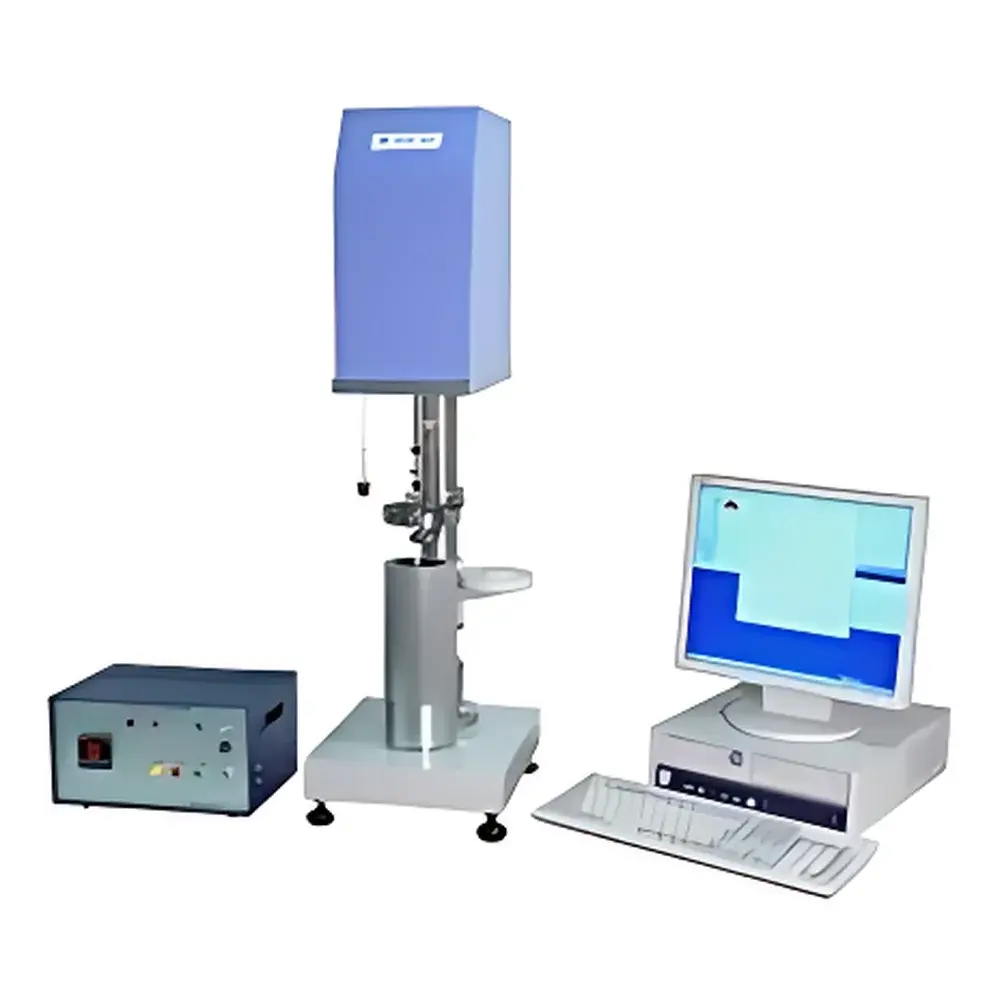
Yasuda No.170-AUTO Automatic Clash-Berg Torsion Flexibility Tester
| Brand | Yasuda |
|---|---|
| Origin | Japan |
| Model | No.170-AUTO |
| Temperature Range | −60 °C to 100 °C (dry ice cooling) |
| Heating Rate | 2 °C/min |
| Specimen Dimensions | W 6.35 ± 0.03 mm × L 64 mm × T 0.8–1.5 mm |
| Gauge Length | 40 mm |
| Angular Range | 0–270° (1° resolution) |
| Torque Application | Pulley-type weight system (5 g, 10 g, 20 g, 50 g) |
| Encoder Type | Rotary encoder for torsional angle measurement |
| Power Supply | 220 V, single-phase, 10 A, 50/60 Hz |
| Host Dimensions/Weight | ~300 × 400 × 780 mm / ~40 kg |
| Control Box Dimensions/Weight | ~330 × 350 × 180 mm / ~10 kg |
| Standards Compliance | JIS K6734, K6745, K6773, K6924-2, ASTM D1043, ISO 458 |
Overview
The Yasuda No.170-AUTO Automatic Clash-Berg Torsion Flexibility Tester is a precision thermal-mechanical instrument engineered for the quantitative evaluation of low-temperature torsional stiffness and flexibility in elastomeric and thermoplastic materials. Based on the classical Clash-Berg principle—originally standardized in Japanese Industrial Standards (JIS) and widely adopted internationally—the system applies a controlled static torque via calibrated dead weights acting through a pulley mechanism, inducing torsional deformation in a rectangular strip specimen held between two clamps across a defined gauge length. As temperature is systematically varied from −60 °C (achieved using dry ice-based cooling) to +100 °C, high-resolution rotary encoders continuously monitor angular displacement, enabling real-time calculation of torsional rigidity (k = M/θ, where M is applied torque and θ is measured twist angle). The resulting temperature–rigidity curve provides critical inflection points—including the torsional flexibility temperature (Tf)—which correlates directly with the material’s glass transition behavior under shear-dominated deformation. This method offers superior reproducibility for quality control and formulation development compared to bending or tensile-based low-temperature tests, particularly for thin-section rubber compounds, PVC plastisols, and thermoplastic elastomers.
Key Features
- Automated temperature ramping with programmable heating rate (2 °C/min standard, adjustable within system limits) and integrated dry ice cooling manifold for sub-zero operation down to −60 °C
- High-precision rotary encoder (1° angular resolution) for direct, drift-free measurement of torsional deflection without optical alignment dependencies
- Dual-chamber design: thermally isolated test zone (host unit) and separate electronics control box to minimize thermal crosstalk and ensure long-term signal stability
- Modular torque application system utilizing calibrated stainless-steel weights (5 g, 10 g, 20 g, 50 g) and low-friction pulleys, eliminating motorized actuation artifacts and ensuring traceable mechanical loading
- Standardized specimen fixture geometry: fixed 40 mm gauge length, 6.35 mm width tolerance (±0.03 mm), and thickness range (0.8–1.5 mm) compliant with JIS and ASTM dimensional requirements
- Integrated dual-channel digital thermometer inputs for independent verification of bath and specimen surface temperatures during testing
Sample Compatibility & Compliance
The No.170-AUTO is validated for use with vulcanized rubber sheets, thermoplastic elastomer films, rigid PVC compounds, and crosslinked polyolefin blends meeting dimensional specifications per JIS K6734 (rubber), K6745 (synthetic rubber), K6773 (PVC), and K6924-2 (automotive sealants). It satisfies the core mechanical and thermal requirements of ASTM D1043 (“Standard Test Method for Stiffness of Plastic Materials by Means of a Torsion Test”) and ISO 458 (“Rubber—Determination of torsional stiffness at low temperatures”). All hardware components—including specimen cutting dies, hole-punch tools, installation gauges, and vacuum-insulated cryogenic bottles—are supplied as factory-certified accessories to ensure procedural fidelity. The system architecture supports GLP-compliant documentation workflows when paired with validated third-party data acquisition software; audit trails, user access logs, and electronic signatures may be implemented per 21 CFR Part 11 requirements if deployed in regulated QC environments.
Software & Data Management
While the No.170-AUTO operates as a stand-alone instrument with analog meter readouts and manual data recording capability, it features RS-232 and analog voltage output interfaces (0–10 V for temperature, 0–5 V for angular displacement) compatible with industry-standard SCADA platforms and validated laboratory data systems (e.g., LabArchives, Empower, or custom Python/Matlab acquisition scripts). Raw encoder pulses and thermocouple signals are time-stamped at ≥10 Hz sampling rate, enabling post-acquisition derivation of dynamic parameters such as damping ratio and hysteresis loss if required. Calibration certificates for weights, encoder linearity, and temperature sensors are provided with each unit and traceable to JCSS (Japan Calibration Service System) standards. Firmware updates and configuration backups are performed via USB interface using Yasuda’s proprietary setup utility, which enforces parameter locking and revision-controlled configuration files.
Applications
- Determination of low-temperature flexibility thresholds for automotive weatherstrips, hose compounds, and cable jacketing materials
- Comparative ranking of plasticizer efficiency in PVC formulations under thermal cycling conditions
- Quality assurance of batch-to-batch consistency in silicone elastomer production lines
- Research into structure–property relationships of novel bio-based thermoplastic elastomers subjected to cryogenic torsion
- Validation of accelerated aging effects on torsional recovery behavior in medical-grade rubber tubing
- Supporting ASTM F1980 (accelerated aging of sterile barrier systems) by quantifying embrittlement onset temperatures in packaging laminates
FAQ
What is the primary measurement output of the No.170-AUTO?
The instrument outputs torsional rigidity (in N·m/rad or equivalent derived units) as a function of temperature, from which the torsional flexibility temperature (Tf)—defined as the temperature at which rigidity reaches a predefined threshold (e.g., 10⁵ N·m/rad)—is determined.
Can the system operate below −60 °C?
No. The dry ice cooling subsystem is rated for a minimum operational temperature of −60 °C. Liquid nitrogen integration is not supported due to thermal shock risks and lack of condensate management in the current mechanical design.
Is automatic data logging included as standard?
No. Real-time data capture requires external DAQ hardware and software. The base configuration includes analog and serial outputs for integration but no embedded memory or touchscreen interface.
Are calibration services available outside Japan?
Yes. Yasuda authorizes certified third-party metrology laboratories in North America, Europe, and APAC regions to perform on-site verification and recalibration against JCSS-traceable reference standards, with full documentation provided.
How is specimen alignment verified prior to testing?
The included installation gauge ensures parallelism between clamping faces and correct insertion depth. Visual alignment is confirmed using the engraved scale on the specimen holder and the 1°-marked angular dial adjacent to the encoder coupling.







