
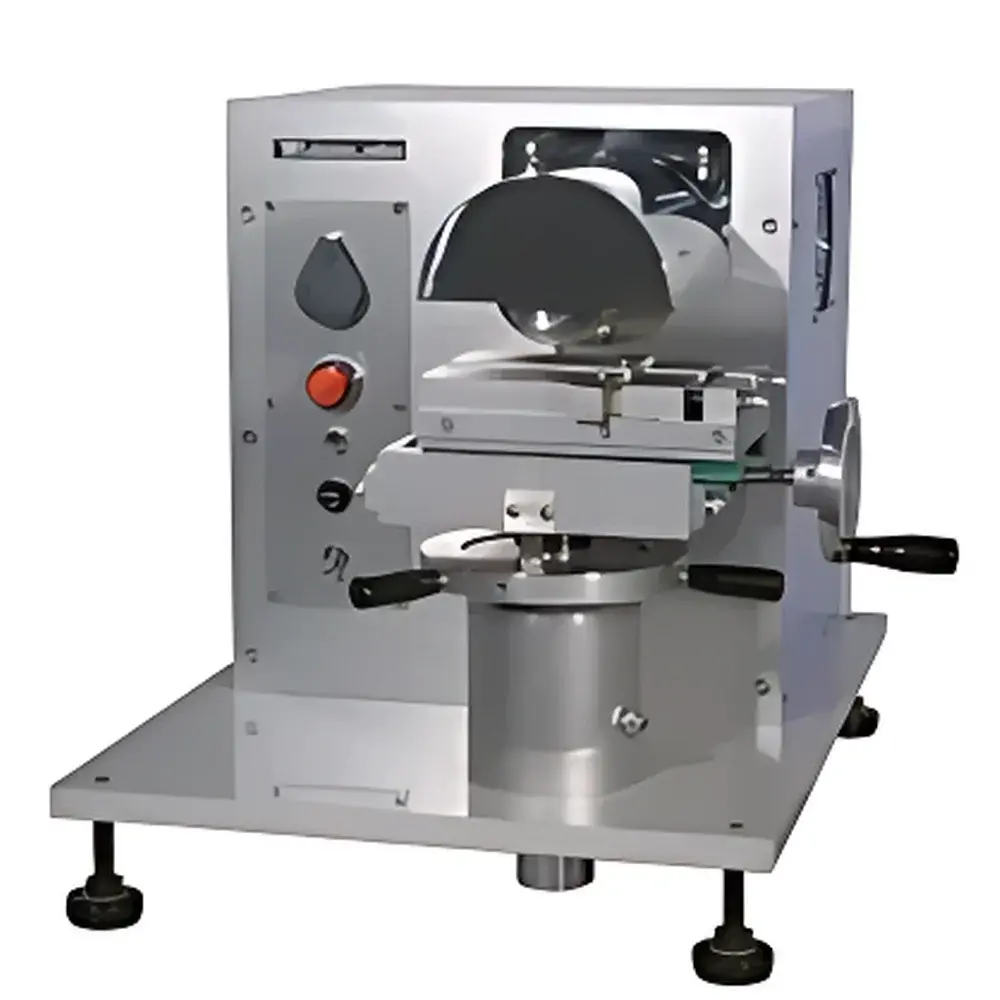
Yasuda No.189-PN Notched Specimen Preparation Machine
| Brand | Yasuda |
|---|---|
| Origin | Japan |
| Model | No.189-PN |
| Compliance Standards | JIS K7144, ISO 2818 |
| Blade Type | Interchangeable Single-Edge Cutting Tool |
| Application | Charpy/Izod Impact Test Specimen Notching |
| Mounting | Benchtop, Fixed-Base Design |
| Drive Mechanism | Manual Feed with Precision Depth Stop |
Overview
The Yasuda No.189-PN Notched Specimen Preparation Machine is a precision-engineered benchtop instrument designed for the reproducible fabrication of standardized notches in rigid polymer, composite, and metallic test specimens—specifically those intended for Charpy and Izod impact testing per JIS K7144 and ISO 2818. Unlike automated or motorized systems, the No.189-PN employs a manually actuated, gravity-assisted feed mechanism combined with a calibrated depth stop to ensure consistent notch geometry (depth, radius, and flank angle) across batches. Its mechanical architecture prioritizes rigidity and dimensional stability: the base casting is fabricated from high-grade cast iron, and the specimen clamping system utilizes hardened steel vise jaws with micrometer-adjustable parallelism control. This design eliminates thermal drift and vibration-induced deviation—critical factors when producing notches with ±0.02 mm depth tolerance, as required by ISO 2818 Annex A for Type A (2-mm depth, 0.25-mm radius) and Type B (1-mm depth, 0.25-mm radius) notches.
Key Features
- Interchangeable single-edge carbide-tipped cutting tool—designed for rapid blade replacement without realignment; each blade is pre-calibrated to maintain notch radius accuracy within ±0.01 mm.
- Adjustable specimen support platform with T-slot configuration, enabling secure mounting of rectangular bars (up to 15 mm thick × 20 mm wide × 120 mm long) and ASTM D6110-compliant polymeric rods.
- Mechanical depth stop with vernier scale (0.01 mm resolution) and locking knob—ensures repeatable notch depth across operator shifts and laboratories.
- Integrated chip guard and removable stainless-steel debris tray—facilitates safe operation and simplifies cleaning between specimen types (e.g., switching from ABS to carbon-fiber-reinforced PA6).
- No electrical power requirement—eliminates electromagnetic interference concerns in metrology-dense lab environments and supports use in explosion-proof zones where pneumatic or electric tools are restricted.
Sample Compatibility & Compliance
The No.189-PN accommodates flat, prismatic specimens conforming to ISO 179-1 (Charpy), ISO 180 (Izod), and JIS K7111 standards. Compatible materials include thermoplastics (PP, PC, PBT), thermosets (epoxy, phenolic), fiber-reinforced composites (glass/CFRP laminates), and aluminum alloys (e.g., 6061-T6). Specimen dimensions must fall within 8–15 mm thickness, 10–20 mm width, and ≥100 mm length to engage fully with the vise and support rails. All notch geometries comply with ISO 2818:2019 Clause 6.2 (notch root radius tolerance: 0.25 ±0.05 mm; flank angle: 45° ±1°; depth: 2.0 ±0.05 mm for Type A). The machine itself bears no CE marking but meets the mechanical safety requirements of ISO 12100 for stationary laboratory equipment.
Software & Data Management
The No.189-PN operates as a standalone mechanical system with no embedded firmware, software interface, or digital connectivity. This architecture ensures full compliance with GLP and GMP environments requiring audit-trail-free instrumentation—particularly relevant for regulated quality control labs performing routine impact testing under ISO/IEC 17025. Operators record notch parameters (depth, tool serial number, date, operator ID) manually in bound logbooks or LIMS-integrated paperless workflows. Calibration certificates for depth stops and blade radius verification (traceable to NMIJ/JCSS) are supplied with each unit and recommended for annual recalibration against certified gauge blocks and optical profilometry.
Applications
- Preparation of notched specimens for standardized impact resistance evaluation in QC labs serving automotive plastics suppliers (e.g., instrument panel substrates, bumper beams).
- R&D validation of toughening agents in engineering thermoplastics—where notch sensitivity directly correlates with fracture toughness (KIc) trends.
- Third-party testing laboratories accredited to ISO/IEC 17025 conducting interlaboratory comparisons under ISO 5725-2 protocols.
- Educational institutions teaching polymer mechanics—leveraging the machine’s transparency and repeatability to demonstrate the effect of notch geometry on brittle-to-ductile transition temperature.
- Failure analysis labs preparing specimens for fractographic examination via SEM, where consistent notch initiation points are essential for crack path interpretation.
FAQ
What standards does the No.189-PN support for notch geometry verification?
It complies with ISO 2818:2019 (Annex A) and JIS K7144 for Type A and Type B notches; verification requires optical measurement of root radius using a calibrated stereomicroscope or profilometer.
Is the cutting tool compatible with non-Yasuda blades?
No—only Yasuda-manufactured single-edge carbide inserts (Part No. 189-BL-SE) are dimensionally and geometrically validated for use with the No.189-PN’s holder and depth calibration system.
Can the machine prepare double-notched specimens?
No—it is engineered exclusively for single-sided notching; symmetrical double-notch preparation requires repositioning and manual realignment, which voids ISO 2818 conformance.
What maintenance schedule is recommended?
Monthly inspection of vise jaw parallelism with feeler gauges; quarterly lubrication of depth stop threads with ISO VG 32 mineral oil; annual verification of blade holder runout (<0.005 mm TIR) using dial indicator on granite surface plate.



