
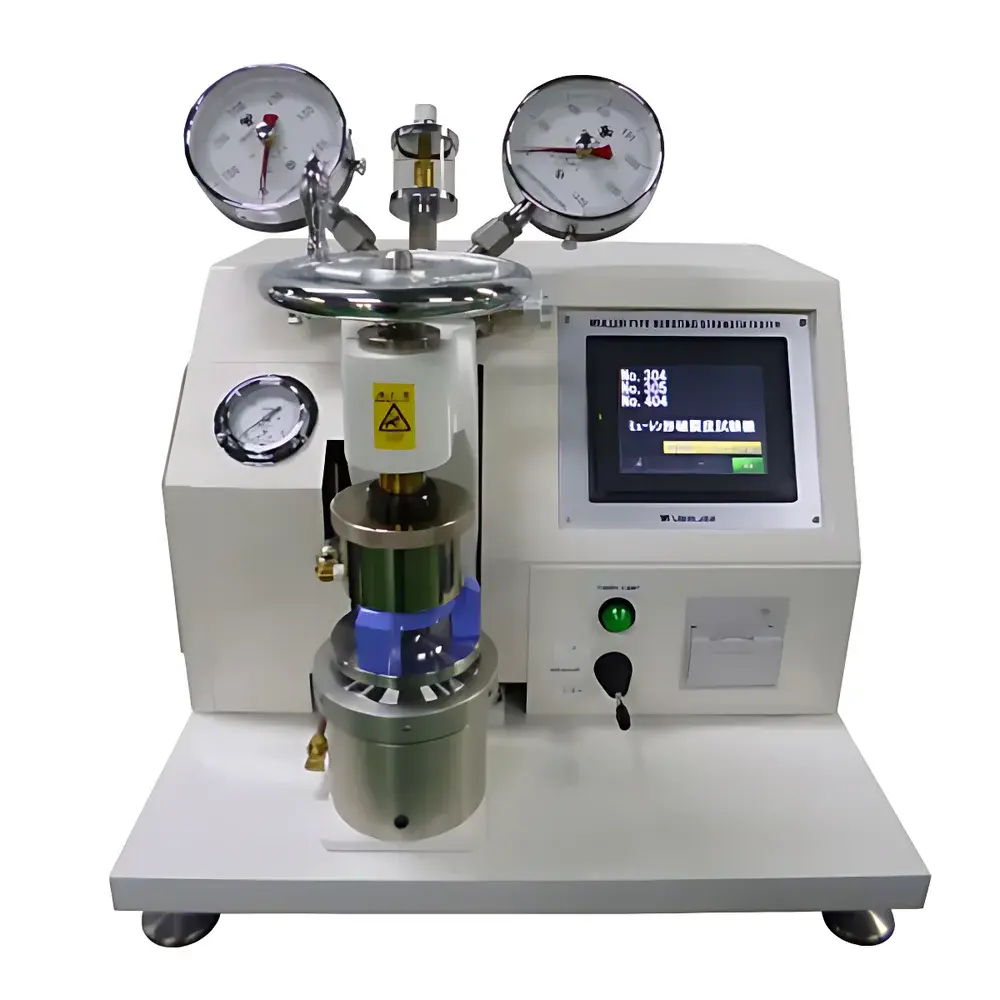
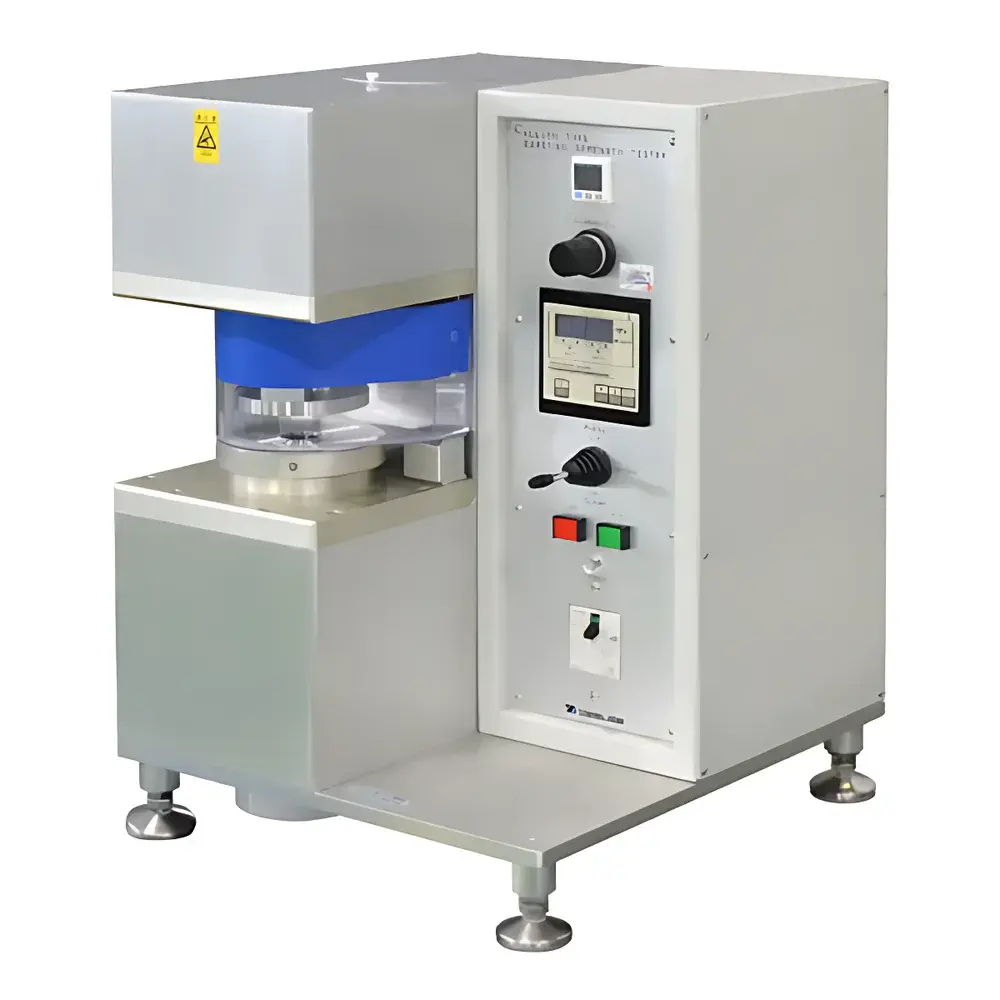
Yasuda No.305-YPL Mullen-Type Low-Pressure Burst Strength Tester
| Brand | Yasuda |
|---|---|
| Origin | Japan |
| Model | No.305-YPL |
| Applicable Standards | JIS K6404-11, P8112, P8131, TAPPI T403, T807, T810, ISO 2758, ISO 2759 |
| Pressure Range | Low-pressure configuration (typically up to 1.6 MPa / 232 psi) |
| Test Principle | Hydraulic diaphragm burst method with clamped specimen |
| Display | Digital readout |
| Compliance | Designed for GLP-compliant lab environments with manual data recording capability |
Overview
The Yasuda No.305-YPL is a precision-engineered Mullen-type low-pressure burst strength tester designed specifically for evaluating the rupture resistance of flexible sheet materials used extensively in packaging and industrial applications. Operating on the hydraulic diaphragm burst principle—where a standardized circular test specimen is clamped between two parallel plates and subjected to uniformly increasing hydraulic pressure via an elastomeric rubber diaphragm—the instrument measures the maximum pressure at which the specimen ruptures. This method directly correlates to real-world performance under internal or external mechanical stress, such as compression during stacking, filling pressure in flexible containers, or handling-induced deformation. Unlike tensile testing, which evaluates elongation and ultimate tensile load along a single axis, burst strength quantifies multidirectional resistance to localized pressure, making it indispensable for corrugated board, linerboard, kraft paper, coated papers, synthetic films, rubberized fabrics, and laminated packaging substrates. The No.305-YPL is calibrated and validated for compliance with internationally recognized standards including ISO 2758 (paper and board), ISO 2759 (corrugated fiberboard), TAPPI T403 (bursting strength of paper), T807 (corrugated board), T810 (solid fiberboard), JIS K6404-11 (Japanese Industrial Standard for paperboard bursting strength), and industry-specific specifications P8112 and P8131.
Key Features
- Robust cast-iron frame with precision-machined clamping surfaces ensuring consistent specimen alignment and minimal edge distortion during pressurization.
- Digital pressure transducer with analog-to-digital conversion and zero-stability compensation for repeatable readings across ambient temperature fluctuations (15–30 °C).
- Adjustable clamping force mechanism compliant with TAPPI T403 requirements, enabling secure fixation of specimens ranging from 0.1 mm to 3.0 mm in thickness without slippage or premature failure.
- Low-pressure hydraulic system optimized for accurate measurement within the 0.05–1.6 MPa range, minimizing overpressure risk while maintaining resolution ≤0.02 MPa.
- Manual operation interface with calibrated pressure gauge and digital display—designed for laboratories requiring traceable, non-software-dependent measurement workflows.
- Interchangeable rubber diaphragms (standard 38.1 mm diameter) conforming to ISO 2758 Annex A geometry specifications, with documented service life and replacement protocols per GLP documentation guidelines.
Sample Compatibility & Compliance
The No.305-YPL accommodates standard test specimens measuring 193 mm × 193 mm (per ISO 2758) or 152 mm × 152 mm (per TAPPI T403), cut using certified die-cutters to eliminate shear-induced edge defects. It supports both flat and lightly pre-curved samples—common in corrugated board evaluation—provided curvature radius exceeds 150 mm. Materials routinely tested include virgin and recycled kraft linerboard, testliner, medium fluting, solid bleached sulfate (SBS), polycoated paperboard, metallized films, PVC-laminated textiles, and EPDM rubber sheets. All test procedures align with ISO/IEC 17025 clause 7.2.2 (method validation) and support audit readiness for GMP-regulated packaging qualification (e.g., pharmaceutical secondary packaging per USP <661.2>). While the instrument itself does not embed electronic audit trails, its manual data capture workflow is fully compatible with laboratory notebooks meeting FDA 21 CFR Part 11 record-keeping expectations when paired with controlled documentation practices.
Software & Data Management
The No.305-YPL operates as a standalone benchtop instrument with no integrated software or USB/RS-232 connectivity. Data acquisition relies on direct operator reading and transcription into laboratory information management systems (LIMS) or Excel-based QA databases. Each unit ships with a NIST-traceable calibration certificate covering pressure sensor linearity (±1.0% FS), hysteresis (<0.5% FS), and repeatability (±0.8% FS), valid for 12 months under normal use conditions. Optional accessories include a calibrated deadweight tester for field verification and a specimen thickness gauge (0–10 mm, ±0.01 mm resolution) compliant with ISO 534 for pre-test dimensional verification. For labs requiring digital integration, third-party DAQ modules may be interfaced via analog 0–5 V output (available upon request with factory modification).
Applications
- Quality control of incoming paperboard rolls prior to converting operations (e.g., flexographic printing, die-cutting, folding)
- Validation of corrugated box compression resistance in relation to ECT and BCT modeling
- Comparative analysis of coating integrity on barrier-laminated packaging for food and pharma sectors
- R&D evaluation of biodegradable substrate formulations under variable humidity conditioning (ASTM D685)
- Supplier qualification testing per contractual burst strength thresholds (e.g., ≥550 kPa for export-grade double-wall boxes)
- Root cause investigation of packaging failures during distribution simulation (ISTA 3A/3E)
FAQ
What distinguishes the No.305-YPL from high-pressure Mullen testers like the No.304 series?
The No.305-YPL utilizes a lower-range hydraulic circuit optimized for materials with burst strengths below 1.6 MPa (e.g., lightweight liners, newsprint, thin films), whereas the No.304 series extends to 6.9 MPa for heavy-duty containerboard and solid fiberboard.
Is the instrument suitable for testing wet-strength papers?
Yes—when used in conjunction with standardized conditioning per ISO 187 (23 °C / 50% RH) and optional humidity-controlled test chambers, provided specimens are handled with lint-free gloves to prevent moisture transfer.
Does Yasuda provide installation qualification (IQ) or operational qualification (OQ) documentation?
Standard delivery includes Factory Acceptance Test (FAT) report and calibration certificate; IQ/OQ protocols can be supplied as optional engineering services upon request.
Can the No.305-YPL be used for non-standard specimen sizes?
Only standard diameters (193 mm or 152 mm) are supported per normative test methods; deviations invalidate compliance with ISO/TAPPI reporting requirements.
What maintenance intervals are recommended for the rubber diaphragm?
Diaphragms should be inspected before each test series and replaced after 500 cycles or every 6 months—whichever occurs first—to maintain geometric conformity and pressure transmission fidelity.
Related Products





