
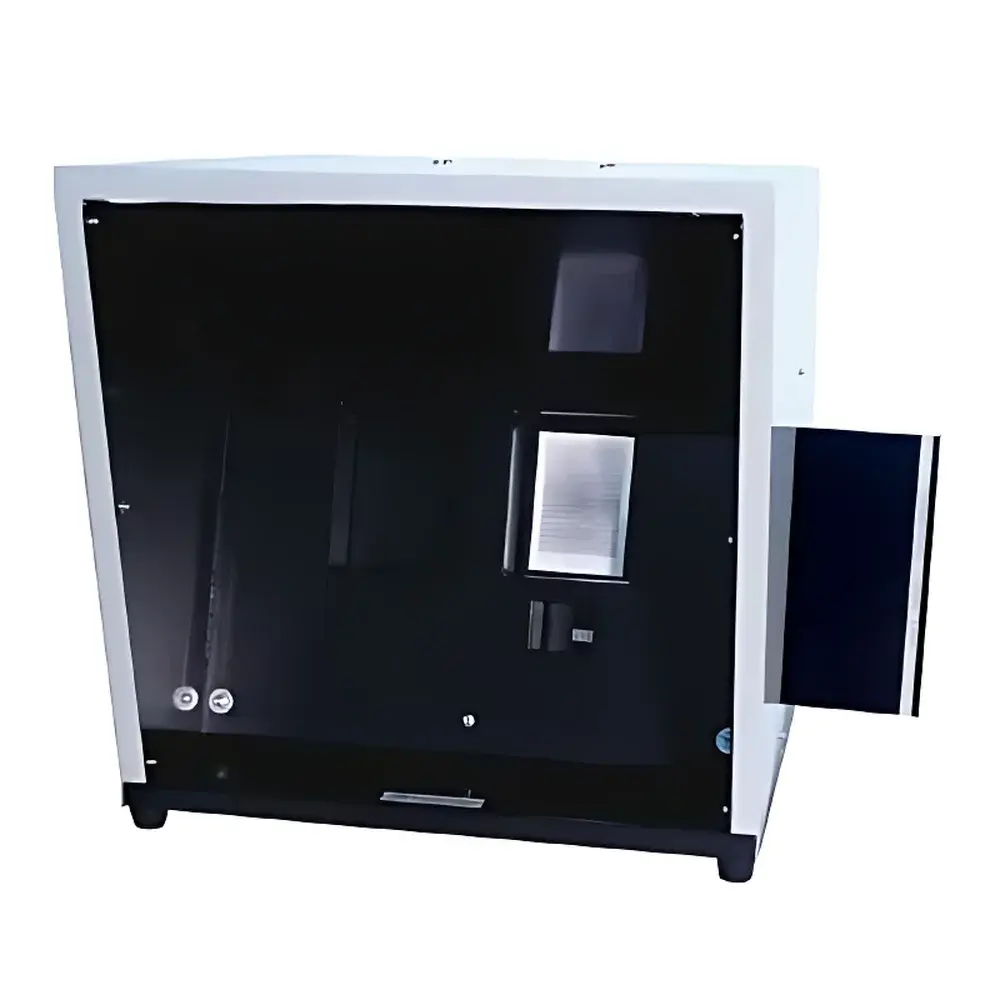
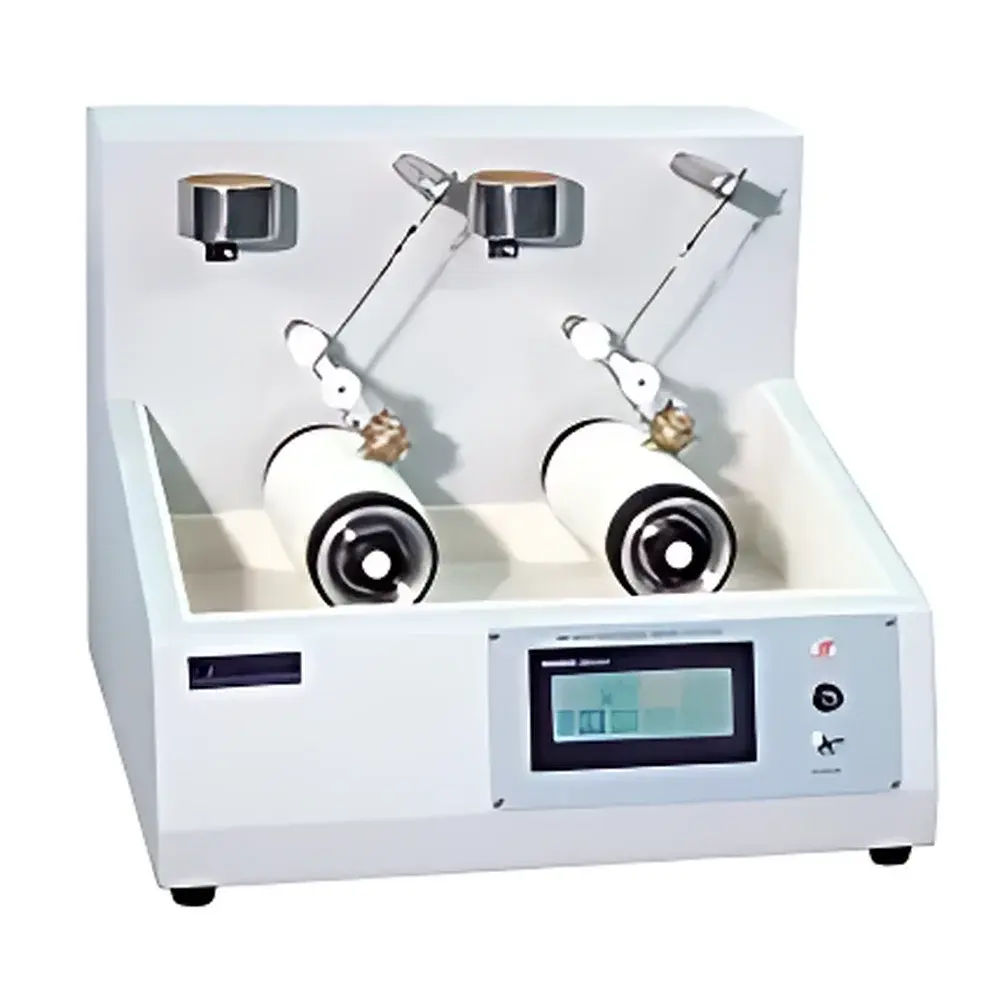
Yasuda No.473 ICI Mace Snag Tester
| Brand | Yasuda |
|---|---|
| Origin | Japan |
| Model | No.473 |
| Test Standards | JIS L 1058, ASTM D3939 |
| Test Method | ICI Mace (Rotating Drum with Protruding Pins) |
| Rotation Cycles | 100 ± 1 rev |
| Sample Mounting | Cylindrical Mandrel Wrapped with Fabric Specimen |
| Evaluation | Visual Comparison Against Standard Photographic Rating Scale (Grade 1–5) |
Overview
The Yasuda No.473 ICI Mace Snag Tester is a precision-engineered textile evaluation instrument designed to quantify the propensity of woven and knitted fabrics to develop snags—unraveled loops or pulled yarns—under mechanical abrasion simulating real-world wear conditions. It operates on the internationally recognized ICI (International Confederation of Inspection Agencies) Mace test principle, wherein a standardized cylindrical mandrel is tightly wrapped with a conditioned fabric specimen and rotated 100 times inside a rigid drum fitted with six evenly spaced, hardened steel pins (12 mm length, 1.6 mm diameter). This controlled mechanical interaction induces localized yarn displacement, enabling objective assessment of surface integrity degradation. The device is calibrated and validated for strict compliance with JIS L 1058 (Japanese Industrial Standard for snagging resistance of textiles) and ASTM D3939 (Standard Test Method for Snag Resistance of Woven and Knitted Fabrics Using the ICI Mace Tester), making it suitable for quality assurance in R&D laboratories, third-party testing facilities, and textile manufacturing QA/QC departments operating under ISO/IEC 17025-accredited frameworks.
Key Features
- Robust cast-iron frame with vibration-dampening base ensures mechanical stability during repetitive rotation cycles, minimizing measurement variability.
- Precision-machined aluminum mandrel (Ø 100 mm × 150 mm L) with uniform surface finish and consistent clamping mechanism for reproducible specimen tensioning.
- Drum assembly features six hardened stainless-steel pins mounted at precise radial intervals and angular orientation per ICI specification; pin geometry is traceable to NIST-certified reference gauges.
- Digital counter with reset function provides accurate cycle registration (100 ± 1 revolutions), eliminating operator-dependent timing errors.
- Integrated safety interlock prevents operation unless the drum lid is fully closed and secured, meeting EN 61000-6-2 electromagnetic compatibility and EN ISO 13857 machine safeguarding requirements.
- Modular design facilitates rapid cleaning and pin inspection without tools; all contact surfaces are corrosion-resistant and compliant with OSHA-recommended laboratory equipment maintenance protocols.
Sample Compatibility & Compliance
The No.473 accommodates standard fabric specimens measuring 200 mm × 200 mm, cut parallel to warp and weft directions as specified in JIS L 1058 Annex A and ASTM D3939 Section 7. It supports single-layer and multi-layer laminates (e.g., coated technical textiles, stretch knits, nonwovens used in automotive interiors), provided specimens maintain dimensional stability under mandrel wrapping tension. Preconditioning follows ISO 139 (standard atmosphere: 20 °C ± 2 °C, 65 % RH ± 4 % RH) prior to testing. Results are reported using the five-grade visual rating scale (Grade 1 = severe snagging; Grade 5 = no visible snags), aligned with the official ICI photographic reference standards (Catalog No. ICI-SNAG-STD-2023). Data generated meets documentation requirements for GLP-compliant textile testing reports and supports audit readiness for brands enforcing Restricted Substances Lists (RSLs) under ZDHC MRSL v3.0.
Software & Data Management
While the No.473 is a manually evaluated mechanical tester, its output integrates seamlessly into digital QA workflows. Each test record includes mandatory metadata fields: specimen ID, lot number, preconditioning duration, operator ID, test date/time, environmental log (temperature/humidity), and assigned snag grade. These entries are compatible with LIMS platforms via CSV export or barcode-scanned entry using optional Yasuda DataLink Module (sold separately). Audit trails comply with FDA 21 CFR Part 11 principles when paired with validated electronic signature systems. Calibration certificates for mandrel dimensions and pin geometry are issued annually by Yasuda’s Tokyo Calibration Center, accredited to ISO/IEC 17025:2017 (Certificate No. YAS-CLB-2024-473-0892).
Applications
- Pre-production validation of filament polyester knits for sportswear and athleisure garments.
- Comparative snag resistance benchmarking across competing yarn types (e.g., textured vs. air-jet interlaced nylon 6.6).
- Quality gate testing for automotive seat covers subjected to ISO 17076-1 abrasion cycles.
- Root cause analysis of snag formation in seamless hosiery—correlating fiber denier, loop length, and finishing chemistry.
- Regulatory submission support for OEKO-TEX® STANDARD 100 Class II product certifications requiring mechanical durability evidence.
FAQ
What fabric types are suitable for testing on the No.473?
Woven, knitted, and warp-knitted fabrics—including stretch blends, coated technical textiles, and nonwovens—with minimum tensile strength ≥ 150 N (warp) and ≥ 120 N (weft) per ISO 13934-1.
Is operator training required to achieve repeatable results?
Yes. Consistent specimen wrapping tension and visual grading require certification per Yasuda’s ICI Snag Testing Competency Program (Module SN-473-TS), which includes inter-laboratory proficiency testing.
How often must the steel pins be replaced?
Pins undergo hardness verification every 500 test cycles; replacement is mandated after 2,000 cycles or upon measured tip deformation exceeding 0.1 mm per ISO 2062.
Can test data be exported to Excel or SAP QM modules?
Yes—via Yasuda DataLink Module (v2.1), supporting .xlsx export and direct SAP QM IDoc integration through certified middleware (SAP PI/PO 7.5+).
Does the instrument meet CE marking requirements for EU market placement?
Yes. Certified to EN 61000-6-2 (EMC), EN 61000-6-3 (Emission), and EN ISO 12100 (Safety of Machinery), with Declaration of Conformity issued by TÜV Rheinland (DoC No. RH-ICISM-2024-7731).






