
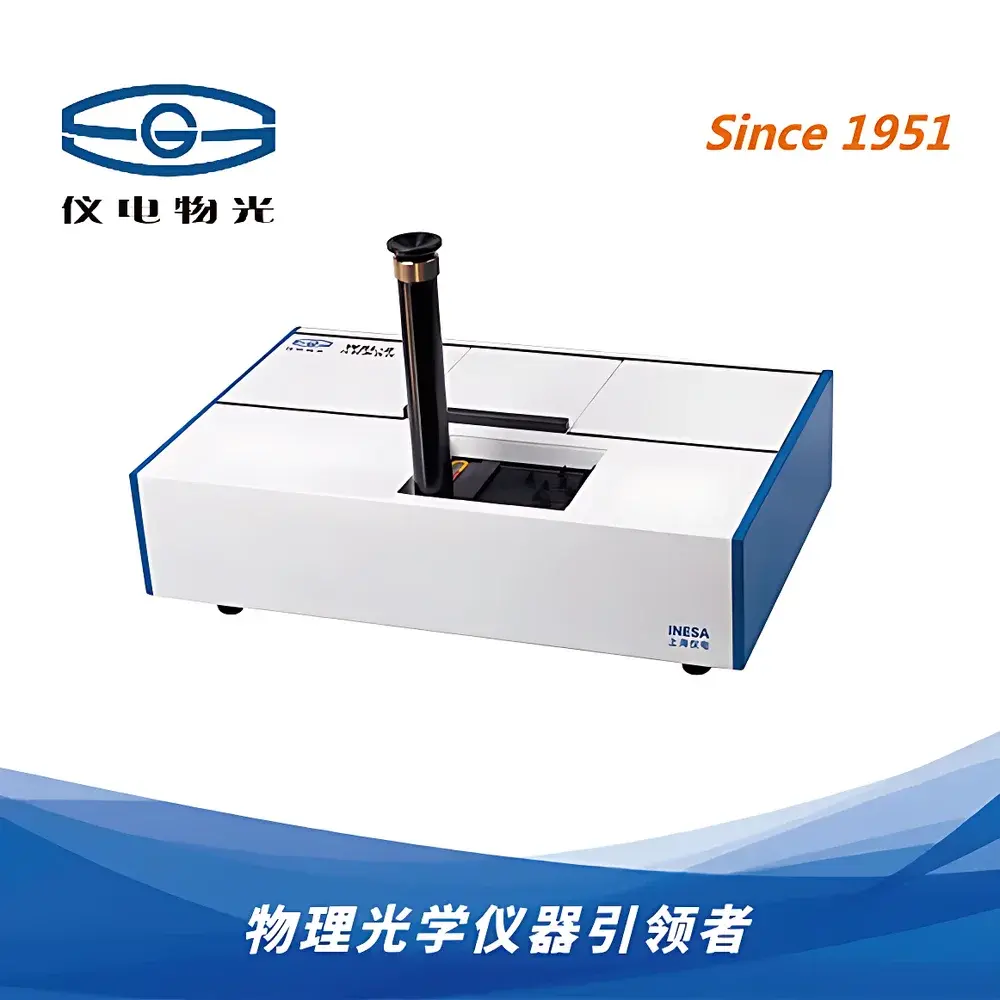
YDWG WSL-2 Lovibond Tintometer (Visual Color Comparator)
| Brand | YDWG |
|---|---|
| Origin | Shanghai, China |
| Model | WSL-2 |
| Red Scale Range | R 0.1–R79.9 Lovibond Units |
| Yellow Scale Range | Y 0.1–Y79.9 Lovibond Units |
| Blue Scale Range | B 0.1–B49.9 Lovibond Units |
| Neutral Grey Scale Range | N 0.1–N3.9 Lovibond Units |
| Minimum Scale Division | 0.1 Lovibond Unit |
| White Reference Plate Diffuse Reflectance | >80% |
| Viewing Tube Diameter | φ30 mm, Length: 215 mm |
| Standard Cell Dimensions | 10 × 20 × 40 mm, 25.4 × 20 × 40 mm, and 133.4 × 20 × 40 mm |
| Magnifier Lens Magnification | 1.9× |
| Power Supply | 220 V ± 22 V, 50 Hz ± 1 Hz, 50 W |
| Instrument Dimensions (Main Unit) | 500 × 320 × 130 mm |
| Net Weight | 8 kg |
Overview
The YDWG WSL-2 Lovibond Tintometer is a precision visual color comparator engineered for standardized, observer-based color assessment using the internationally recognized Lovibond color scale system. Unlike electronic spectrophotometers, this instrument relies on human visual evaluation under controlled illumination and geometric conditions—making it especially suitable for routine quality control in industries where empirical color matching remains the regulatory or specification standard. Its operational principle centers on side-by-side comparison of a sample against calibrated colored glass standards (red, yellow, blue, and neutral grey) arranged along linear sliding scales. The user adjusts each scale until a perceptual match is achieved, with final color designation expressed as a four-number Lovibond notation (e.g., R20 Y35 B10 N1.5). This method complies with foundational colorimetric practices defined in ASTM D1209 (for platinum-cobalt scale), ASTM D1500 (petroleum products), and ISO 2760 (edible oils), and serves as a reference technique in pharmacopoeial monographs requiring visual hue evaluation.
Key Features
- Four independent linear scale mechanisms for red (R), yellow (Y), blue (B), and neutral grey (N), each graduated in 0.1-unit increments across defined ranges (R/Y: 0.1–79.9; B: 0.1–49.9; N: 0.1–3.9 Lovibond units)
- Dual-path optical design with fixed viewing geometry (φ30 mm tube, 215 mm length) and integrated 1.9× magnifier to enhance contrast resolution and minimize parallax error
- Three standard cell holders accommodating cuvettes of 10 mm, 25.4 mm (1-inch), and 133.4 mm path lengths—enabling flexibility across low- and high-absorbance samples including viscous oils, syrups, and suspensions
- High-reflectance white reference plate (>80% diffuse reflectance) for consistent background calibration and glare reduction
- Robust mechanical construction with aluminum alloy housing, designed for long-term stability in laboratory and production floor environments
- Compliance-ready configuration: no software or data storage required, eliminating validation complexity while supporting GLP-aligned manual recordkeeping
Sample Compatibility & Compliance
The WSL-2 accommodates transparent to semi-transparent liquids (e.g., edible oils, solvents, resins), colloidal dispersions (paints, inks), granular solids (flour, sugar), and powdered materials (pharmaceutical excipients, pigments) when prepared in standardized cells. Its methodology aligns with multiple industry-specific standards—including AOCS Cc 13b-92 (vegetable oils), ISO 6271 (plasticizers), and USP & EP general chapters on color evaluation (e.g., USP <631> “Color” and Ph. Eur. 2.2.29). While not intended for quantitative spectral analysis, its results are traceable to NIST-traceable Lovibond reference standards and accepted as legally defensible in contractual color specifications where visual assessment is contractually stipulated.
Software & Data Management
The WSL-2 operates entirely without embedded electronics or digital interfaces. All measurements are manually recorded by the operator using standardized log sheets or LIMS-integrated paper forms. This analog architecture ensures zero risk of firmware obsolescence, cybersecurity exposure, or 21 CFR Part 11 compliance overhead. For laboratories operating under GMP or ISO/IEC 17025, the instrument supports full auditability through documented observer training records, periodic verification against certified Lovibond standards, and controlled environmental logs (illuminant type, ambient light levels, observer vision screening).
Applications
- Edible oil refining: Monitoring bleaching efficiency and oxidation status via R/Y/B shifts during deodorization
- Petrochemical QA: Assessing kerosene, diesel, and lubricant clarity per ASTM D1500 classification
- Food & beverage: Grading honey, molasses, fruit juices, and jam consistency against industry-defined hue benchmarks
- Paint & coatings: Verifying batch-to-batch color repeatability prior to spectral measurement or customer approval
- Pharmaceutical manufacturing: Performing compendial color tests for APIs and liquid dosage forms where visual assessment is specified
- Textile dyeing: Supporting shade sorting and lot acceptance in pre-spectral QC workflows
FAQ
Is the WSL-2 compliant with FDA or ISO requirements for color testing?
Yes—the instrument implements a standardized visual method referenced in ISO 2760, ASTM D1500, and pharmacopoeial texts. While it does not generate electronic records, its use satisfies regulatory expectations for observer-based color assessment when supported by trained personnel and documented procedures.
Can the WSL-2 measure opaque or highly scattering samples?
No—it requires optically homogeneous, transmission-mode samples. Turbid or opaque materials must be clarified, diluted, or assessed via reflectance methods using alternative instrumentation.
What calibration standards accompany the WSL-2?
The unit ships with factory-calibrated Lovibond glass standards traceable to primary references. Annual verification against certified replacement standards (e.g., Lovibond Model 2000 Reference Set) is recommended per ISO/IEC 17025 Clause 6.6.
Does the instrument require annual recalibration by a certified lab?
Not inherently—mechanical scale integrity and optical alignment can be verified in-house using reference cells and trained observers. Third-party certification is optional and typically pursued only for audited GMP environments.
How does the WSL-2 compare to digital colorimeters in accuracy?
It delivers higher inter-laboratory reproducibility for pass/fail specification checks where human perception defines acceptability—but lacks the spectral resolution, repeatability, and multi-observer objectivity of modern spectrophotometers used in R&D or formulation development.



