
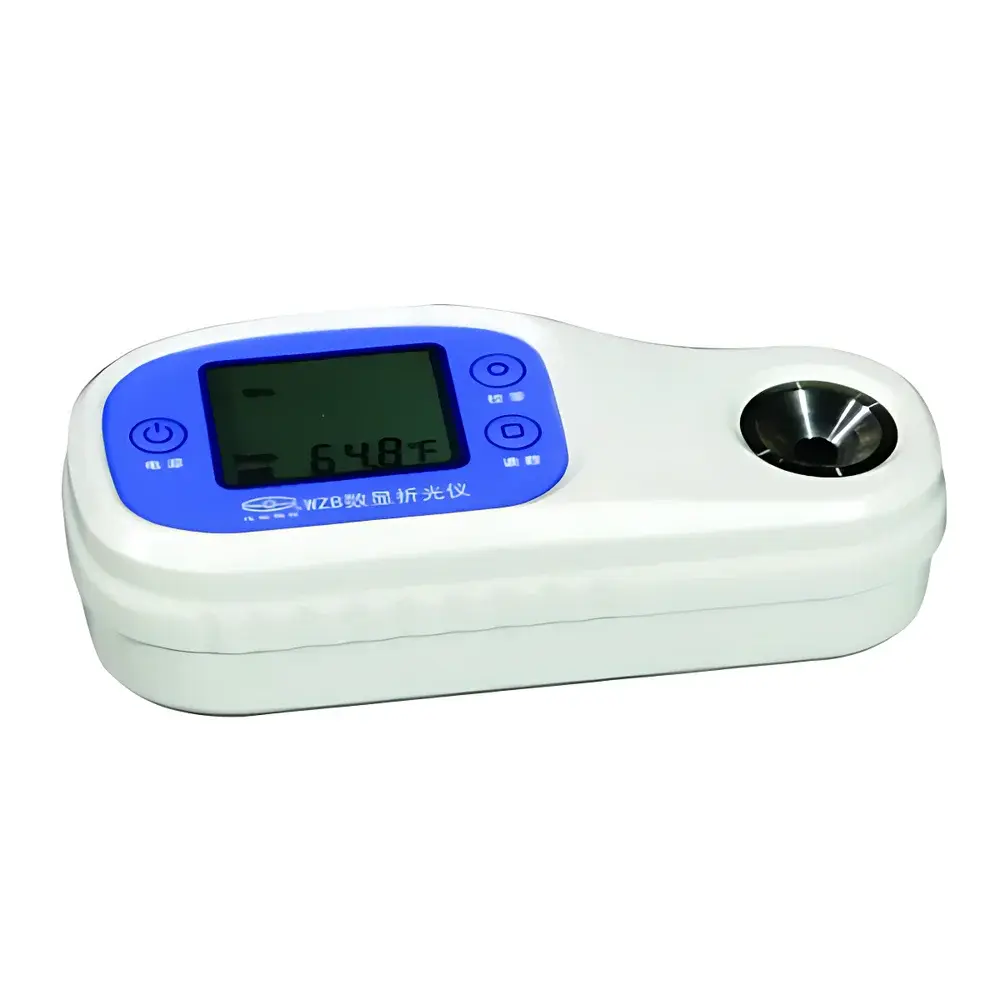
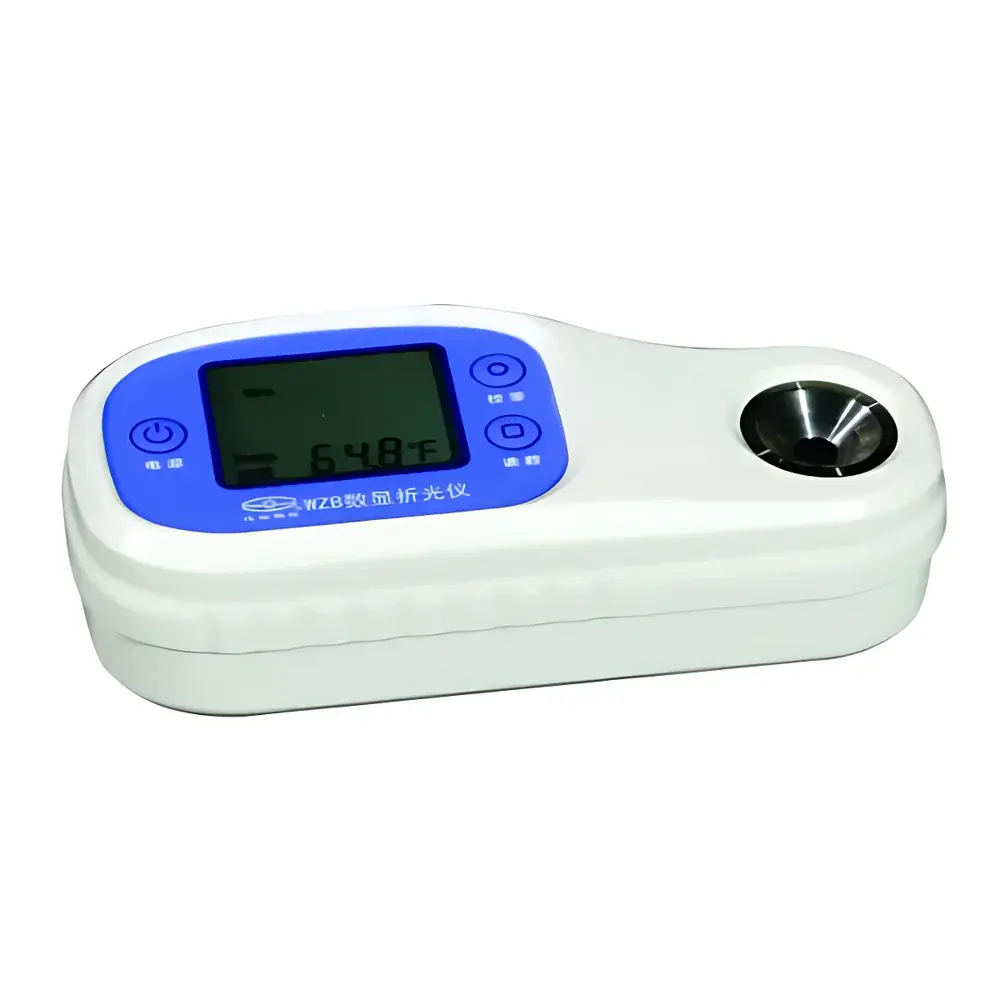
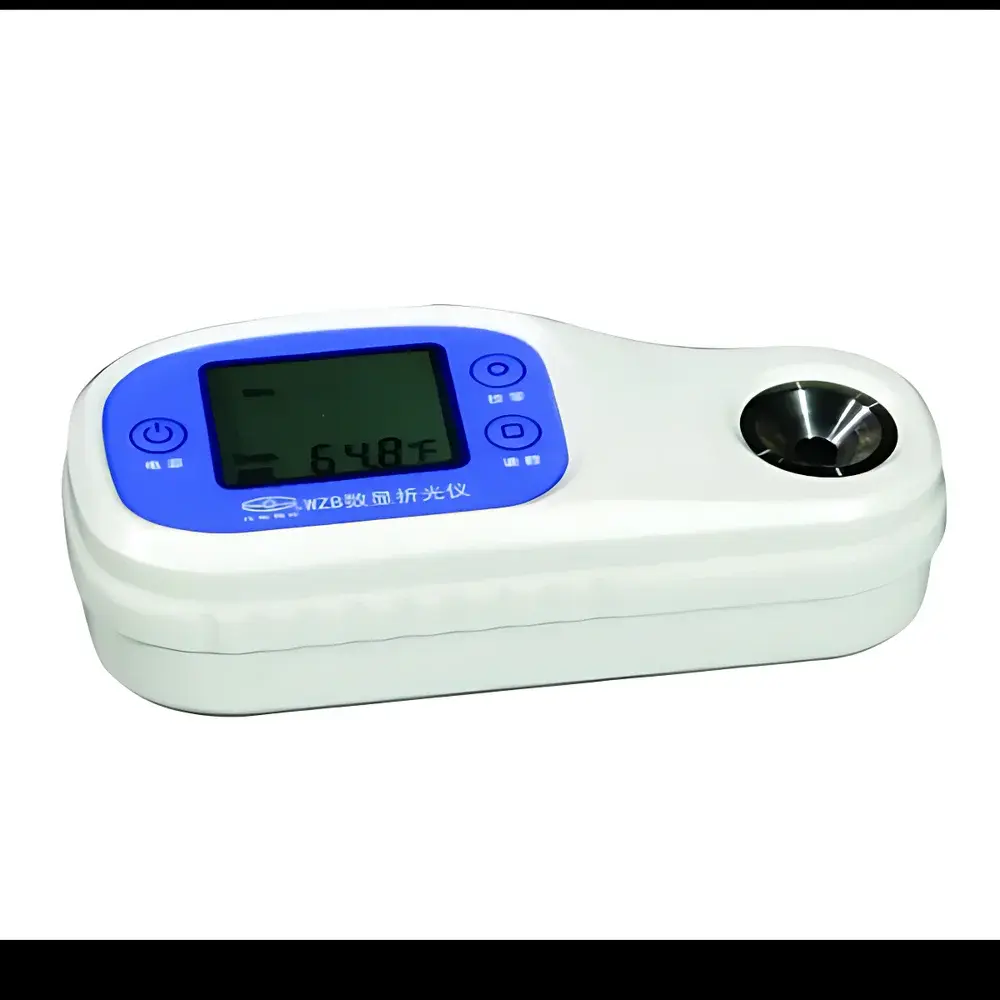
YDWG WZB92 Portable Digital Refractometer
| Brand | YDWG |
|---|---|
| Origin | Shanghai, China |
| Product Type | Handheld Refractometer |
| Temperature Compensation | Yes |
| Digital Display | Yes |
| Measurement Range (Brix) | 58–92% |
| Refractive Index Range | 1.4370–1.5233 |
| Resolution (Brix) | 0.1% |
| Resolution (RI) | 0.0001 |
| Accuracy (Brix) | ±0.2% |
| Accuracy (RI) | ±0.0003 |
| Auto Power-Off | Yes |
| Battery Low Warning | Yes |
| °C/°F Toggle | Yes |
| Operating Life | >10,000 measurements |
Overview
The YDWG WZB92 Portable Digital Refractometer is a precision handheld optical instrument engineered for rapid, field-deployable refractive index and Brix concentration measurements in high-sugar or high-density liquid samples. Based on the fundamental principle of total internal reflection at the prism–sample interface, the device determines refractive index by measuring the critical angle of light transition between the calibrated sapphire prism and the sample. This optical measurement is directly correlated to solute concentration via established empirical calibration curves traceable to NIST-referenced sucrose standards. Designed specifically for applications where conventional benchtop refractometers are impractical—such as honey grading, concentrated syrup quality control, molasses analysis, and high-Brix fruit concentrates—the WZB92 operates within an extended refractive index range (1.4370–1.5233) and Brix range (58–92%), distinguishing it from general-purpose models. Its compact, pocket-sized form factor (142 × 65 × 38 mm), robust ABS housing, and IP65-rated sealing ensure reliable operation in humid production environments, cold storage rooms, orchard-side testing, or mobile QC labs.
Key Features
- High-range Brix measurement capability (58–92%) optimized for viscous, supersaturated solutions including raw honey, maple syrup, condensed milk, and industrial sugar syrups
- Dual-parameter display: simultaneous real-time readout of Brix (%) and refractive index (RI) with 0.0001 RI resolution and 0.1% Brix resolution
- Integrated automatic temperature compensation (ATC) across 10–40 °C using a high-stability thermistor embedded adjacent to the prism surface, minimizing thermal drift per ISO 2173 and AOAC 932.12
- Large backlit LCD screen with intuitive icon-based navigation; supports unit toggling between °C and °F for global operational flexibility
- Low-power design with >10,000 measurement cycles per battery set (2 × AAA); auto power-off after 3 minutes of inactivity and audible/visual low-battery alert
- Sapphire-coated measurement prism offering superior scratch resistance, chemical inertness to acidic or alkaline samples, and long-term calibration stability
Sample Compatibility & Compliance
The WZB92 is validated for use with non-volatile, homogeneous aqueous solutions exhibiting Newtonian flow behavior at room temperature. Typical compatible matrices include filtered honey, clarified fruit concentrates, caramelized sugar syrups, malt extracts, and glycerol-based formulations. It is not intended for volatile solvents, emulsions, suspensions, or highly turbid samples without prior centrifugation or filtration. The instrument complies with core optical metrology requirements outlined in ISO 2173 (fruit juice determination), AOAC Official Method 932.12 (sugar content in foods), and ASTM D1218 (refractive index of hydrocarbons). While not FDA 21 CFR Part 11–compliant (as it lacks audit trail or user authentication), its measurement repeatability (RSD < 0.15% at 80% Brix) supports GLP-aligned documentation when paired with external lab notebooks or LIMS-integrated reporting workflows.
Software & Data Management
The WZB92 operates as a standalone field instrument with no embedded firmware update capability or USB/Bluetooth connectivity. All calibration, unit selection, and temperature compensation logic are hard-coded into the microcontroller to ensure deterministic response and eliminate software-related variability—a design choice prioritizing metrological integrity over digital feature expansion. Calibration verification is performed manually using certified sucrose standard solutions (e.g., 60%, 75%, and 90% w/w) traceable to NIST SRM 84d. Users maintain calibration logs externally per ISO/IEC 17025 Clause 6.4.3; the device’s mechanical stability ensures calibration intervals of ≥6 months under routine use, subject to daily verification with control standards.
Applications
- Honey authenticity assessment and floral origin screening via Brix–moisture correlation per Codex Alimentarius STAN 12-1981
- In-process monitoring of sugar inversion during confectionery boiling cycles (e.g., taffy, fondant, fudge)
- Quality release testing of concentrated fruit purees (apple, mango, guava) prior to aseptic packaging
- Verification of glycerin or propylene glycol concentration in pharmaceutical excipient batches
- Field-based estimation of dry matter content in maple sap during seasonal collection
- Supporting HACCP Critical Control Point (CCP) checks in jam, jelly, and marmalade manufacturing lines
FAQ
What is the recommended calibration frequency for the WZB92?
Calibration verification should be performed before each measurement session using a certified sucrose standard solution matching the expected sample range (e.g., 75% Brix for honey). Full recalibration is required if verification deviates beyond ±0.2% Brix or ±0.0003 RI.
Can the WZB92 measure undiluted fruit juices or wines?
No—the WZB92 is optimized for high-Brix matrices (58–92%). For low-concentration liquids (e.g., apple juice, grape must), the WZB-S1 or WZB-35 model is appropriate due to their 0–35% Brix range and improved signal-to-noise ratio in dilute regimes.
Is the prism surface resistant to citric acid or vinegar-based samples?
Yes—the sapphire coating provides exceptional resistance to organic acids at concentrations ≤10% w/w and pH ≥2.5. Prolonged exposure to strong oxidizers or hot caustic cleaners is not advised.
Does the ATC function compensate for sample temperature gradients during measurement?
ATC corrects for ambient temperature fluctuations affecting the prism block—not for thermal lag in viscous samples. For optimal accuracy, allow samples to equilibrate to 20–25 °C prior to measurement, especially for honey or syrups with high thermal mass.
How is measurement traceability maintained without digital data export?
Traceability is achieved through documented calibration records, controlled reference standards, operator identification in logbooks, and adherence to written SOPs aligned with ISO/IEC 17025 Section 7.7—consistent with many small-scale food labs operating under third-party certification (e.g., BRCGS, SQF Level 2).





