
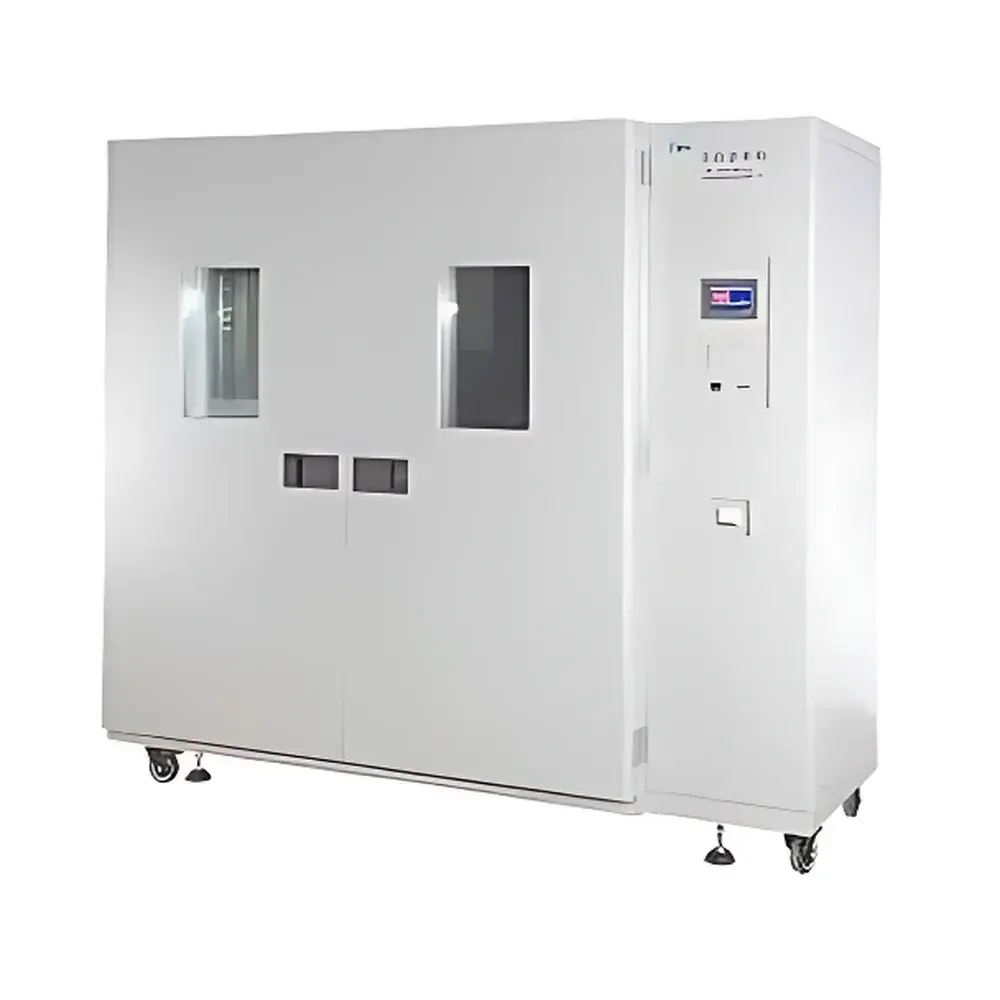
Yi Heng LRH-F Series Large-Capacity Biochemical Incubators with Multi-Stage Programmable LCD Controller
| Brand | Yi Heng (Shanghai Yi Heng) |
|---|---|
| Model | LRH-800F / LRH-1000F / LRH-1500F |
| Origin | Shanghai, China |
| Temperature Range | 0–60 °C |
| Temperature Resolution | 0.1 °C |
| Temperature Uniformity | ±2.5 °C (at 25 °C) |
| Temperature Fluctuation | ±0.5 °C (high-temp), ±1.0 °C (low-temp) |
| Power Supply | AC 220 V / 50 Hz (LRH-800F, LRH-1000F), AC 380 V / 50 Hz (LRH-1500F) |
| Input Power | 4100 W (LRH-800F/LRH-1000F), 5000 W (LRH-1500F) |
| Internal Dimensions (W×D×H, mm) | 800×590×1650 (LRH-800F), 1050×590×1650 (LRH-1000F), 1550×590×1650 (LRH-1500F) |
| Standard Shelving | 3 adjustable stainless-steel shelves |
| Timer Range | 0–9999 min |
| Refrigerant | R134a |
| Compliance | Designed for GLP-aligned laboratory workflows |
Overview
The Yi Heng LRH-F Series Large-Capacity Biochemical Incubators are engineered for precise, stable, and programmable temperature control in demanding life science applications. These units operate on a forced-air convection principle with microprocessor-regulated refrigeration and heating circuits, enabling accurate thermal management across a wide operational range (0–60 °C). The system integrates an eco-friendly R134a refrigerant cycle paired with an internationally certified compressor, delivering enhanced cooling efficiency—reducing cooldown time by over 40% compared to legacy low-temperature incubators—while maintaining low acoustic emissions (<55 dB(A) at 1 m) and extended service life. Designed for uninterrupted operation in regulated environments, the LRH-F platform meets foundational requirements for BOD analysis, microbial cultivation, cell-based assays, and long-term biological sample preservation under controlled ambient conditions.
Key Features
- Mirror-finish stainless-steel interior chamber with seamless, radius-corner construction for optimal cleanability and corrosion resistance—compliant with ISO 14644-1 Class 7 cleanroom-compatible maintenance protocols.
- Multi-stage programmable LCD controller supporting up to 30 user-defined segments; each segment allows independent configuration of target temperature, ramp rate, dwell time (1–9999 minutes), and fan speed profile.
- Intelligent adaptive airflow control: fan speed dynamically modulates based on real-time thermal load and setpoint proximity—reducing turbulence during sensitive culture phases while ensuring uniform heat distribution (±2.5 °C at 25 °C).
- Dual safety architecture: independent mechanical high-limit thermostat backed by digital PID-based overtemperature detection—both trigger audible/visual alarms and automatic power cutoff to prevent thermal runaway or sample loss.
- Modular I/O interface: standard RS-485 port (Modbus RTU protocol), optional USB data export via removable flash drive, and configurable analog/digital printer output for audit-ready temperature traceability.
- Energy-optimized thermal design: optimized insulation thickness, low-emissivity inner door seal, and compressor duty-cycle modulation reduce average power consumption by ~18% versus non-PID-controlled equivalents (per IEC 62304 Annex C test conditions).
Sample Compatibility & Compliance
The LRH-F Series accommodates diverse biological sample formats—including Petri dishes, multiwell plates, Erlenmeyer flasks, serum bottles, and tissue culture vessels—across volumetric capacities from 800 L to 1500 L. Chamber geometry permits vertical stacking of standard ISO 8655-compliant glassware without airflow obstruction. Units are validated for use in environmental monitoring per EPA Method 1604 (total coliform enumeration), CLSI M22-A3 (microbial growth support), and ISO 20387:2018 (biobanking infrastructure). While not FDA 21 CFR Part 11–certified out-of-the-box, the controller’s timestamped event log (with user ID tagging when integrated with external LIMS) supports ALCOA+ data integrity principles for GLP/GMP-aligned laboratories.
Software & Data Management
The embedded controller firmware stores full-cycle temperature history with 1-second sampling resolution (buffered for ≥72 hours). Exported CSV files include ISO 8601-formatted timestamps, setpoint/actual temperature pairs, fan status, alarm events, and user-initiated parameter changes. When connected to a host PC via RS-485 or USB, third-party SCADA platforms (e.g., Ignition SCADA, LabVIEW DAQmx) can ingest real-time Modbus registers for centralized monitoring. Optional software packages provide automated report generation aligned with ISO/IEC 17025 clause 7.7 (result reporting) and support electronic signature capture for SOP-compliant workflow execution.
Applications
- Biochemical Oxygen Demand (BOD5) testing per APHA Standard Methods 5210B and ASTM D5210.
- Cultivation of mesophilic bacteria (e.g., Escherichia coli, Staphylococcus aureus), fungi (Aspergillus niger), and yeasts under ISO 7218 microbiological guidelines.
- Seed germination and plant tissue culture requiring diurnal temperature cycling (e.g., 20 °C day / 15 °C night profiles).
- Stability studies for pharmaceutical excipients and diagnostic reagents per ICH Q1A(R2) guidelines.
- Environmental simulation for aquatic toxicology assays (OECD 201, 210) where precise thermal control directly impacts metabolic rate endpoints.
FAQ
What is the minimum ambient temperature required for stable operation?
The unit requires an ambient environment between +5 °C and +30 °C. Operation below +5 °C may impair refrigerant cycle efficiency and compromise temperature uniformity.
Can the incubator maintain temperatures below 0 °C?
No. The LRH-F series is rated for 0–60 °C only. For sub-zero capability, consider the LRH-L series (–10 to 60 °C), which employs enhanced compressor staging and dual evaporator design.
Is validation documentation provided with shipment?
Factory-installed IQ/OQ documentation templates (in English) are included. Full PQ support—including calibrated probe placement maps and uncertainty budgets—is available upon request through Yi Heng’s global service network.
How is temperature uniformity verified during installation qualification?
Per ISO 14644-3 Annex B, nine-point mapping (center + eight corners at mid-height) using NIST-traceable Class A PT100 sensors is recommended. Deviation must remain within ±2.5 °C at nominal setpoint (25 °C).
Does the controller support password-protected parameter modification?
Yes. Three-tier access control (Operator / Supervisor / Administrator) restricts editing of calibration offsets, alarm thresholds, and program memory—enabling role-based compliance with 21 CFR Part 11 §11.10(d).




