
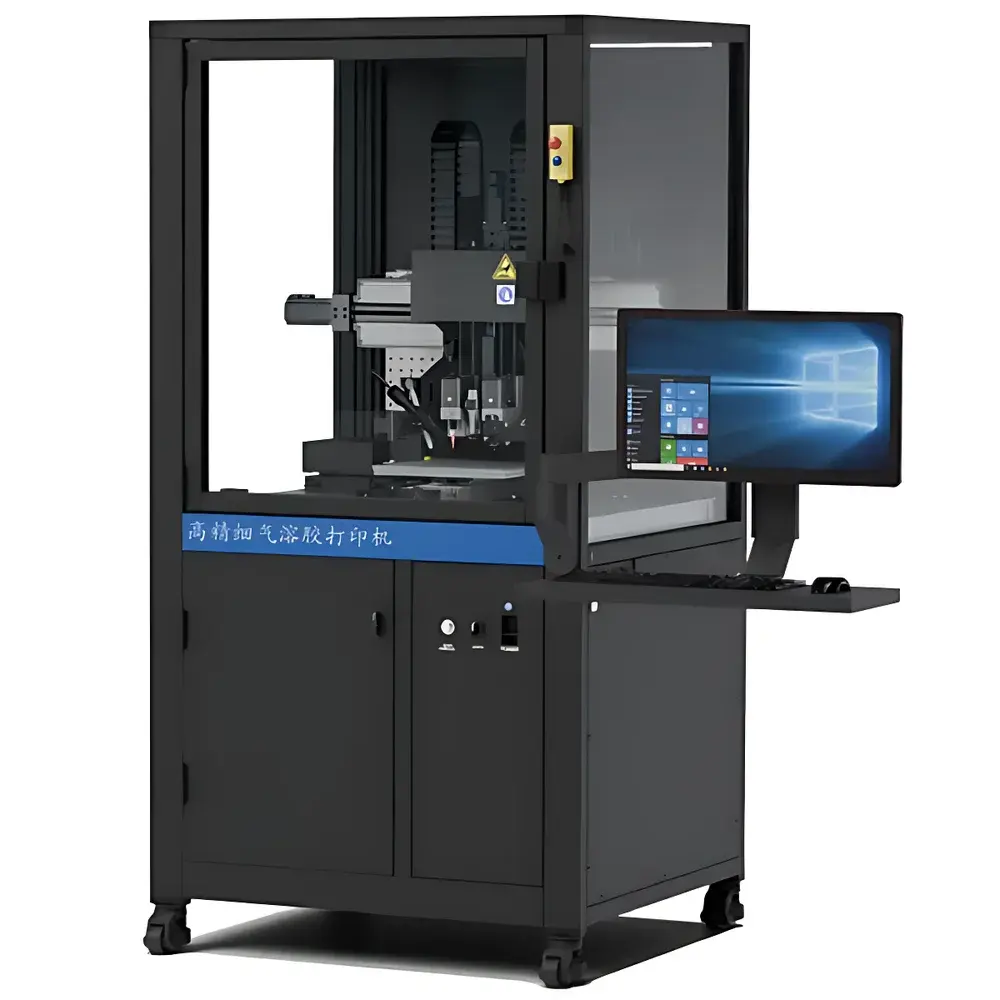
Yi Xin Technology Aerosol Jet Printing System
| Brand | Yi Xin Technology |
|---|---|
| Origin | Beijing, China |
| Manufacturer Type | Authorized Distributor |
| Country of Origin | China |
| Model | Aerosol Printing |
| Pricing | Available Upon Request |
Overview
The Yi Xin Technology Aerosol Jet Printing System is a precision additive manufacturing platform engineered for functional microscale deposition in research and pilot-scale production environments. Unlike conventional inkjet or extrusion-based 3D printers, this system employs aerosol jetting—a collimated stream of charged droplets generated via pneumatic atomization and aerodynamic focusing—to achieve non-contact, high-resolution patterning of functional materials onto planar and conformal substrates. The core principle relies on the generation of a stable aerosol from liquid or colloidal precursors (e.g., metal nanoparticle inks, conductive polymers, dielectric pastes, or bio-inks), followed by carrier gas acceleration and laminar flow focusing through a concentric sheath gas nozzle. This enables sub-50 µm feature resolution with excellent edge definition, minimal coffee-ring effect, and consistent film thickness control across heterogeneous topographies—including curved, textured, or temperature-sensitive surfaces.
Key Features
- Sub-10 µm minimum printable line width under optimized process conditions, validated using silver nanoparticle inks on glass and polyimide substrates
- Multi-material compatibility: supports aqueous and organic solvent-based inks, nanocolloids (1–100 nm), microparticles (up to 5 µm), 2D flakes (e.g., graphene, MXenes), and viscous suspensions (up to 1000 cP)
- Modular architecture with optional large-area coating module—enabling uniform deposition over substrates up to 300 × 300 mm² with automated Z-axis compensation
- Integrated real-time particle concentration monitoring and closed-loop aerosol flow stabilization for inter-run reproducibility
- Programmable XYZθZ-stage with ±0.5 µm positional repeatability and thermal drift compensation (operating range: 20–80 °C substrate temperature)
- Industrial-grade motion controller synchronized with aerosol pulse modulation (1–1000 Hz) for precise material dosage control per voxel
Sample Compatibility & Compliance
The system accommodates rigid (Si wafers, ceramics, glass), flexible (PET, PI, PDMS), and biodegradable (PLA, chitosan films) substrates without requiring vacuum clamping or surface priming. It supports direct printing on pre-patterned devices, including CMOS wafers and MEMS sensors. In terms of regulatory alignment, the hardware design and software logging architecture are structured to support GLP-compliant documentation workflows. While not certified as a medical device or GMP production tool, its data integrity features—including timestamped parameter logs, user-access audit trails, and exportable CSV/JSON metadata—facilitate traceability for R&D reporting and technology transfer to ISO 13485 or IEC 62304-aligned environments. All electrical components comply with CE/EMC Directive 2014/30/EU and RoHS 2011/65/EU standards.
Software & Data Management
Control is managed via AerosolPrint Studio—a Windows-based application supporting CAD import (DXF, GDSII, SVG), raster-to-vector path optimization, multi-layer registration alignment, and parametric script execution (Python API available). The software includes built-in calibration routines for nozzle offset, aerosol density mapping, and substrate height profiling using integrated capacitive sensors. All print jobs generate immutable log files containing environmental conditions (ambient RH/T), aerosol generator settings, stage trajectory data, and real-time pressure/flow telemetry. Export formats include HDF5 for scientific analysis and standardized XML schemas compatible with LIMS integration. For regulated environments, optional 21 CFR Part 11 compliance packages provide electronic signature enforcement, role-based access control, and audit trail archiving with SHA-256 hash verification.
Applications
- Flexible hybrid electronics: antenna traces, stretchable interconnects, and thin-film transistor electrodes
- Wearable biosensors: dry-electrode arrays for EEG/ECG, enzymatic glucose sensing layers, and impedance spectroscopy microelectrodes
- Advanced packaging: redistribution layers (RDL), under-bump metallization (UBM), and fan-out wafer-level packaging (FOWLP) prototyping
- Energy devices: patterned catalyst layers for PEM fuel cells, solid-state battery current collectors, and perovskite solar cell charge transport layers
- Microfluidics & lab-on-chip: embedded electrodes, resistive heating elements, and localized surface functionalization
- Aerospace & defense: conformal EMI shielding patterns on composite airframes and radiation-hardened sensor interposers
FAQ
What types of inks are compatible with this system?
A wide range of commercially available and custom-formulated inks can be used—including metal nanoparticle dispersions (Ag, Cu, Au), conductive polymers (PEDOT:PSS), dielectrics (SiO₂, Al₂O₃ sol-gels), semiconductors (ZnO, perovskites), and hydrogels. Viscosity must remain below 1000 cP; particle size distribution should be <10% D90 > 5 µm to avoid nozzle clogging.
Is vacuum required during operation?
No. The system operates at ambient pressure and does not require vacuum chambers or inert gloveboxes—though optional N₂ purge integration is available for oxygen/moisture-sensitive inks.
Can it print on curved or 3D surfaces?
Yes. With optional laser triangulation height mapping and dynamic Z-compensation, the system achieves consistent focus and material delivery on substrates with radii of curvature down to 5 mm.
What is the typical maintenance schedule?
Daily nozzle purging and weekly aerosol generator cleaning are recommended. Full calibration (nozzle alignment, flow sensor validation) is advised every 200 operational hours or quarterly, whichever occurs first.
Does the system support multi-nozzle configurations?
The standard configuration uses a single focused nozzle. Dual-nozzle modules (for simultaneous conductive/dielectric printing) are available as factory-installed options with independent fluidic control paths.



