
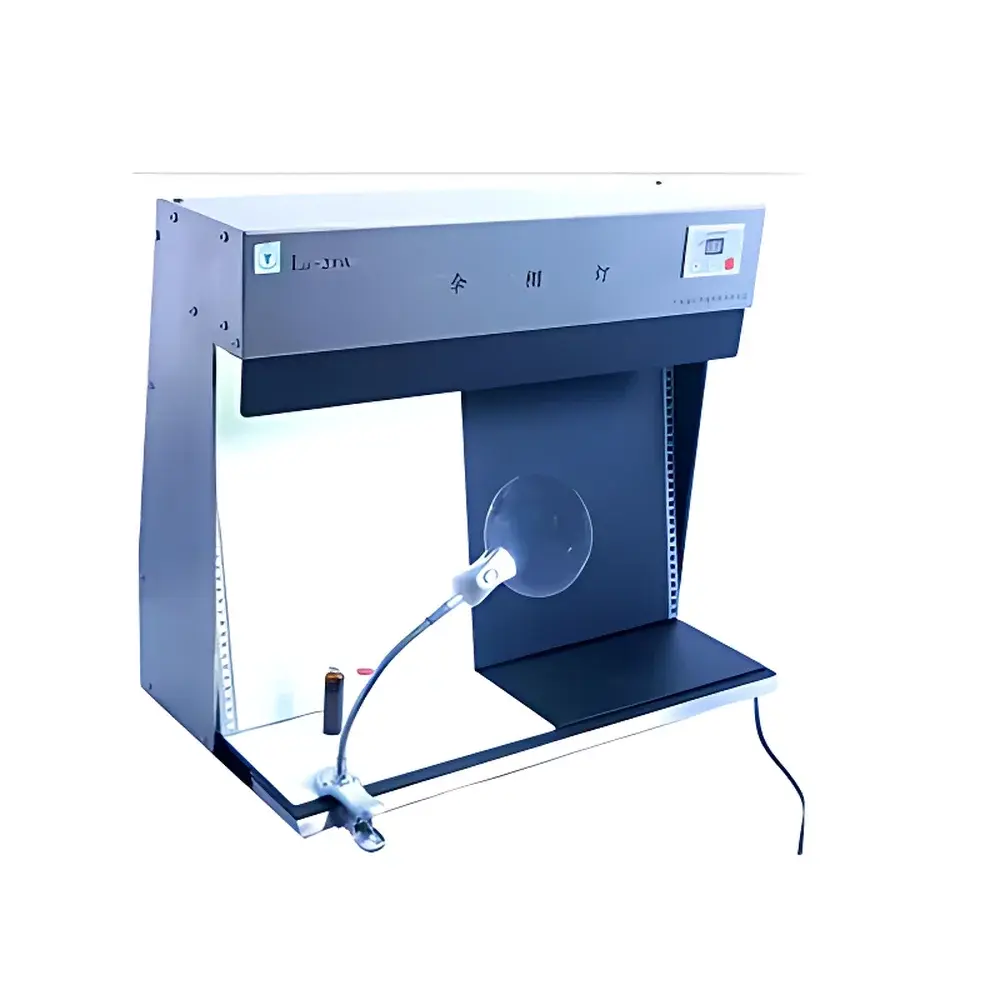
Yinhuang Technology Lu-200A Visible Particulate Inspection Canopy Lamp (USP <790>, EP 2.9.20, ChP 0904 Compliant)
| Brand | Yinhuang Technology |
|---|---|
| Origin | Beijing, China |
| Manufacturer Type | Direct Manufacturer |
| Origin Category | Domestic (China-made) |
| Model | Lu-200A |
| Price Range | USD 2,800 – 7,000 |
| Light Source | High-power white LED array (250 mm × 10 mm × 4 pcs) |
| Color Temperature | 6000–6500 K |
| Illuminance Range | 0–10,000 lx (centered measurement point) |
| Power Consumption | 40 W |
| Magnifier Diameter | 110 mm |
| Magnification | 2.5× |
| Input Voltage/Frequency | 220 V AC / 50 Hz |
| Dimensions (L×H×D) | 560 × 490 × 250 mm |
| Weight | 10 kg |
| Housing Material | Brushed 304 stainless steel |
| Background Panels | Dual-side matte-finish PVC (black/white), calibrated scale-integrated, motorized longitudinal adjustment |
| Optical Design | Diffuse-reflection LED canopy with cylindrical light band geometry (semi-cylindrical illumination zone), digitally controlled illuminance regulation |
| Viewing Distance | Fixed 250 mm eye-to-sample working distance |
Overview
The Yinhuang Technology Lu-200A Visible Particulate Inspection Canopy Lamp is an engineered solution for manual visual inspection of suspended particles in parenteral preparations, ophthalmic solutions, and biologics—strictly aligned with pharmacopoeial requirements including Chinese Pharmacopoeia (ChP) General Chapter 0904, United States Pharmacopeia (USP) <790>, European Pharmacopoeia (EP) 2.9.20, Japanese Pharmacopoeia (JP) 6.07, and WHO TRS Annex 9. It operates on the principle of controlled, multidirectional diffuse illumination to enhance contrast and eliminate shadow artifacts during naked-eye examination. Unlike conventional benchtop lamps, the Lu-200A employs a semi-cylindrical LED light band (250 mm × 10 mm × 4 units) mounted above a dual-background stage, generating uniform vertical irradiance across the observation plane. This optical architecture ensures that particles sized 50–500 µm—particularly low-contrast colored or translucent particulates in clear glass vials or plastic syringes—are rendered with enhanced three-dimensional spatial definition against either black or white matte backgrounds. The fixed 250 mm viewing distance complies with ISO 14644-1 and GMP ergonomic guidelines for consistent operator posture and reproducible detection sensitivity.
Key Features
- Pharmacopoeia-compliant illumination system delivering 0–10,000 lx adjustable illuminance (measured at center point), certified per ChP 0904, USP <790>, and EP 2.9.20 photometric protocols
- Semi-cylindrical diffuse LED canopy with 6000–6500 K correlated color temperature, engineered to minimize glare and chromatic aberration while maximizing spectral uniformity
- Dual-sided matte-finish PVC background panels (black and white), each embedded with precision-calibrated linear scales (±0.5 mm accuracy) and synchronized longitudinal translation mechanism for repeatable sample positioning
- Integrated 110 mm diameter, 2.5× achromatic magnifier with anti-reflective coating—mounted on a height-adjustable cantilever arm to reduce ocular strain during extended inspection shifts
- Brushed 304 stainless steel chassis with IP54-rated enclosure, corrosion-resistant hardware, and ESD-safe surface finish suitable for ISO Class 5–8 cleanroom environments
- Digital illuminance control via microprocessor-based circuitry; no mechanical dimmers or thermal drift; LED lifetime rated ≥50,000 hours at nominal output
Sample Compatibility & Compliance
The Lu-200A accommodates standard pharmaceutical containers up to 100 mL volume, including Type I borosilicate glass vials (2R–20R), pre-filled syringes (1–5 mL), ampoules, and blow-fill-seal (BFS) containers. Its stage design supports upright, inverted, and tilted orientations (±15°) to facilitate particle mobilization under gravity. All optical and mechanical specifications conform to regulatory expectations for manual visible particulate inspection under Good Manufacturing Practice (GMP) and Good Laboratory Practice (GLP) frameworks. The instrument satisfies audit readiness requirements for FDA 21 CFR Part 11 (when used with documented SOPs and operator training records), EU Annex 11, and PIC/S PI 007-6. Calibration traceability is maintained through annual verification against NIST-traceable lux meters and chromaticity analyzers per ISO/IEC 17025-accredited procedures.
Software & Data Management
As a manually operated optical inspection device, the Lu-200A does not incorporate embedded software or digital data capture. However, it is fully compatible with external laboratory information management systems (LIMS) and electronic batch record (EBR) platforms via standardized documentation workflows. Users may integrate the instrument into structured inspection protocols that include: (i) pre-defined acceptance criteria per USP <790> Section 5.3, (ii) operator qualification logs, (iii) daily illuminance verification records (with timestamped lux meter readings), and (iv) deviation tracking per ICH Q9 principles. Optional accessories—including calibrated reference particle slides (ISO 11171-certified polystyrene microspheres) and digital lux loggers—enable automated calibration history archiving compliant with 21 CFR Part 11 audit trails when paired with validated CSV files.
Applications
- Final container inspection of sterile injectables, monoclonal antibodies, mRNA-LNPs, and viral vector therapeutics
- Stability study monitoring for visible particulate formation under accelerated and real-time storage conditions
- In-process checks during filling line interventions or stopper crimping validation
- Root cause analysis of filter integrity failures or leachables-related haze formation
- Educational use in QC training programs for new analysts performing ChP 0904-compliant visual inspection
- Comparative evaluation of container-closure system compatibility (e.g., silicone oil migration, glass delamination)
FAQ
Does the Lu-200A meet USP <790> and EP 2.9.20 illuminance uniformity requirements?
Yes—the semi-cylindrical LED canopy achieves ≤±15% illuminance variation across the 150 mm × 150 mm central inspection zone, verified per USP <790> Section 4.2 and EP 2.9.20 Annex 1.
Can the background panels be replaced with custom colors or textures?
No—only factory-supplied black and white matte PVC panels are validated for compliance; third-party substitutions void regulatory conformance claims.
Is routine calibration required, and what documentation is provided?
An initial factory calibration certificate (traceable to CNAS-accredited standards) is included; annual recalibration by authorized service centers is recommended and documented using Form LU-CAL-01.
What maintenance intervals are specified for the LED array and magnifier optics?
LED output stability is verified quarterly using a handheld lux meter; magnifier lenses require weekly cleaning with isopropyl alcohol and lint-free wipes per SOP-LU-MNT-03.
Does the instrument support integration with automated vision systems?
While standalone, the Lu-200A’s mechanical footprint and stage geometry are designed to accommodate third-party camera mounts (e.g., USB3 machine vision modules) for hybrid manual/automated workflows—subject to user validation.
Related Products







