
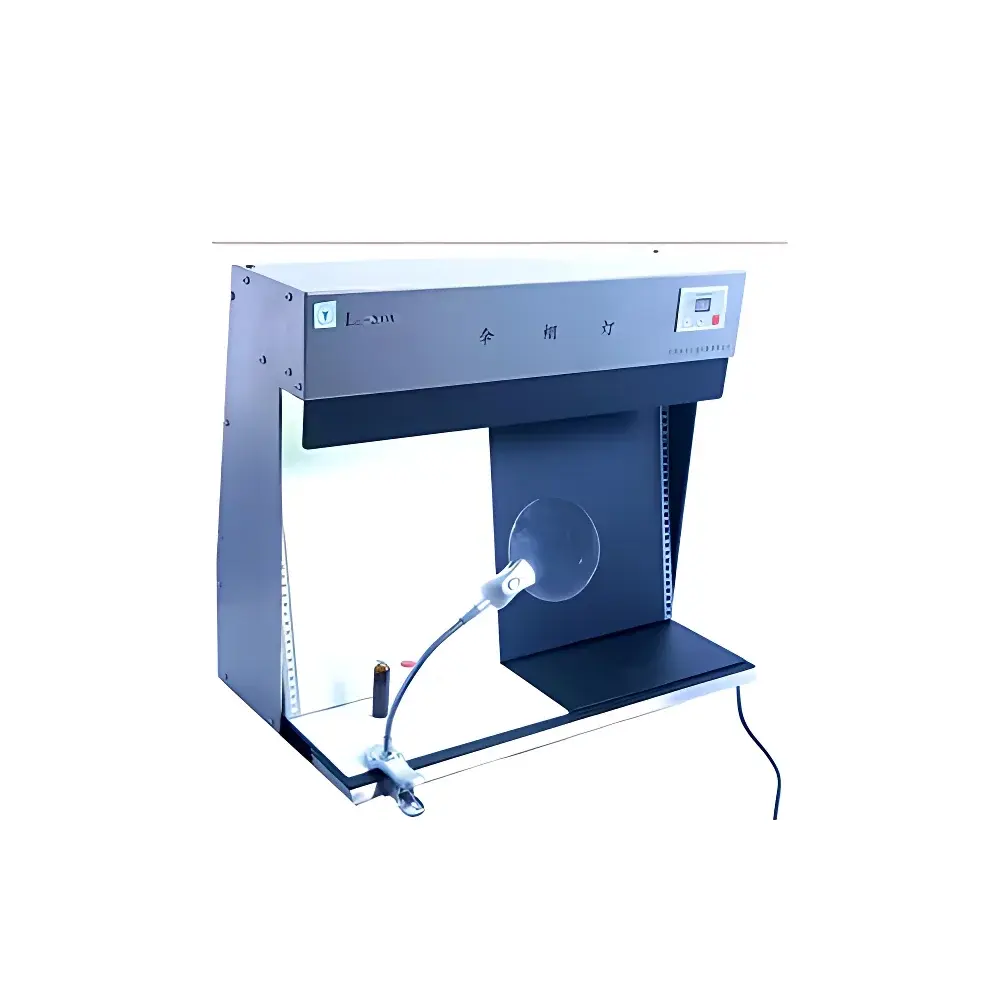
Yinhuang Technology Lu-200A Visual Particulate Inspection Hood Lamp
| Brand | Yinhuang Technology |
|---|---|
| Origin | Shanghai, China |
| Manufacturer Type | Direct Manufacturer |
| Country of Origin | China |
| Model | Lu-200A |
| Price Range | USD 2,800 – 7,000 |
| Light Source | High-power white LED array (250 mm × 10 mm × 4) |
| Color Temperature | 6000–6500 K |
| Illuminance Range | 0–10,000 lx (centered measurement point) |
| Power Consumption | 40 W |
| Magnifier Diameter | 110 mm |
| Magnification | 2.5× |
| Input Voltage/Frequency | 220 V / 50 Hz |
| Dimensions (L×H×D) | 560 × 490 × 250 mm |
| Weight | 10 kg |
| Housing Material | Brushed 304 stainless steel |
| Background Panels | Dual-side matte-finish black/white PVC diffusers with integrated scale markings |
| Adjustable Stage | Motor-free manual linear translation (front–back), synchronized with background panels |
| Optical Design | Diffuse-reflection LED ceiling module generating vertically oriented, uniform luminous band |
| Illuminance Control | Digital microcontroller-based dimming circuitry |
Overview
The Yinhuang Technology Lu-200A Visual Particulate Inspection Hood Lamp is a purpose-built optical inspection station engineered for manual visual detection of subvisible and visible particulates in parenteral pharmaceutical preparations—primarily injectables, biologics, vaccines, and ophthalmic solutions. Designed in strict compliance with the visual inspection methodology outlined in Chinese Pharmacopoeia (ChP) General Chapter 0904 (2020 Edition, Volume III), the device also satisfies illumination and ergonomics requirements specified in United States Pharmacopeia (USP) <790>, European Pharmacopoeia (Ph. Eur.) 2.9.20, Japanese Pharmacopoeia (JP) 6.07, and WHO Technical Report Series No. 992 Annex 6. Its core optical architecture employs a diffuse-reflection illumination principle: a high-luminance, color-stable white LED array (6000–6500 K CCT) is mounted on the top panel and optically conditioned through a custom-engineered light-diffusing layer to generate a vertically collimated, spatially uniform luminous band. This geometry eliminates directional shadowing and enhances contrast sensitivity across all viewing angles—critical for resolving translucent or low-contrast particles ranging from 50 µm to 500 µm against both black and white backgrounds.
Key Features
- Optimized optical path: 250 mm fixed eye-to-sample working distance ensures consistent magnification and depth-of-field alignment per pharmacopoeial guidance.
- Dual-background system: Interchangeable matte-finish black and white PVC diffuser panels with embedded metric scale rulers (0–100 mm) support standardized orientation and size estimation during particle assessment.
- Adjustable observation stage: Manually actuated front–back translation mechanism synchronizes background panel movement with sample platform, enabling precise positioning without mechanical backlash or motorized complexity.
- Integrated 2.5× wide-field magnifier: 110 mm aperture achromatic lens reduces ocular strain during prolonged inspections and maintains edge-to-edge clarity across the entire field of view.
- Digital illuminance control: Microprocessor-regulated dimming circuit enables stepless adjustment from 0 to >10,000 lx at the central inspection zone—exceeding minimum requirements of USP <790> (≥2000 lx) and Ph. Eur. 2.9.20 (≥3750 lx).
- Robust industrial construction: All structural components fabricated from brushed 304 stainless steel; corrosion-resistant, non-shedding, and compatible with cleanroom-grade disinfectants (e.g., 70% IPA, hydrogen peroxide vapor).
Sample Compatibility & Compliance
The Lu-200A accommodates standard pharmaceutical containers including 2R–30R glass vials, syringes (1–20 mL), ampoules, pre-filled pens, and IV bags (up to 1 L). Its open-top hood design permits unobstructed access for manual manipulation and rotational examination under controlled lighting. The system meets ISO 14644-1 Class 5 (ISO Class 5) compatibility when operated within laminar flow cabinets or isolators. Instrument qualification documentation supports IQ/OQ protocols aligned with FDA 21 CFR Part 11 and EU Annex 11 requirements. Calibration traceability is maintained via NIST-traceable lux meter verification reports, provided upon request. Routine performance checks comply with ChP 0904 procedural validation criteria—including uniformity mapping (±15% deviation across 100 mm² central zone) and spectral stability testing (Δu’v’ ≤ 0.003 over 10,000 h LED lifetime).
Software & Data Management
As a manually operated optical inspection device, the Lu-200A does not incorporate embedded software or digital data acquisition. However, its design facilitates integration into enterprise quality management systems (QMS) through standardized documentation workflows. Users may record inspection parameters—including illuminance setting, background selection, magnifier usage, and observed particle count/size—within paper-based or electronic batch records compliant with ALCOA+ principles. Optional accessories include calibrated photometric logbooks and GxP-compliant inspection checklists aligned with ICH Q5C and Q5A guidelines for biological product characterization.
Applications
- Final container inspection of sterile injectables prior to release (ChP 0904, USP <790>)
- Comparative analysis of visible particulates across different packaging formats (glass vs. polymer)
- Root cause investigation of filtration breakthrough or leachables-induced haze
- Visual assessment of lyophilized cake integrity and reconstitution clarity
- Training and competency evaluation of QC personnel in particle recognition proficiency
- Supporting method transfer studies between manufacturing sites operating under divergent pharmacopoeial frameworks
FAQ
Does the Lu-200A meet FDA requirements for visible particulate inspection?
Yes—the device satisfies the illumination intensity, background contrast, and ergonomic specifications referenced in FDA Guidance for Industry: Visible Particulate Inspection of Injectable Products (2022), and supports compliance with CGMP regulations under 21 CFR Parts 210 and 211.
Is calibration service available for the built-in illuminance control?
While the unit itself does not require periodic recalibration, Yinhuang Technology provides optional annual verification using a NIST-traceable handheld lux meter (model LX1330B), with full report generation and uncertainty budgeting.
Can the Lu-200A be used in Grade A environments?
Yes—its stainless-steel housing, absence of moving parts or internal electronics beyond the LED driver, and smooth non-porous surfaces allow safe operation inside ISO 5 laminar flow hoods or RABS configurations when cleaned per site-specific SOPs.
What maintenance is required for long-term performance?
Routine cleaning of the magnifier lens and background panels with lint-free wipes and 70% isopropyl alcohol; annual visual inspection of LED output uniformity and electrical safety testing per IEC 61010-1.
Is there an option for dual-voltage input (110 V / 220 V)?
Standard units are configured for 220 V / 50 Hz operation; 110 V / 60 Hz variants are available upon special order with modified power supply modules and regional safety certifications (UL/cUL, PSE).





