YK100400 Miniature Pitot-Static-AOA-AOS Sensor System
| Brand | — |
|---|---|
| Origin | Beijing, China |
| Manufacturer Type | Authorized Distributor |
| Country of Origin | China |
| Model | YK100400 |
| Pricing | Upon Request |
| Dimensions (L × Ø) | 30 in (762 mm) × 3 in (76 mm) |
| Mass | 6 oz (170 g) |
| Max Calibrated Equivalent Airspeed | ≥340 kt |
| Output Signals | Total Pressure, Static Pressure, Angle of Attack (AOA), Angle of Sideslip (AOS) |
| Heating Option | Optional Total/Static Pressure Ports |
| Typical Platform Class | UAVs, RC Aircraft, Light-Sport Aircraft (LSA), Research Vehicles, Automotive Aerodynamics Test Rigs, Railway Boundary Layer Studies |
Overview
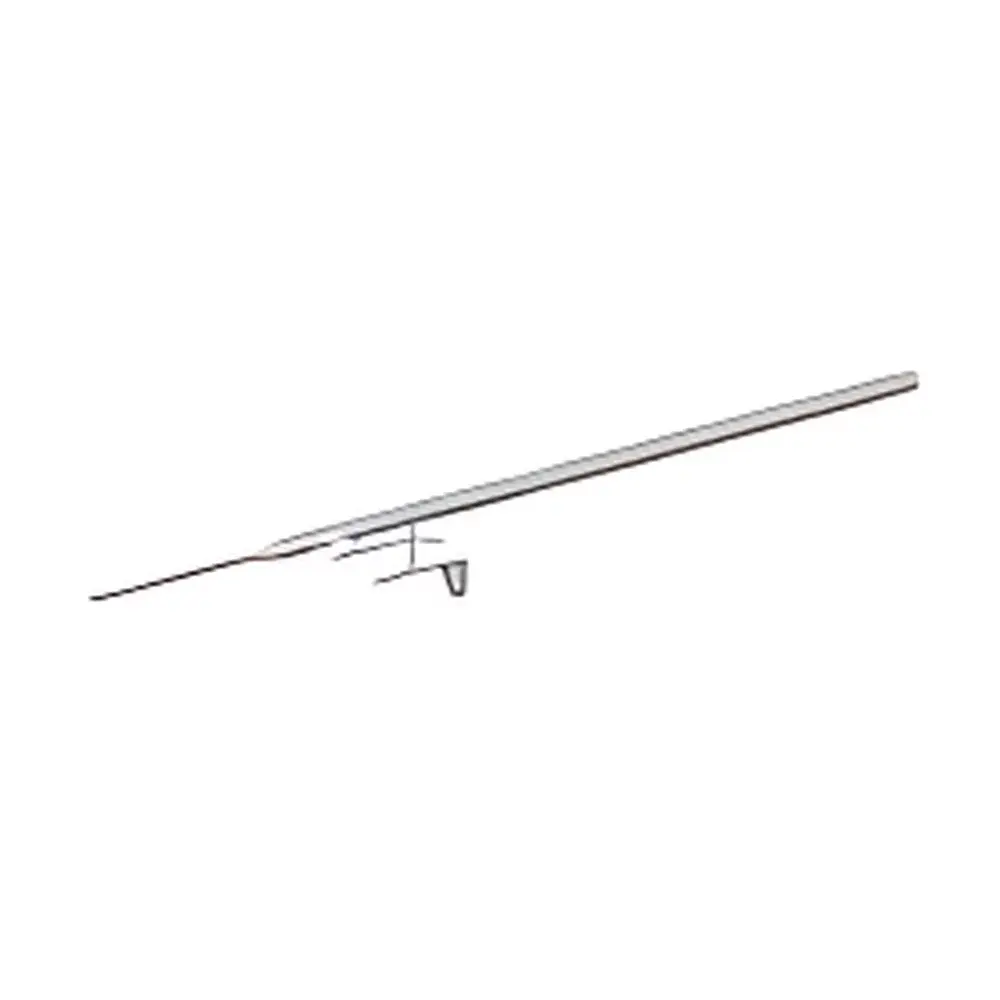
The YK100400 Miniature Pitot-Static-AOA-AOS Sensor System is an integrated aerodynamic probe engineered for high-fidelity, multi-parameter air data acquisition in space-, weight-, and power-constrained platforms. Based on classical pitot-static measurement principles combined with precision dual-axis angular transduction, the system simultaneously outputs total pressure (Pt), static pressure (Ps), angle of attack (AOA), and angle of sideslip (AOS) — all referenced to a common mechanical datum and thermally stabilized mounting interface. Its compact cylindrical form factor (762 mm × 76 mm) and low mass (170 g) enable flush or semi-flush installation on wing leading edges, fuselage stations, or pod-mounted test fixtures without inducing significant flow distortion. The probe operates across a calibrated equivalent airspeed range up to and exceeding 340 knots, making it suitable for subsonic flight regimes typical of unmanned aerial systems (UAS), light-sport aircraft (LSA), and ground-based aerodynamic validation platforms.
Key Features
- Integrated four-parameter output: Pt, Ps, AOA (±30° full scale), and AOS (±20° full scale) — all synchronized and time-aligned via internal sampling clock
- Modular pressure port configuration: total and static ports are optionally available with integrated resistive heating elements (12–28 VDC input) to mitigate ice accretion during low-temperature operations
- Hermetically sealed stainless-steel pressure sensing elements with temperature-compensated piezoresistive bridges, rated for long-term stability under cyclic thermal and vibrational loads
- Low-power analog/digital hybrid output: standard 0–5 VDC or 0–10 VDC for pressure channels; ±5 VDC differential for AOA/AOS; optional RS-422 or CAN 2.0B digital interface with configurable update rates (up to 200 Hz)
- Robust mechanical architecture: anodized aluminum housing with IP65-rated environmental sealing; operational temperature range: −40°C to +85°C
- Traceable calibration documentation provided per NIST-traceable standards; individual probe calibration certificates include pressure linearity, angular hysteresis, and cross-coupling error matrices
Sample Compatibility & Compliance
The YK100400 is compatible with fixed-wing and rotary-wing unmanned platforms where structural integration envelope is limited, including Class I and II UAS per ASTM F3322-22, as well as experimental LSA meeting FAA AC 90-109A guidance. It supports both steady-state and transient aerodynamic characterization in wind tunnel testing (per ISO 5167-2 for pressure tap placement compliance) and open-field flight test campaigns. While not certified to DO-160 or ETSI EN 300 328 by default, its electromagnetic compatibility (EMC) performance meets industrial-grade immunity thresholds (IEC 61000-4-2/3/4/6), and pressure channel accuracy complies with ISO 5167-4 Annex C uncertainty guidelines for pitot-static systems used in research applications. Data integrity protocols align with GLP-compliant test reporting requirements, supporting audit-ready traceability when paired with timestamped acquisition hardware.
Software & Data Management
The sensor system interfaces seamlessly with industry-standard data acquisition platforms including National Instruments CompactRIO, Dewesoft X, and MATLAB/Simulink Real-Time. Calibration coefficients are stored onboard in non-volatile memory and auto-loaded during initialization. Optional configuration software (Windows/Linux CLI/GUI) enables field adjustment of zero offsets, gain scaling, and digital filtering parameters (Butterworth low-pass, cutoff 50 Hz). All output channels support IEEE 1588 Precision Time Protocol (PTP) synchronization when integrated into distributed test networks. Raw and processed data streams may be exported in HDF5, CSV, or ASAM MDF 4.1 formats — fully compatible with post-processing workflows requiring DO-178B-compliant traceability or ISO/IEC 17025-accredited analysis pipelines.
Applications
- Flight control law development and validation for autonomous UAVs and eVTOL prototypes
- Wind tunnel model testing of high-lift configurations, morphing wings, and laminar flow control surfaces
- Ground vehicle aerodynamic coefficient extraction (CL, CD, Cm) using moving-model or stationary probe arrays
- Railway aerodynamic safety studies — crosswind stability assessment at platform edges and tunnel entries
- Academic aerodynamics laboratories requiring modular, repeatable air data instrumentation for student-led flight test projects
- Dynamic calibration of computational fluid dynamics (CFD) boundary conditions using high-temporal-resolution in-situ measurements
FAQ
Is the YK100400 compliant with aviation certification standards such as DO-160 or TSO-C106?
No — it is designed and validated for research, development, and non-certified platform use. Certification-ready variants require additional qualification testing and documentation.
Can the probe be mounted on composite airframes without thermal or galvanic concerns?
Yes — the housing is electrically isolated via ceramic-coated mounting flange; thermal expansion mismatch is mitigated through elastomeric interface gasketing.
What is the recommended static port location relative to the total head for minimal interference error?
Per ISO 5167-4, static ports should be positioned ≥5× probe diameter downstream of the total head centerline and aligned with local freestream static pressure recovery zones — detailed placement guidance is included in the installation manual.
Does the system support real-time AOA/AOS compensation for dynamic pressure calculations?
Yes — onboard signal conditioning applies real-time cosine corrections to Pt and Ps based on measured AOA/AOS, enabling direct computation of true airspeed and load factor components.
Are CAD models provided in neutral formats for integration into mechanical design workflows?
Yes — ACIS (.sat), STEP (.stp), and Parasolid (.x_t) files are supplied with purchase, including geometric tolerance annotations and fastener interface specifications.