
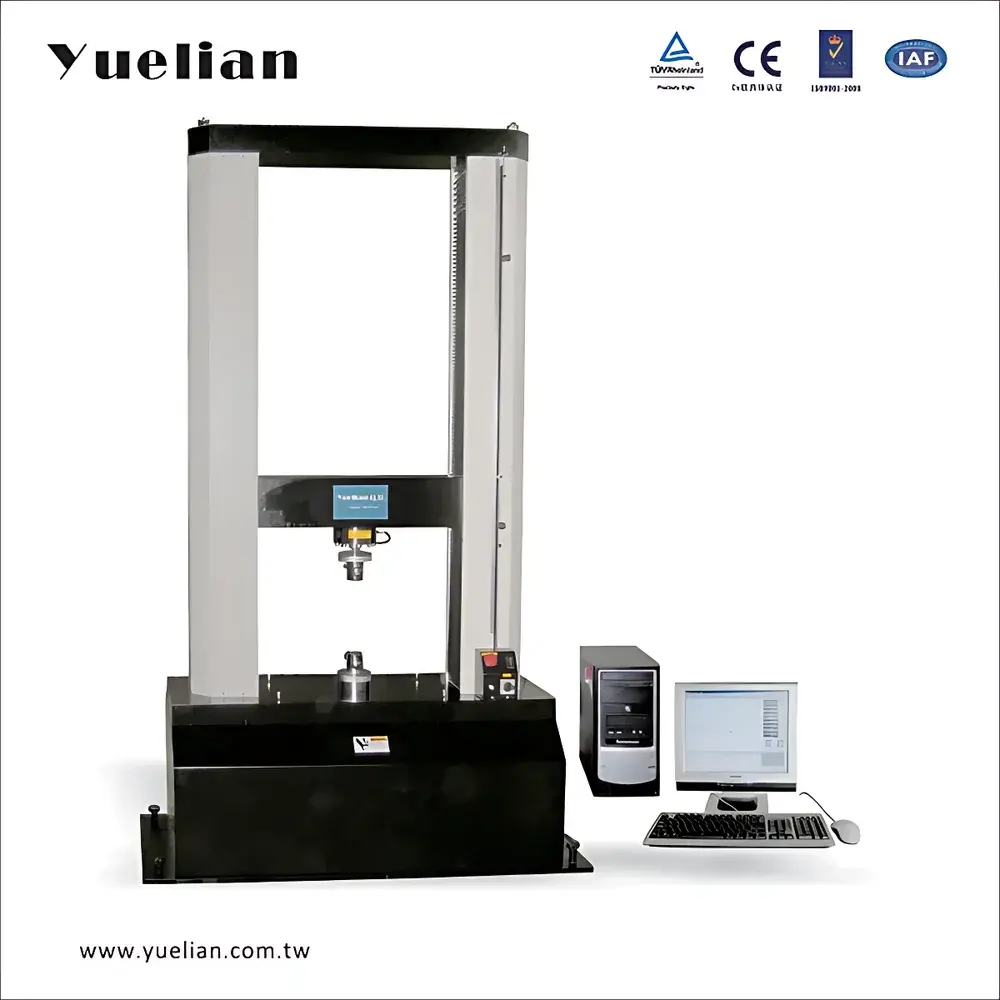
YL-1152 20-Ton Electronic Tensile Testing Machine (Yuelian)
| Brand | Yuelian |
|---|---|
| Origin | Guangdong, China |
| Manufacturer Type | Authorized Distributor |
| Country of Origin | China |
| Model | YL-1152 |
| Instrument Type | Electronic Universal Testing Machine |
| Load Capacity | 20 kN (20,000 N) |
| Force Resolution | 1/250,000 full scale |
| Force Accuracy | ≤ ±0.5% FS |
| Travel Resolution | 0.005 mm |
| Test Speed Range | 0.5–500 mm/min (PC-controlled) |
| Maximum Stroke | 1000 mm |
| Test Width | 550 mm |
| Drive System | Servo Motor + Precision Ball Screw |
| Power Supply | 220 V, 50/60 Hz, 10 A |
| Rated Power | 2500 W |
| Dimensions (W×D×H) | 108 × 85 × 205 cm |
| Weight | ~950 kg |
| Compliant Standards | ISO 7500-1, ASTM E4, EN 10002-1, GB/T 228.1, JJG 475, DIN 51221, JIS B7721/B7733, BS 1610 |
Overview
The YL-1152 20-Ton Electronic Tensile Testing Machine is a precision-engineered universal testing system designed for static mechanical characterization of metallic and non-metallic materials under uniaxial loading conditions. Based on the fundamental principles of Hooke’s Law and stress–strain continuum mechanics, the machine applies controlled tensile, compressive, flexural, shear, peel, tear, and adhesion forces to standardized specimens—enabling quantitative determination of mechanical properties including ultimate tensile strength (UTS), yield strength (YS), elongation at break, Young’s modulus, Poisson’s ratio, and proof stress. Its rigid C-frame architecture, high-stiffness ball-screw actuation, and closed-loop servo control ensure consistent load application and displacement tracking across extended test durations. The system is calibrated in accordance with ISO 7500-1 Class 1 accuracy requirements and validated against traceable national standards (JJG 475), making it suitable for accredited laboratory environments operating under ISO/IEC 17025 quality management systems.
Key Features
- High-resolution force measurement: 1/250,000 full-scale resolution with ≤ ±0.5% FS accuracy across the 20 kN capacity range
- Programmable crosshead speed: 0.5–500 mm/min, adjustable in real time via PC interface with ramp-hold-step profiling capability
- Integrated safety protocols: Overload cutoff, emergency stop button, automatic specimen rupture detection, upper/lower limit position stops, and motor-driven auto-return function
- Modular fixture compatibility: Standardized T-slot base plate supports interchangeable grips—including wedge-action, pneumatic, hydraulic, and custom-designed fixtures for bolts, fasteners, wires, and thin films
- Thermally stable structural frame: Heavy-duty steel construction (950 kg mass) minimizes vibration-induced noise and ensures long-term repeatability in multi-shift industrial QA/QC operations
- Full PC-based operation: Eliminates embedded controllers; all motion control, data acquisition, and real-time visualization occur via Windows-hosted software using USB 2.0 communication
Sample Compatibility & Compliance
The YL-1152 accommodates specimens ranging from miniature fasteners (M2–M24 metric screws, ASTM F606-compliant bolt assemblies) to sheet metal coupons (up to 550 mm wide), elastomeric strips, composite laminates, and polymer films. It supports standardized test geometries per ISO 6892-1 (tensile testing of metallic materials), ASTM D638 (plastics), ASTM D3039 (composites), ISO 1974 (tear resistance), and ISO 8510-2 (peel adhesion). All calibration certificates are issued with uncertainty budgets aligned to ISO/IEC 17025 requirements. The system meets essential safety and electromagnetic compatibility directives applicable to CE-marked laboratory equipment (EN 61000-6-2/-6-3, EN 61000-6-4), and its software architecture allows audit-ready configuration for GLP/GMP-regulated environments when deployed with appropriate documentation controls.
Software & Data Management
The proprietary test control software operates natively on Windows 10/11 platforms and interfaces directly with MS Access relational databases for structured storage of raw force–displacement records, metadata (operator ID, batch number, environmental conditions), and derived parameters (modulus, yield offset, fracture energy). It supports multi-sensor synchronization (e.g., extensometer, temperature probe, video extensometry input), real-time curve overlay, statistical batch analysis (mean, SD, CV%), and customizable report generation compliant with ASTM E122 and ISO 5725 guidelines. Export formats include CSV, PDF, XML, and image-based PNG/SVG plots. While not inherently 21 CFR Part 11-compliant out-of-the-box, the software permits integration with third-party electronic signature and audit trail modules to satisfy FDA-regulated material qualification workflows.
Applications
This system serves as a foundational instrument for mechanical validation across diverse sectors: automotive component suppliers performing bolt preload verification and thread engagement analysis; aerospace Tier-1 manufacturers conducting fastener fatigue pre-screening per SAE AMS2750; packaging R&D labs evaluating seal integrity and film tensile performance; wire-and-cable producers certifying conductor elongation per IEC 60228; and academic research groups studying strain-rate-dependent behavior of nanocomposites. Its dual-capacity option (e.g., 2 kN/20 kN) enables seamless transition between micro-scale fastener testing and macro-scale structural coupon evaluation without recalibration.
FAQ
What fastener types can be tested on the YL-1152?
Standard metric and imperial screws, bolts, nuts, rivets, and studs—up to M24 diameter—can be evaluated using dedicated wedge or vise-type grips configured for axial tension, proof load, or torque-tension correlation.
Is an extensometer supported?
Yes—the system provides analog and digital input channels compatible with clip-on, video, and laser extensometers for strain measurement independent of crosshead displacement.
Can test methods be saved and recalled?
All test configurations—including speed profiles, trigger conditions, calculation algorithms, and reporting templates—are stored as reusable method files with version timestamping and user access logging.
Does the machine support ASTM F606 testing for bolted joints?
It fully supports the mechanical test portions of ASTM F606 (proof load, tensile strength, yield strength) when used with certified fixtures and calibrated load cells traceable to NIST or equivalent NMIs.
What maintenance is required for long-term accuracy?
Annual recalibration of the load cell and displacement encoder is recommended; periodic inspection of ball screw lubrication, grip jaw wear, and alignment of the load train is advised per manufacturer’s preventive maintenance schedule.



