
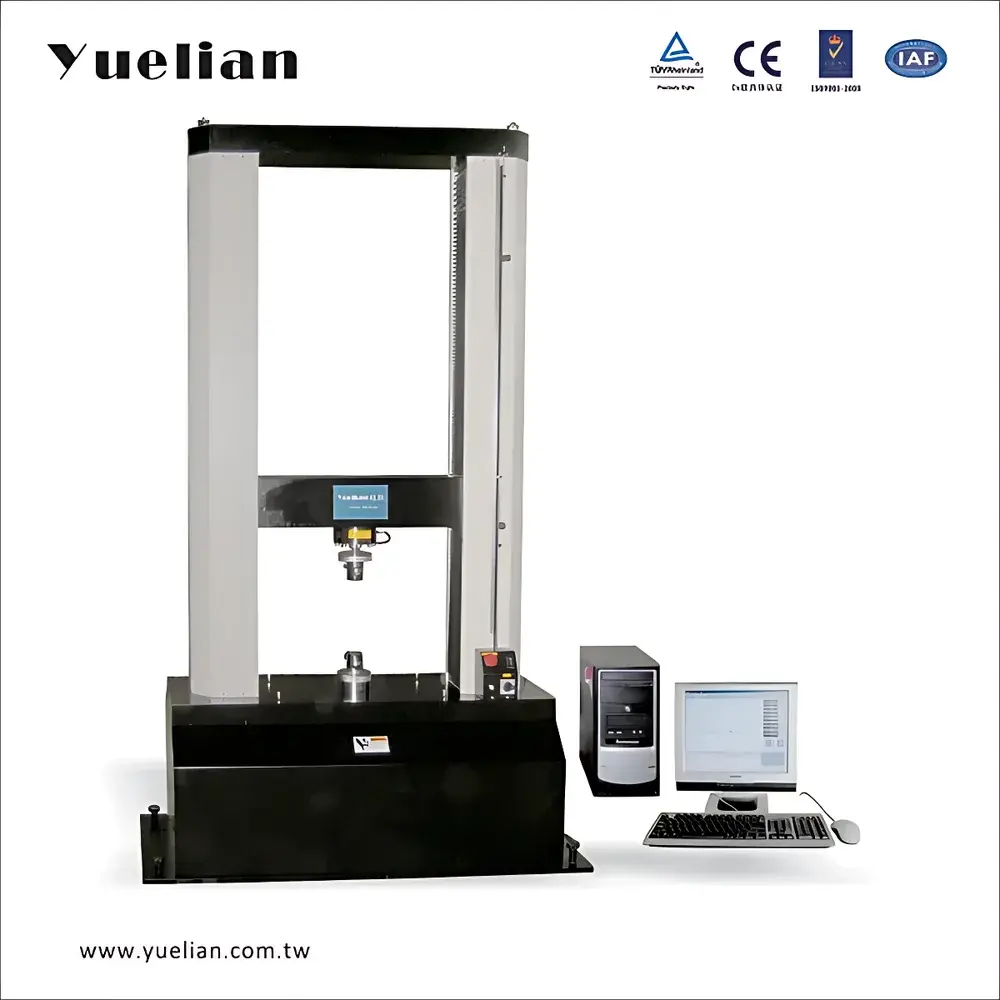
YL-1152 Yuelian Electronic Universal Tensile Testing Machine for Seat Belt Strength Evaluation
| Brand | Yuelian |
|---|---|
| Origin | Guangdong, China |
| Model | YL-1152 |
| Instrument Type | Electronic Universal Tensile Testing Machine |
| Load Capacity Options | 1 kN, 2 kN, 5 kN, 10 kN, 20 kN, 50 kN, 100 kN (dual-range configuration available) |
| Force Resolution | 1/250,000 full scale |
| Force Accuracy | ≤ ±0.5% of reading |
| Crosshead Travel Resolution | 0.005 mm |
| Maximum Travel | 1000 mm |
| Test Width | 550 mm |
| Speed Range | 0.5–500 mm/min (programmable via PC) |
| Control Interface | PC-based with USB connectivity |
| Data Acquisition | Real-time sampling via dedicated interface board |
| Compliant Standards | ISO 7500-1, ASTM E4, EN 10002-1, EN 10002-2, DIN 51221, JIS B7721/B7733, GB/T 228.1, JJG 475 |
Overview
The YL-1152 Yuelian Electronic Universal Tensile Testing Machine is a precision-engineered mechanical testing system designed specifically for evaluating the tensile strength, elongation at break, yield behavior, and load-deformation response of seat belt assemblies and their constituent materials—including webbing (polyester, nylon), retractor mechanisms, anchorage hardware, and pretensioner components. Operating on the principle of controlled uniaxial force application via servo-motor-driven crosshead displacement, the system conforms to standardized quasi-static loading protocols defined in ISO 6683 (seat belt anchorages), FMVSS No. 209, ECE R16, and UN Regulation 16. Its rigid C-frame architecture, coupled with high-resolution load cell feedback and closed-loop position control, ensures repeatable, traceable, and metrologically sound measurements under both ambient and conditioned environmental conditions.
Key Features
- Modular dual-range load cell support enabling seamless switching between high-sensitivity (e.g., 1–5 kN) and high-capacity (up to 100 kN) configurations without recalibration.
- Precision ball-screw transmission system with synchronous timing belt drive, delivering positional accuracy of ±0.005 mm and velocity stability across the full 0.5–500 mm/min range.
- Integrated safety interlock circuitry including overload cut-off, emergency stop button, automatic specimen rupture detection, and programmable upper/lower travel limits.
- PC-based control and analysis platform compliant with Windows OS environments, supporting real-time data streaming, multi-curve overlay, and automated report generation per ISO/IEC 17025 documentation requirements.
- Comprehensive test method library pre-configured for seat belt static strength (ISO 6683-1), webbing tensile (ISO 1140), dynamic inertia lock verification, and anchorage pull-out testing per SAE J1819.
Sample Compatibility & Compliance
The YL-1152 accommodates flat, woven, or molded specimens up to 550 mm wide and 1000 mm active gauge length, making it suitable for full-system seat belt evaluation as well as component-level testing of webbing, buckles, tongue plates, and D-rings. Fixturing options include pneumatic wedge grips, roller clamps for low-slippage webbing retention, and custom-designed anchorage fixtures replicating vehicle mounting geometry. All measurement procedures align with international regulatory frameworks governing automotive passive safety systems—including FMVSS 209, ECE R16 Rev. 5, UN R16.06, and ISO 6683 series standards—ensuring data acceptability in type-approval submissions and OEM supplier audits. Calibration traceability is maintained to national metrology institutes (e.g., NIM, NPL, PTB) via ISO/IEC 17025-accredited service providers.
Software & Data Management
The embedded test control software operates under Microsoft Windows and interfaces directly with MS Access relational databases for structured storage of raw load-displacement time-series, operator metadata, environmental logs, and calibration history. Each test record includes timestamped audit trails compliant with FDA 21 CFR Part 11 requirements when configured with electronic signatures and role-based access controls. Advanced curve processing functions include automatic yield point detection (0.2% offset method), tangent modulus calculation, fracture energy integration, and statistical batch reporting (mean, SD, CV%, min/max). Export formats include CSV, XLSX, PDF (with embedded digital signatures), and XML for LIMS integration. Software validation documentation (IQ/OQ/PQ protocols) is available upon request for GMP/GLP-regulated laboratories.
Applications
- Static tensile verification of lap/shoulder belt assemblies per ISO 6683-1 Clause 6.2.
- Webbing tensile strength and elongation characterization per ISO 1140 and ASTM D5035.
- Anchorage strength and deformation assessment under simulated crash loading profiles.
- Dynamic locking performance evaluation using controlled ramp-and-hold tension sequences.
- Material development studies for high-strength synthetic fibers (e.g., Dyneema®, Technora®) used in next-generation restraint systems.
- Quality assurance screening of incoming webbing batches, buckle weld integrity, and stitching seam strength.
FAQ
Does the YL-1152 meet FMVSS 209 and ECE R16 compliance requirements for seat belt certification?
Yes—the system’s force accuracy (≤ ±0.5%), displacement resolution (0.005 mm), and programmable test profiles fully satisfy the instrumentation specifications outlined in FMVSS 209 Appendix A and ECE R16 Annex 4.
Can the machine perform cyclic loading tests for fatigue evaluation of belt components?
While primarily optimized for quasi-static tests, the PC-based controller supports user-defined waveform sequencing (e.g., trapezoidal, sinusoidal) up to 5 Hz frequency for preliminary low-cycle fatigue screening; dedicated servo-hydraulic systems are recommended for high-cycle applications.
Is third-party calibration and ISO/IEC 17025 certification available for this instrument?
Yes—Yuelian partners with accredited metrology laboratories in Asia, Europe, and North America to provide on-site calibration services with full uncertainty budgets and traceable certificates.
What operating system versions are supported by the control software?
The current release supports Windows 10 (64-bit) and Windows 11 (64-bit); legacy compatibility with Windows 7 SP1 is maintained through extended support mode.
Are custom fixtures for specific vehicle anchorage geometries available?
Yes—engineering drawings and CAD models can be submitted for quotation of application-specific fixture sets, including ISOFIX anchor simulators and vehicle floor rail interfaces.



