
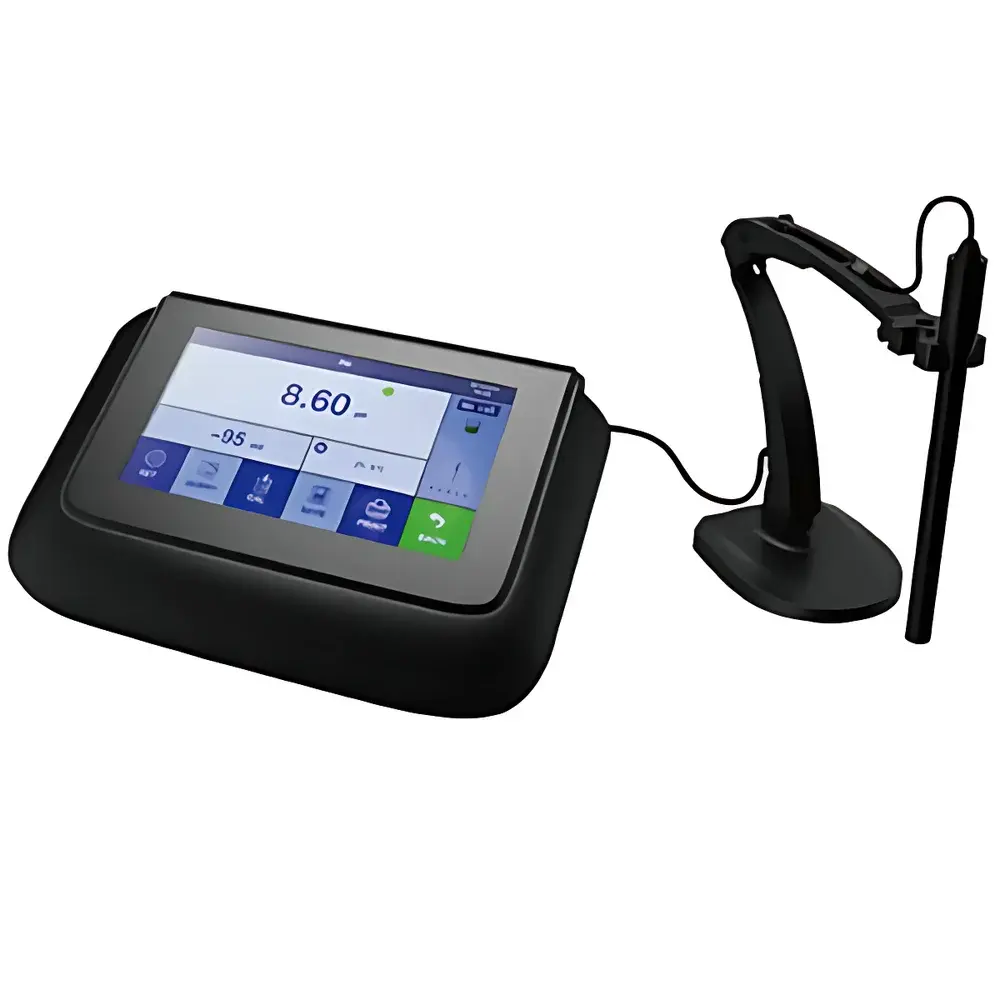
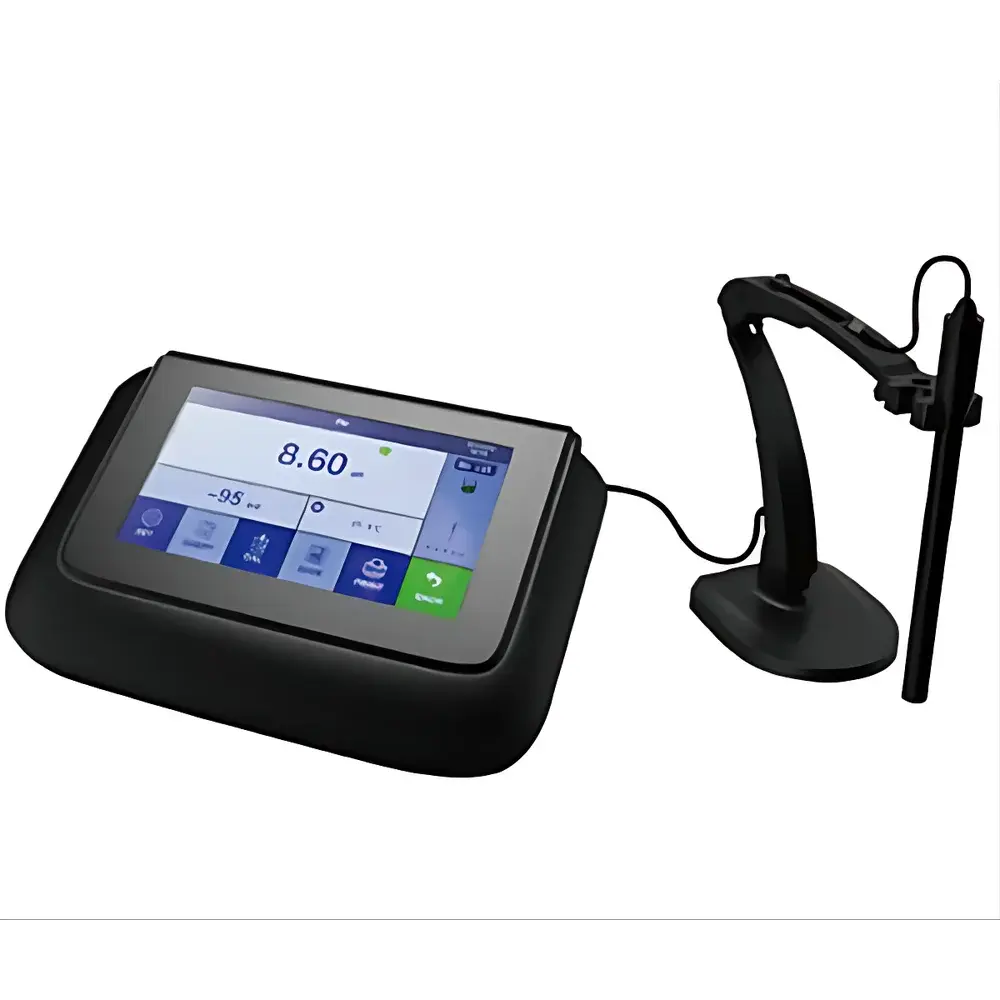
Yoke L-211 Benchtop Conductivity Meter
| Brand | Yoke |
|---|---|
| Origin | Shanghai, China |
| Model | L-211 |
| Form Factor | Benchtop |
| Intended Use | Laboratory |
| Conductivity Range | 0.01 μS/cm to 100 mS/cm |
| TDS Range | 0.01 mg/L to 100 g/L |
| Resistivity Range | 0.01 Ω·cm to 100 MΩ·cm |
| Salinity Range | 0.01 ‰ to 100 ‰ |
| Temperature Range | 0–100 °C |
| Accuracy | ±1% FS (conductivity), ±0.5 °C (temperature) |
| Minimum Resolution | 0.01 μS/cm (conductivity), 0.1 °C (temperature) |
| Display | 7-inch color capacitive touchscreen |
| Calibration | Auto-recognition of 8 standard solutions (including ISO/ASTM-compliant KCl standards), single-point or multi-point calibration |
| Compensation | Automatic and manual temperature compensation (ATC/MTT) |
| Data Management | Statistical analysis (mean, SD, min/max), audit-trail-capable storage, print-ready export, GLP/GMP-compliant metadata tagging |
| Protection Rating | IP54 |
| Electrode Compatibility | Standard 1.0 cm⁻¹ cell (optional 0.1 or 0.01 cm⁻¹ cells for low-conductivity samples) |
Overview
The Yoke L-211 Benchtop Conductivity Meter is a precision-engineered electrochemical instrument designed for reliable, traceable, and compliant conductivity, TDS, resistivity, and salinity measurements in regulated laboratory environments. It operates on the principle of two-electrode or four-electrode conductometric measurement—applying an alternating current across a defined electrode geometry and calculating solution conductivity based on Ohm’s law and cell constant calibration. The meter employs frequency-modulated AC excitation to minimize polarization effects and electrode fouling, ensuring high reproducibility across diverse aqueous matrices—from ultrapure water (≤0.055 µS/cm at 25 °C) to concentrated brines and industrial process streams. Its architecture conforms to fundamental metrological requirements outlined in ASTM D1125, ISO 7888, and USP , supporting routine QC testing, environmental monitoring, pharmaceutical water system validation, and academic research where traceability and data integrity are mandated.
Key Features
- 7-inch high-resolution color capacitive touchscreen with glove-compatible responsiveness, UV-resistant optical bonding, and scratch-resistant surface—engineered for durability under routine lab handling and cleaning protocols.
- Integrated electrode stand with adjustable height and lateral positioning, enabling ergonomic alignment with sample vessels and minimizing mechanical stress on sensor cables and connectors.
- Full dual-language OS (English/Chinese) with configurable date/time stamping, screen brightness control, and selectable temperature units (°C/°F/K) for global deployment.
- Automatic temperature compensation (ATC) using built-in Pt1000 thermistor; manual temperature override available for non-standard thermal profiles or reference-cell applications.
- Intelligent electrode diagnostics—including real-time conductivity drift detection, cell constant verification, and calibration solution recognition via preloaded conductivity/TDS conversion tables aligned with NIST-traceable KCl standards (e.g., 84 μS/cm, 1413 μS/cm, 12.88 mS/cm).
- IP54-rated enclosure providing protection against dust ingress and water splashes during benchtop operation—suitable for shared analytical workspaces and wet-lab environments.
Sample Compatibility & Compliance
The L-211 supports measurement of deionized water, buffer solutions, wastewater effluents, saline media, pharmaceutical purified water (PW) and water-for-injection (WFI), and electrolyte formulations. Its broad dynamic range (0.01 μS/cm to 100 mS/cm) accommodates both low-ionic-strength samples (requiring optional 0.1 or 0.01 cm⁻¹ cells) and high-conductivity industrial brines. All stored measurements retain embedded metadata: timestamp, operator ID (if configured), electrode serial number, calibration history, ambient temperature, and ATC parameters—enabling full compliance with 21 CFR Part 11 (when paired with validated LIMS or ELN integration), EU Annex 11, and GLP/GMP documentation requirements. Firmware supports secure user-level access control and audit-trail logging for critical parameter changes.
Software & Data Management
Data acquisition and post-processing are managed through an embedded application supporting statistical evaluation (n ≥ 3 replicate analysis), outlier identification (Dixon’s Q-test compatible), and summary reporting. Up to 1,000 measurement records can be stored internally with time-stamped metadata. Export options include CSV files via USB-A port (compatible with Windows/macOS/Linux) and direct thermal printing (via optional Bluetooth or USB printer). Firmware updates are performed via signed .bin file upload with checksum validation. Built-in power-loss recovery preserves unsaved data and restores last-known configuration after interruption—critical for unattended overnight measurements or facility-wide power cycling events.
Applications
- Pharmaceutical water system qualification per USP and EP 2.2.38, including conductivity mapping of distribution loops and point-of-use verification.
- Environmental testing labs performing EPA Method 120.1 and ISO 15339 compliance checks for surface water, groundwater, and wastewater discharge monitoring.
- Food & beverage QA/QC for brine concentration control, dairy product conductivity profiling, and CIP rinse water verification.
- Academic electrochemistry teaching labs—demonstrating Kohlrausch’s law, ion mobility trends, and temperature dependence of electrolytic conduction.
- Chemical manufacturing process control for acid/base titration endpoint confirmation and catalyst solution monitoring.
FAQ
Does the L-211 support 21 CFR Part 11-compliant electronic signatures?
No—the instrument itself does not implement digital signature workflows, but it generates timestamped, operator-tagged, and calibration-anchored data sets that meet foundational ALCOA+ principles. Full Part 11 compliance requires integration with a validated third-party LIMS or ELN platform.
Can I use a 0.01 cm⁻¹ cell with the L-211 for ultrapure water measurements?
Yes—provided the cell is connected via the standard BNC interface and its cell constant is manually entered or auto-detected (if equipped with RFID or encoded connector). The meter’s resolution of 0.01 μS/cm ensures adequate sensitivity down to 0.055 μS/cm at 25 °C.
Is firmware upgrade reversible?
No—firmware updates are cumulative and non-revertible; however, a factory reset preserves hardware configuration while restoring default software behavior.
What calibration standards are preloaded?
Eight NIST-traceable KCl-based standards per ISO 7888: 0.084, 0.1413, 1.413, 12.88, 111.8 mS/cm, plus corresponding TDS equivalents and NaCl-based salinity references.
How is temperature accuracy verified?
The integrated Pt1000 sensor is factory-calibrated against a certified dry-block calibrator (±0.1 °C uncertainty at 25 °C); users may perform field verification using a calibrated reference thermometer in stirred thermostatic baths.
Related Products




