
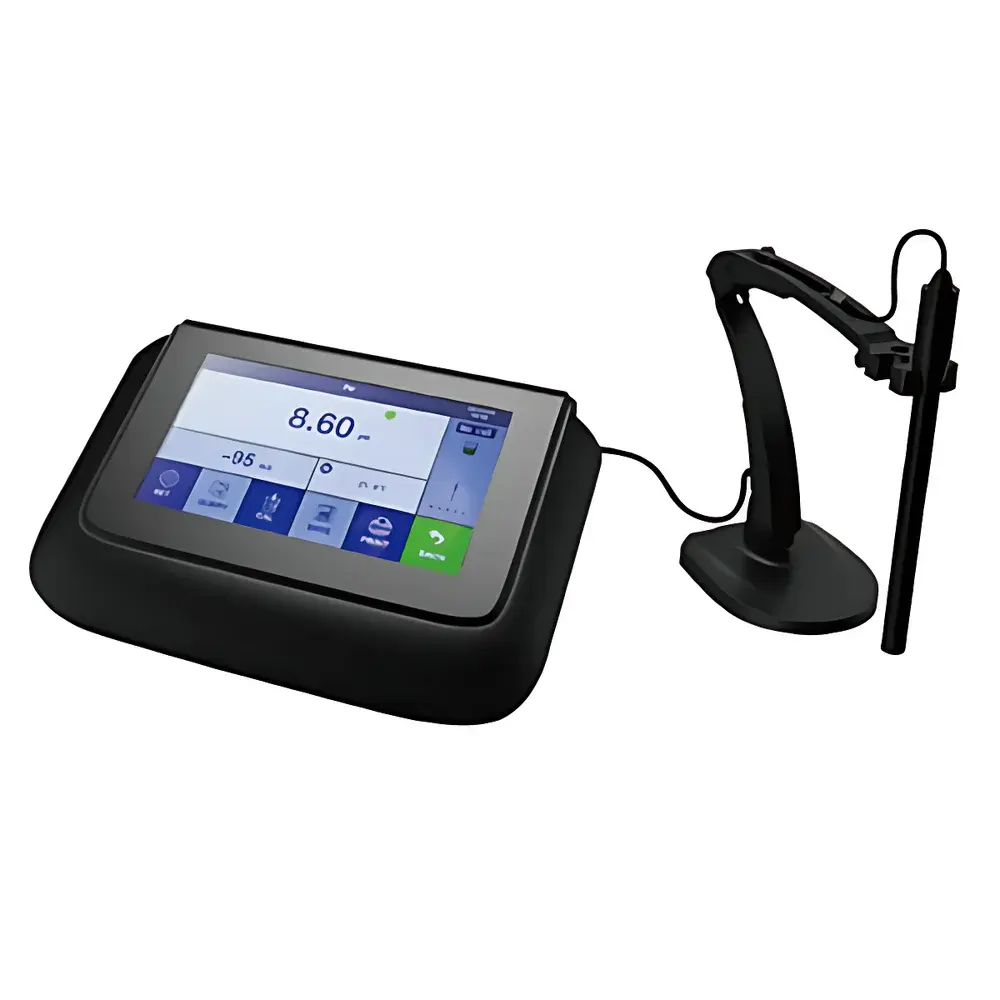
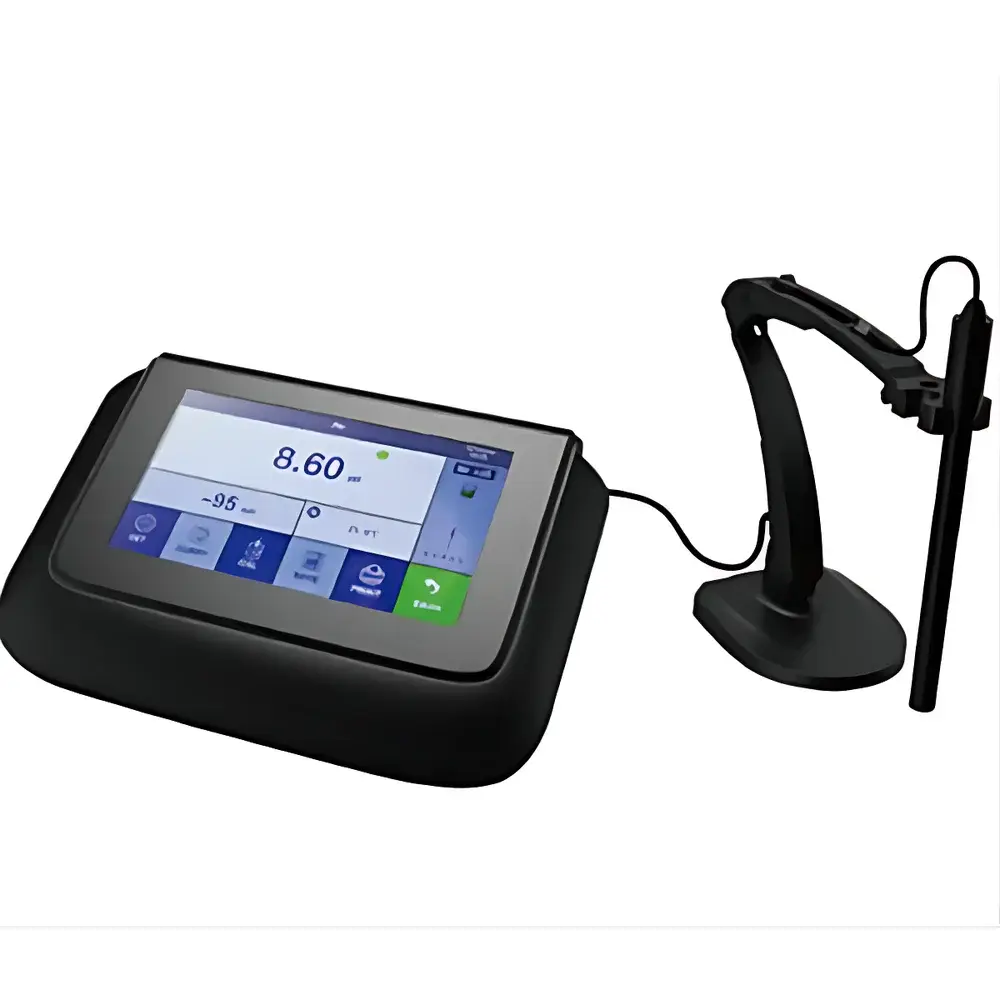
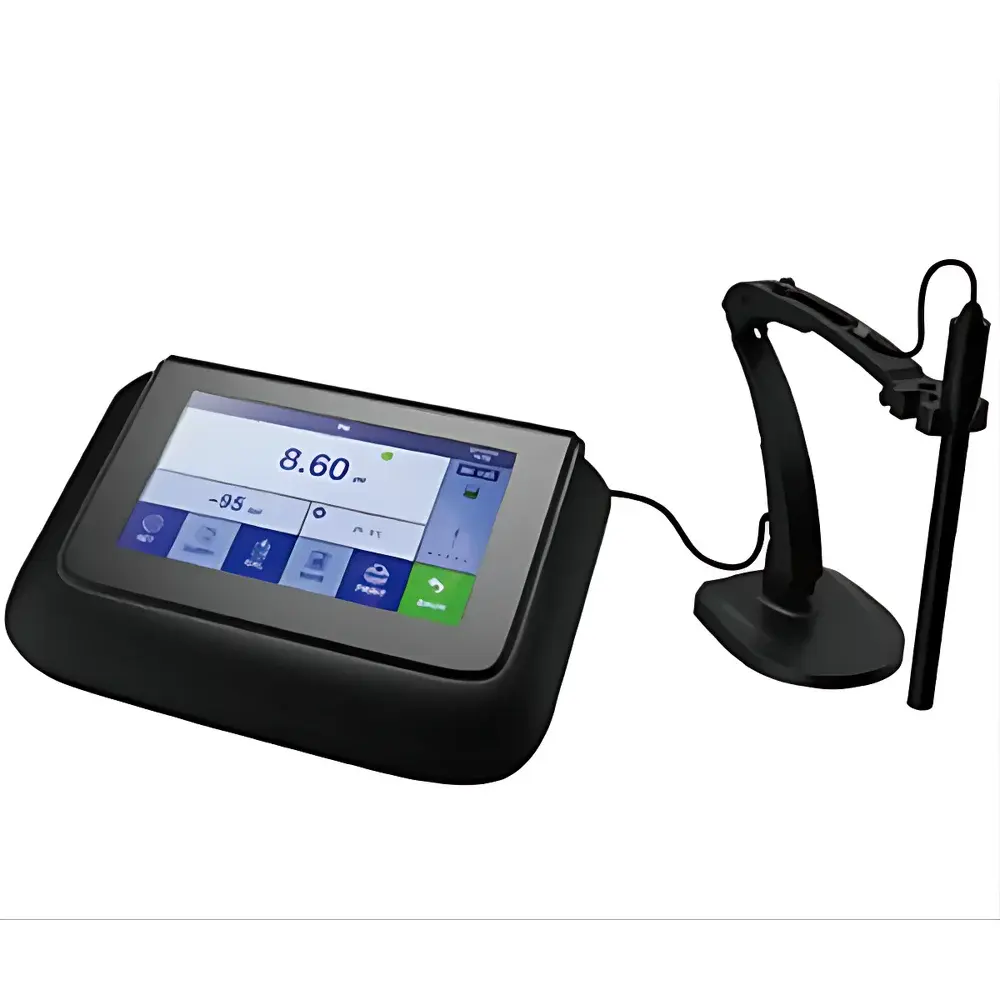
Yoke L-301 Portable pH and Dissolved Oxygen Meter
| Brand | Yoke |
|---|---|
| Origin | Shanghai, China |
| Model | L-301 |
| Instrument Type | Portable |
| Measurement Principle | Fluorescence-based DO detection & Potentiometric pH measurement |
| pH Range | -2.00 to 20.00 |
| pH Resolution | 0.001 / 0.01 / 0.1 pH (user-selectable) |
| mV Resolution | 0.1 / 0.1 / 1 mV (user-selectable) |
| DO Range | 0.00–99.00 mg/L |
| pH Accuracy | ±0.02 pH |
| mV Accuracy | ±1 mV |
| pH Repeatability | ≤±0.01 pH |
| mV Repeatability | ≤±1 mV |
| Temperature Compensation | Automatic and manual modes |
| Calibration | Up to 3-point pH calibration with auto-buffer recognition |
| Display | 7-inch full-color capacitive touchscreen |
| Language Support | English and Chinese |
| Environmental Protection | UV-resistant, scratch-resistant, glove-compatible surface |
| Power | Rechargeable Li-ion battery (operating time ≥12 h typical) |
| Compliance | Designed for field and lab use per ISO 5667-3, ASTM D3693, and USP <781> water quality testing protocols |
Overview
The Yoke L-301 is a dual-parameter portable meter engineered for simultaneous, high-fidelity measurement of pH and dissolved oxygen (DO) in environmental, municipal, and industrial water quality applications. Unlike single-function meters, the L-301 integrates potentiometric pH sensing with optical fluorescence-based DO detection—eliminating membrane fouling, electrolyte depletion, and oxygen consumption inherent in traditional Clark-type electrochemical sensors. Its core architecture adheres to fundamental metrological principles: pH is determined via Nernst equation-based potential difference across a glass/sensitive reference electrode pair, while DO concentration is quantified by phase-shift analysis of modulated blue light excitation and red phosphorescence decay kinetics from an immobilized ruthenium complex. This non-consumptive, temperature-compensated methodology ensures stable baseline performance across variable field conditions—from wastewater influent channels to remote surface water sampling sites.
Key Features
- 7-inch full-color capacitive touchscreen with anti-UV, scratch-resistant Gorilla Glass™ surface—optimized for gloved operation and rapid visual interpretation of multi-parameter trends.
- User-selectable resolution modes: pH (0.001 / 0.01 / 0.1) and mV (0.1 / 1) allow precise adaptation to regulatory reporting requirements or method validation protocols.
- Intelligent electrode diagnostics: real-time slope calculation, offset verification, and status flagging based on calibration history and response kinetics—supporting GLP-compliant documentation.
- Auto-buffer recognition across 15 preloaded IUPAC and NIST-traceable pH standards (e.g., pH 4.01, 6.86, 9.18 at 25°C), plus up to three custom buffer entries with user-defined temperature coefficients.
- Dual-mode temperature compensation: automatic RTD-based correction (0–50°C) or manual entry for fixed-temperature incubation studies; supports °C/°F unit switching.
- Integrated electrode stand with adjustable arm and magnetic base—enabling stable benchtop deployment or quick mounting on tripods, railings, or vessel walls during grab sampling.
Sample Compatibility & Compliance
The L-301 is validated for direct immersion in freshwater, seawater (with salinity compensation), wastewater effluents, drinking water distribution systems, and aquaculture ponds. It meets functional equivalency requirements under ISO 5667-3 (water sampling guidance), ASTM D3693 (standard test method for dissolved oxygen in water), and USP (pH measurement of purified water). While not certified for Class I Div 1 hazardous locations, its IP67-rated enclosure provides dust-tight integrity and 30-minute submersion resistance at 1 m depth—suitable for rain-exposed fieldwork and humid laboratory environments. All firmware and calibration logs comply with ALCOA+ data integrity principles and support audit-ready export (CSV/Excel) for FDA 21 CFR Part 11–aligned workflows when paired with optional secure cloud sync.
Software & Data Management
Data acquisition and configuration are managed through embedded firmware v2.4+, supporting timestamped storage of ≥50,000 measurement records with metadata (operator ID, location tag, electrode serial number, calibration ID). USB-C interface enables direct transfer to Windows/macOS systems without proprietary drivers. Optional YokeLink desktop software (v3.1+) provides statistical process control (SPC) charting, trend overlay across multiple sampling events, and automated report generation compliant with ISO/IEC 17025 clause 7.8. Audit trails record all parameter changes, calibration events, and user logins—including time-stamped digital signatures where enabled.
Applications
- Regulatory compliance monitoring for EPA NPDES permits and EU WFD (Water Framework Directive) reporting.
- In-process control of biological nutrient removal (BNR) reactors, where real-time pH and DO correlation informs aeration and carbon dosing decisions.
- Source water characterization during drought or algal bloom events—detecting diurnal DO supersaturation and acidification shifts.
- Educational laboratories requiring robust, low-maintenance instrumentation for undergraduate analytical chemistry and environmental science curricula.
- Field verification of online analyzers prior to commissioning or after maintenance interventions.
FAQ
Does the L-301 require membrane replacement or electrolyte refilling for DO measurement?
No—the fluorescence-based DO sensor contains no consumable membranes or internal electrolytes. The optode film is chemically stable for ≥24 months under normal field exposure.
Can the instrument store calibration data across multiple electrodes?
Yes—up to four unique electrode profiles can be saved, each retaining individual slope, offset, and last-calibration date for traceability.
Is the touchscreen operable with nitrile or latex gloves?
Yes—the capacitive layer responds reliably to standard laboratory-grade gloves without stylus dependency.
What is the recommended recalibration frequency for routine environmental monitoring?
Per ISO 5667-3 Annex B, daily two-point pH calibration (pH 7.00 + one bracketing standard) and DO zero/span verification are advised before critical sampling campaigns.
Does the device support GLP audit trail export?
Yes—full event logs (including calibration actions, measurement triggers, and user authentication) export as encrypted CSV files with SHA-256 hash verification.
Related Products







