
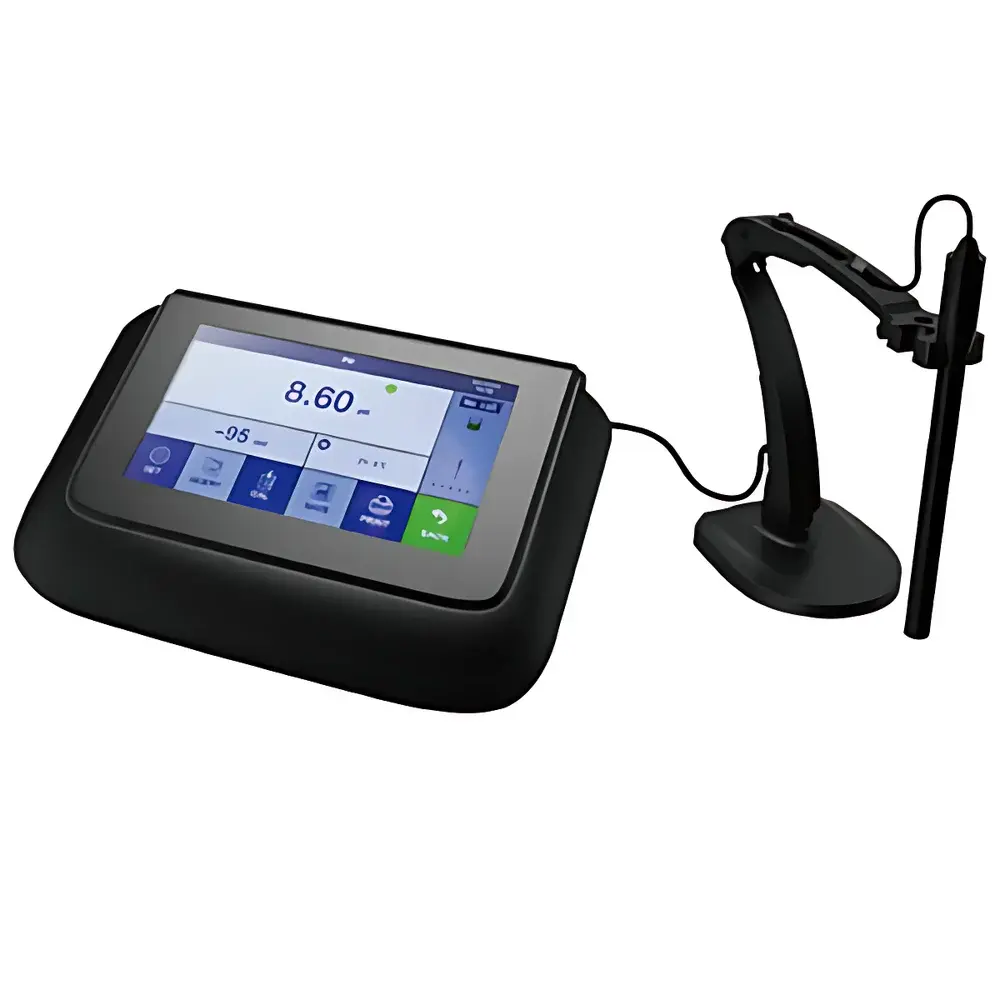
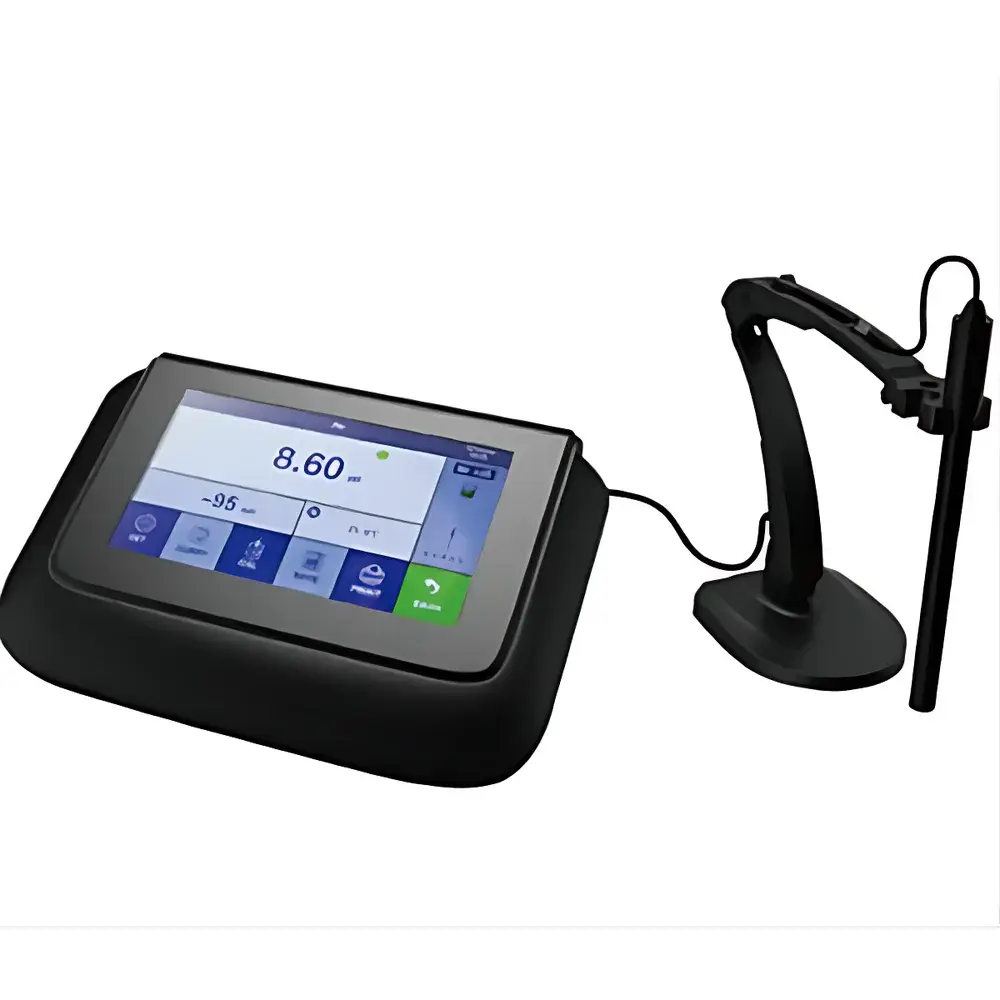
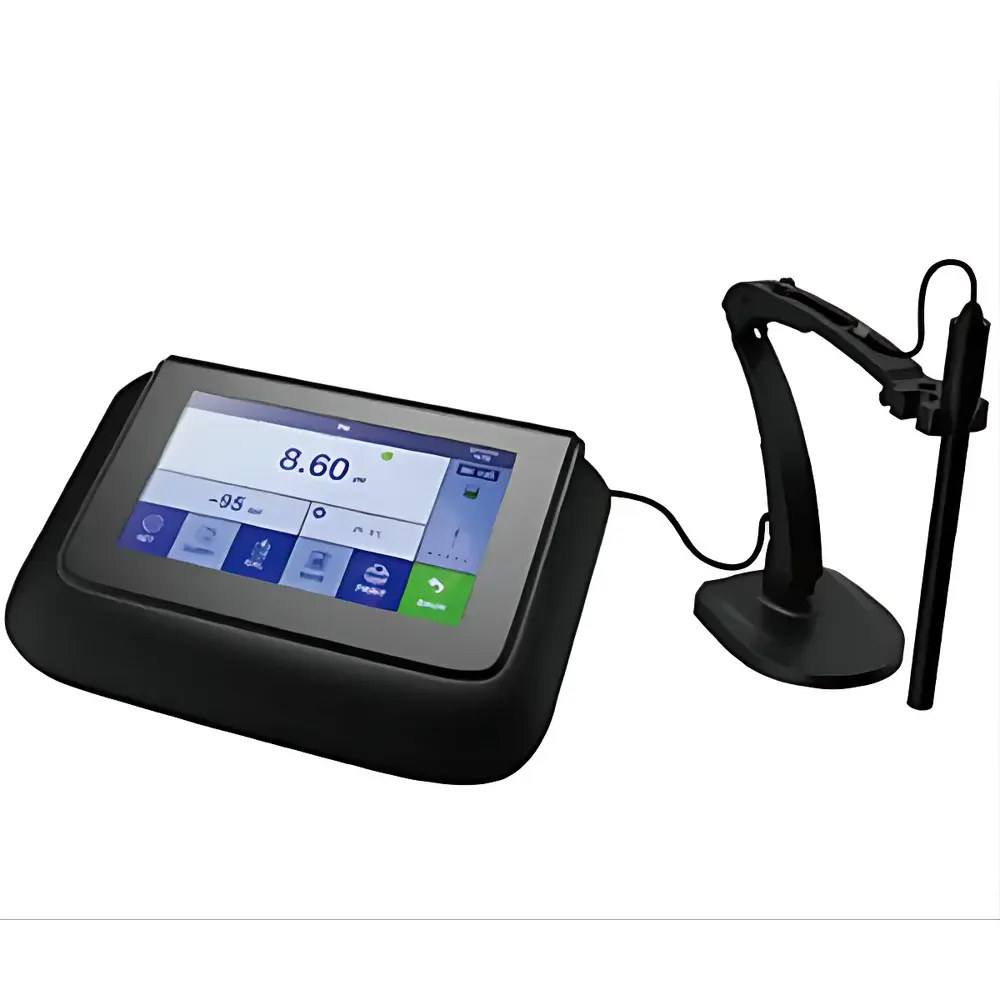
Yoke L-311 Portable Conductivity Meter
| Brand | Yoke |
|---|---|
| Origin | Shanghai, China |
| Model | L-311 |
| Portability | Portable |
| Intended Use | Laboratory |
| Conductivity Range | 0.000 µS/cm to 200 mS/cm |
| TDS Range | 0 to 100 g/L |
| Resistivity Range | 0 to 10 MΩ·cm |
| Salinity Range | 0 to 80 ppt |
| Temperature Range | −5 to 55 °C |
| Accuracy | ±0.5% FS (conductivity), ±0.1 °C (temperature) |
| Minimum Resolution | 0.01 µS/cm (conductivity), 0.1 °C (temperature) |
| Display | 7-inch color TFT capacitive touchscreen |
| Compliance | IP54 |
| Calibration | Auto-recognition of 8 standard solutions (including ISO and GB standards), single-point or multi-point calibration supported |
| Electrode Constant Options | 0.01, 0.1, 1.0 cm⁻¹ (1.0 cm⁻¹ electrode supplied) |
| Data Management | Statistical analysis (min/max/avg/stdev), storage ≥1000 data points, print-ready output, audit-trail-capable logging, firmware upgradability, power-failure recovery, factory reset |
| Temperature Compensation | Automatic (linear & non-linear NIST/ISO models) and manual modes |
| Language Support | English & Chinese UI |
| Environmental Rating | IP54 |
Overview
The Yoke L-311 Portable Conductivity Meter is an engineered solution for precise, traceable, and compliant measurement of electrical conductivity, total dissolved solids (TDS), resistivity, and salinity in aqueous laboratory samples. Based on the fundamental principle of two-electrode or four-electrode conductometric measurement—where sample conductivity is derived from the ratio of applied AC voltage to measured current—the L-311 delivers high reproducibility across a broad dynamic range (0.000 µS/cm to 200 mS/cm). Its design adheres to core electrochemical instrumentation requirements for analytical laboratories operating under GLP, GMP, or ISO/IEC 17025 frameworks. The instrument employs frequency-modulated AC excitation to minimize polarization effects and electrode fouling, ensuring stable readings even in low-conductivity ultrapure water or high-ionic-strength industrial effluents. Temperature compensation follows both linear and non-linear algorithms aligned with ISO 7888 and ASTM D1125 standards, enabling accurate normalization to 25 °C across diverse sample matrices.
Key Features
- 7-inch full-color capacitive touchscreen with glove-compatible responsiveness, anti-scratch surface, UV-resistant coating, and auto-dimming functionality for ergonomic operation in varied lighting conditions.
- Integrated electrode stand with compact footprint and adjustable arm—designed for stability during handheld or benchtop use without requiring external clamps or mounts.
- IP54-rated enclosure ensures protection against dust ingress and water splashes, supporting reliable operation in shared lab environments with controlled humidity and ambient temperature fluctuations.
- Embedded dual-language OS (English/Chinese) with configurable time stamping, brightness control, and selectable temperature units (°C/°F).
- Real-time diagnostics including electrode impedance monitoring, calibration status flagging, and sensor health alerts—supporting proactive maintenance and reducing measurement uncertainty.
- Comprehensive data governance: timestamped storage of ≥1000 measurements with statistical functions (mean, SD, min/max), export-ready CSV formatting, and optional thermal printer interface.
Sample Compatibility & Compliance
The L-311 accommodates a wide spectrum of aqueous samples—from deionized water (0.055 µS/cm) and pharmaceutical buffers to seawater analogs (≈53 mS/cm) and brine solutions (up to 200 mS/cm). With interchangeable electrodes (K = 0.01, 0.1, and 1.0 cm⁻¹), users can optimize cell geometry and sensitivity for specific applications: K = 0.01 cm⁻¹ for ultrapure water analysis per USP , K = 0.1 cm⁻¹ for potable water per EPA Method 120.1, and K = 1.0 cm⁻¹ for wastewater or process streams. Built-in support for eight certified reference standards—including KCl solutions traceable to NIST SRM 3198 and GB/T 6682—enables compliance with ISO 9001 internal calibration protocols and FDA 21 CFR Part 11–aligned electronic record integrity when paired with validated software workflows.
Software & Data Management
Data handling conforms to ALCOA+ principles (Attributable, Legible, Contemporaneous, Original, Accurate, Complete, Consistent, Enduring, Available). Each measurement entry includes operator ID (optional), sample ID, electrode serial number, calibration history, ambient temperature, and timestamp. Statistical summaries are generated on-device; raw datasets export via USB to LIMS or ELN platforms. Firmware updates are performed via signed binary files with SHA-256 verification, preserving configuration integrity. Audit trail functionality logs all user actions—including calibration edits, parameter changes, and data deletions—with immutable timestamps—meeting GLP audit requirements for method validation documentation.
Applications
- Pharmaceutical water system qualification (PW, WFI, Purified Water) per USP and EU Annex 1.
- Environmental monitoring of surface water, groundwater, and effluent streams per ISO 10523 and APHA Standard Methods 2510B.
- Food & beverage QC for syrup concentration, brine strength, and rinse water purity.
- Academic research in colloid science, electrolyte thermodynamics, and membrane permeability studies.
- Industrial process control for boiler feedwater, cooling tower cycles, and electroplating bath management.
FAQ
Does the L-311 support 21 CFR Part 11-compliant electronic signatures?
No—while the device maintains audit-trail-capable logging and user-accessible timestamps, it does not include role-based authentication or digital signature modules required for full Part 11 enforcement. Integration with validated third-party LIMS or ELN systems is recommended for regulated environments.
Can the L-311 measure conductivity below 1 µS/cm with acceptable accuracy?
Yes—when equipped with the optional K = 0.01 cm⁻¹ electrode and operated in low-range mode, the instrument achieves ±0.5% FS accuracy down to 0.05 µS/cm, suitable for ultrapure water monitoring per ASTM D5127.
Is automatic temperature compensation based on NIST-traceable algorithms?
Yes—the built-in TC function implements both linear (α = 2.0 %/°C default) and non-linear (NIST ITS-90 polynomial) models, selectable per application and configurable to match reference solution behavior per ISO 7888 Annex B.
How is calibration verification documented internally?
Each calibration event generates a unique log entry containing date/time, standard used, measured value, deviation from nominal, pass/fail flag, and operator ID—retained indefinitely until manually cleared.
What power source options are available for extended field use?
The L-311 operates on rechargeable Li-ion battery (≥12 h continuous use) or universal AC adapter (100–240 V, 50/60 Hz); battery level and charging status display in real time on the home screen.
Related Products



