
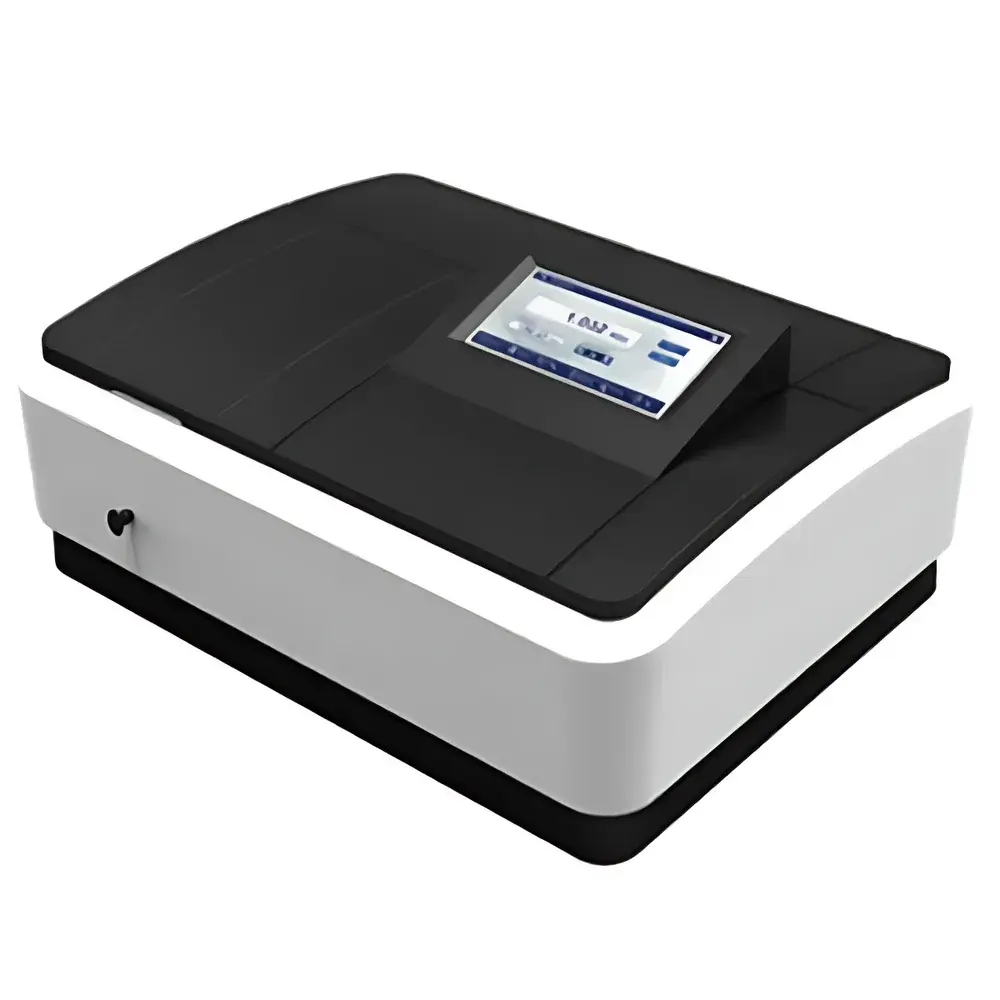
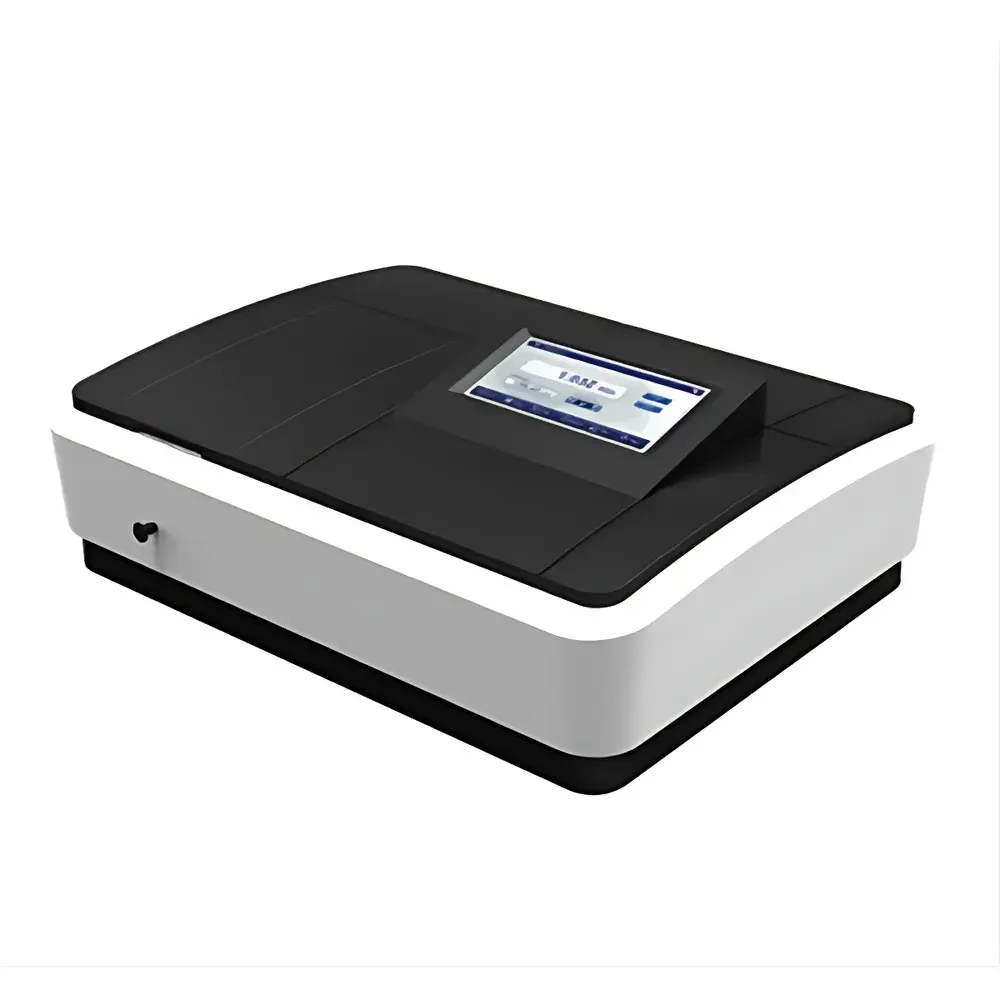
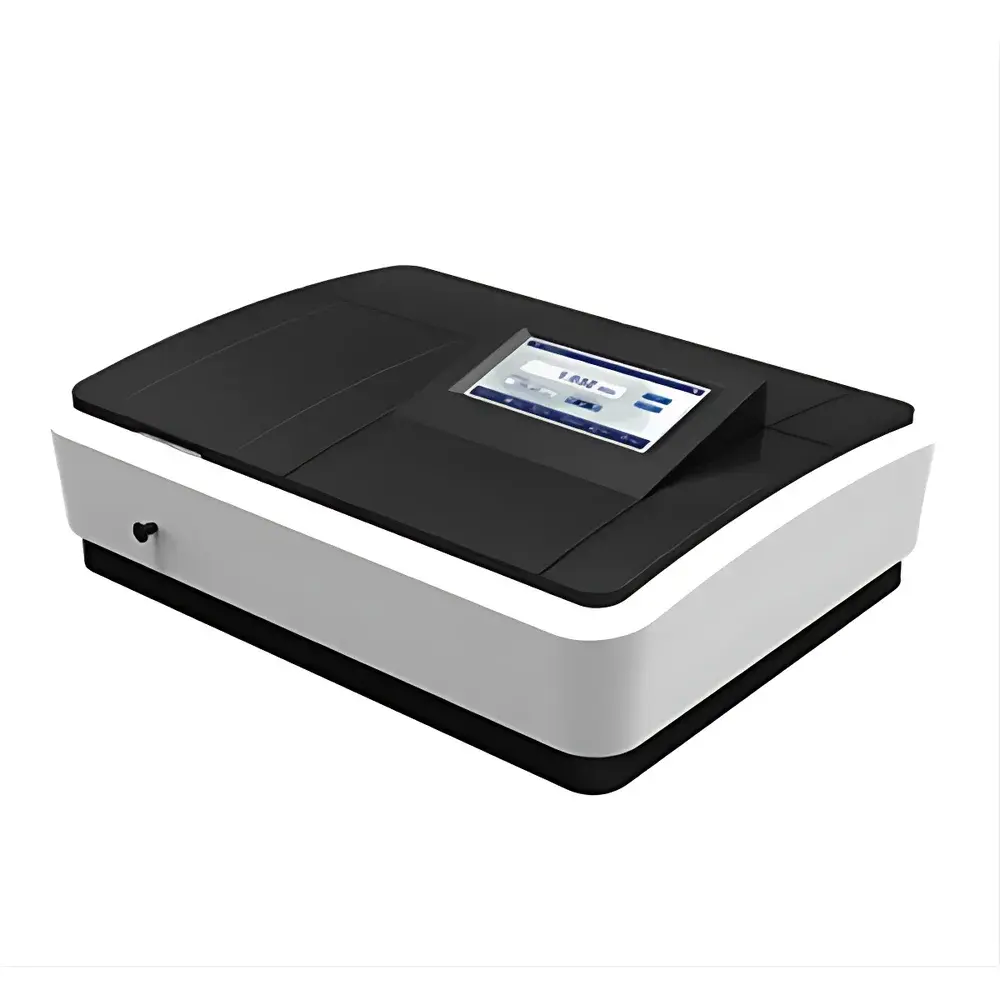
Yoke L-3700S Touchscreen UV-Vis Spectrophotometer
| Brand | Yoke |
|---|---|
| Origin | Shanghai, China |
| Manufacturer Type | Authorized Distributor |
| Product Origin | Domestic (China) |
| Model | L-3700S |
| Instrument Architecture | Double-beam |
| Detector | Photomultiplier Tube (PMT) |
| Wavelength Range | 190–1100 nm |
| Automation Level | Automatic Wavelength Scanning |
| Spectral Bandwidth | 1 nm (standard), adjustable to 0.5/2.0/4.0/5.0 nm |
| Wavelength Accuracy | ±0.3 nm |
| Wavelength Repeatability | ≤0.1 nm |
| Stray Light | ≤0.03% at 220 nm (using NaI solution) |
Overview
The Yoke L-3700S Touchscreen UV-Vis Spectrophotometer is a high-performance double-beam spectrophotometric system engineered for precision quantitative and qualitative analysis across research laboratories, quality control environments, and educational institutions. Based on the fundamental principle of Beer-Lambert law absorption spectroscopy, the instrument measures sample absorbance, transmittance, and reflectance by comparing light intensity through a reference and sample path simultaneously—ensuring real-time correction for source drift, detector sensitivity fluctuations, and environmental variability. Its optical architecture integrates a Czerny-Turner monochromator with a holographic grating and digital photomultiplier tube (PMT) detection, delivering high photometric linearity, low noise, and exceptional baseline stability over extended measurement cycles. The system operates across the full ultraviolet-to-near-infrared range (190–1100 nm), supporting applications from nucleic acid quantification and protein assays to dye kinetics and pharmaceutical dissolution profiling.
Key Features
- 8-inch capacitive touchscreen display (1024 × 800 resolution) enabling intuitive graphical interface navigation, real-time spectral visualization, and standalone operation without external PC dependency.
- ARM12 high-speed embedded processor with onboard storage capacity for up to 5,000 absorbance measurements or 500 calibration curves—ideal for batch testing and field deployment.
- Adjustable spectral bandwidth (0.5/1.0/2.0/4.0/5.0 nm) optimized for resolution-versus-sensitivity trade-offs in diverse sample matrices including turbid suspensions, colored solutions, and thin-film coatings.
- Automated optical alignment routines: auto-zeroing, lamp switching (D₂ and W lamp), wavelength self-calibration at startup, and dynamic baseline correction during scanning.
- Rugged mechanical design featuring reinforced aluminum baseplate and physically separated optical and electronic compartments to minimize thermal drift and vibration-induced signal artifacts.
- Ultra-fast full-spectrum scan capability (up to 3,000 nm/min) facilitating kinetic monitoring of rapid chemical reactions, enzyme catalysis, and photochemical processes.
Sample Compatibility & Compliance
The L-3700S accommodates standard 10-mm square cuvettes, microvolume cells (down to 50 µL), and optional accessories including temperature-controlled cell holders (±0.1 °C stability), integrating spheres for diffuse reflectance, variable-pathlength cells (1–100 mm), solid-sample holders with adjustable incidence angles, and fiber-optic probes for remote or in-situ measurements. All hardware and firmware comply with ISO/IEC 17025:2017 requirements for analytical instrument validation. When operated with the optional PC software suite, the system supports full GLP/GMP compliance—including user-level access control, electronic signature enforcement, audit-trail generation per FDA 21 CFR Part 11, and traceable data archiving with immutable timestamps.
Software & Data Management
The embedded operating system supports direct data export via USB flash drive in four native formats: CSV (for spreadsheet integration), QUA (Yoke proprietary spectral format), TXT (ASCII tab-delimited), and BMP (raster image). Optional Windows-based PC software enables remote instrument control, advanced curve fitting (e.g., multi-peak deconvolution, derivative spectroscopy), method validation workflows, and automated report generation compliant with ISO 10526 and USP . All measurement metadata—including instrument ID, operator login, environmental conditions (if sensor-equipped), and calibration history—is embedded within exported files to satisfy laboratory accreditation documentation requirements.
Applications
- Pharmaceutical QC: Active pharmaceutical ingredient (API) assay, excipient identification, dissolution testing per USP , and stability-indicating methods.
- Biochemistry: DNA/RNA concentration and purity assessment (A260/A280 ratio), Bradford/Lowry/BCA protein assays, enzyme kinetics (e.g., NADH oxidation at 340 nm).
- Environmental analysis: Nitrate/nitrite quantification in water (via diazotization), COD determination, heavy metal complexation studies.
- Materials science: Thin-film thickness estimation via interference fringe analysis, bandgap energy calculation for semiconductors, pigment dispersion characterization.
- Educational labs: Fundamental spectroscopy pedagogy, Lambert-Beer law verification, spectral library construction, and method development exercises.
FAQ
Does the L-3700S support regulatory-compliant data integrity practices?
Yes—when used with the validated PC software, it provides full 21 CFR Part 11 compliance features including role-based user authentication, electronic signatures, and tamper-evident audit trails.
Can the instrument perform kinetic measurements over time?
Yes—the high-speed scanning engine and internal memory allow continuous time-resolved acquisition at user-defined intervals, with up to 500 sequential spectra stored onboard.
Is wavelength accuracy verified traceably to NIST standards?
The factory calibration utilizes certified holmium oxide and didymium oxide reference filters; users may perform periodic verification using NIST-traceable standards such as SRM 2034 or SRM 930e.
What maintenance is required for long-term photometric stability?
Routine checks include lamp intensity monitoring, cuvette compartment cleaning, and annual performance qualification (PQ) using photometric accuracy and stray light test kits per ASTM E275 and ISO 6059.
Are third-party software integrations supported?
The instrument communicates via USB virtual COM port protocol; developers may implement custom control scripts using Python (pySerial), LabVIEW, or MATLAB with provided SCPI command documentation.
Related Products




