
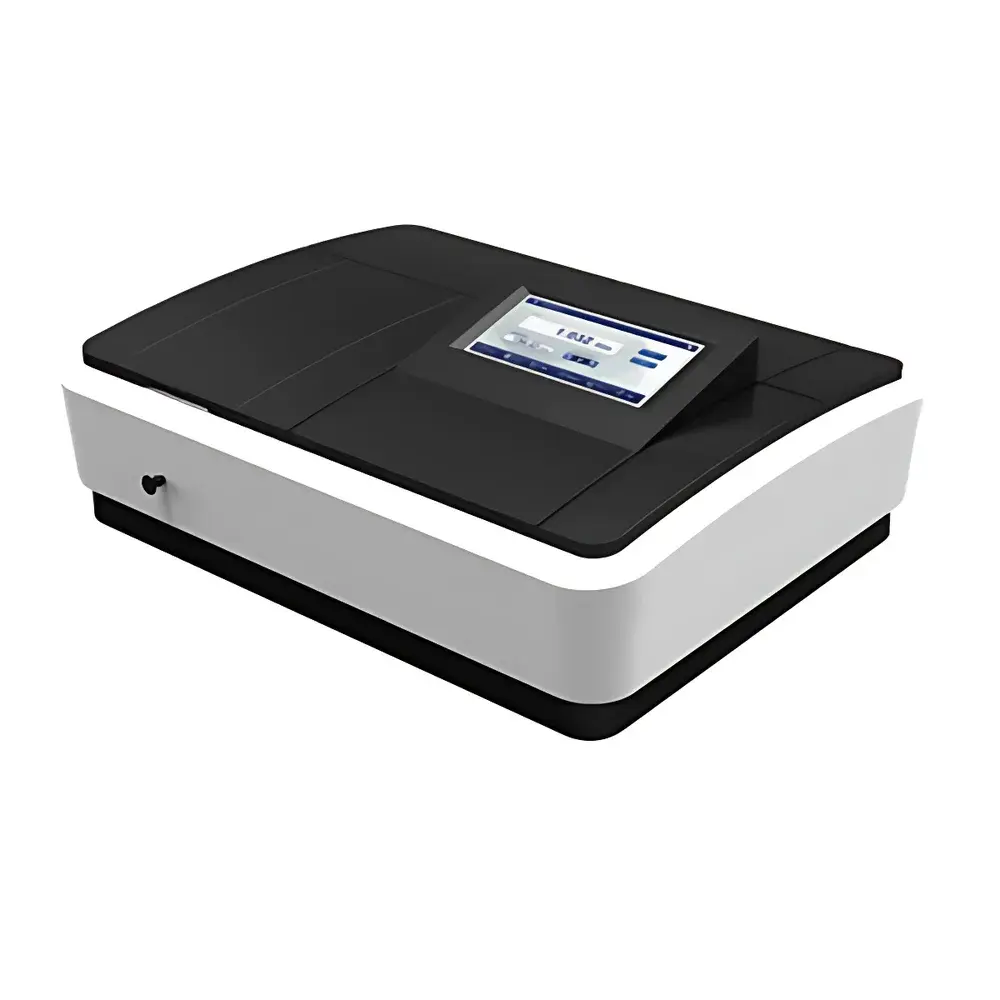
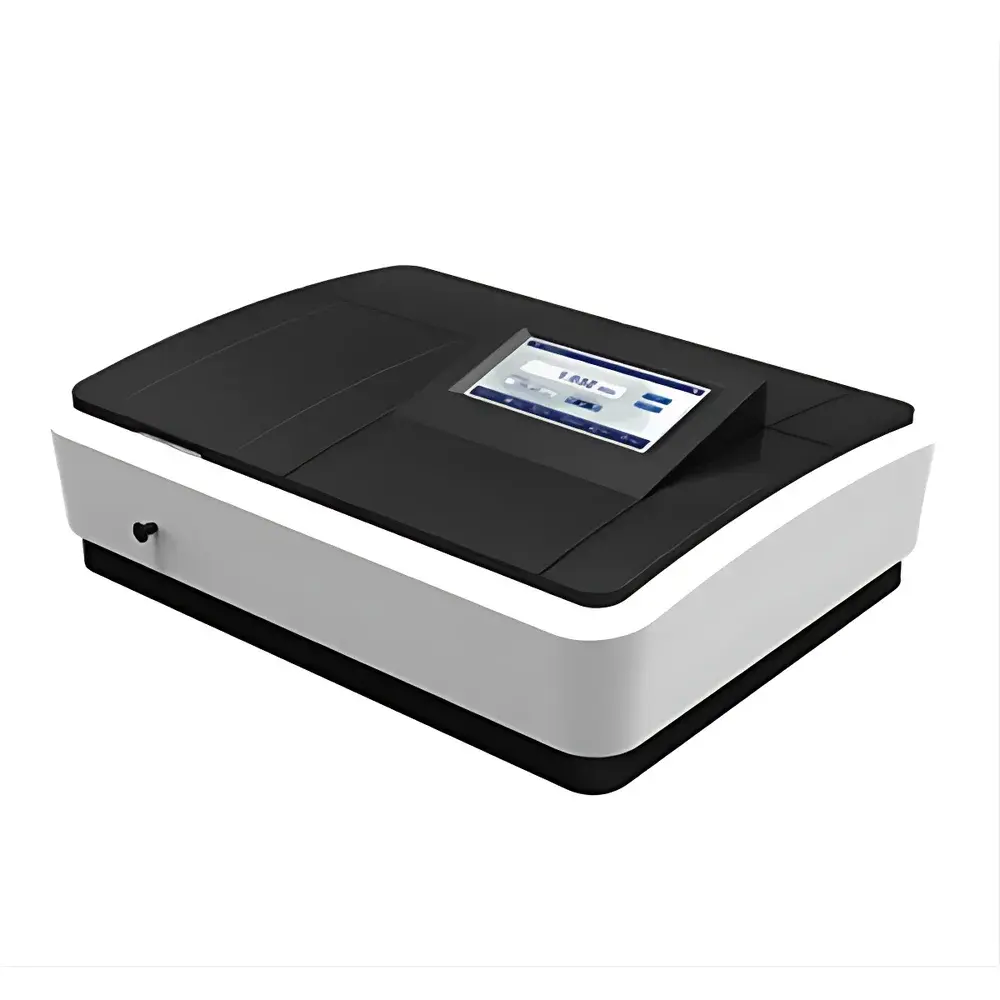
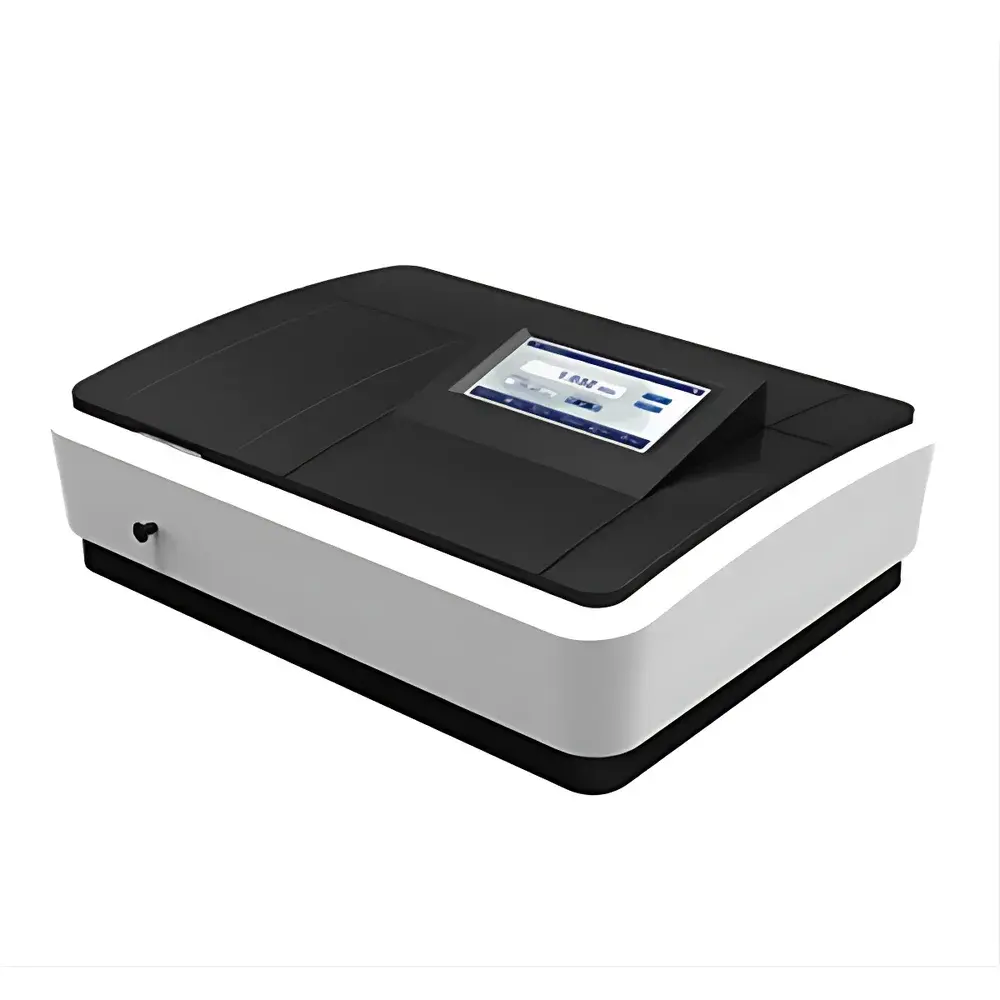
Yoke L-3800 Dual-Beam Ultraviolet-Visible Spectrophotometer
| Brand | Yoke |
|---|---|
| Origin | Shanghai, China |
| Model | L-3800 |
| Optical System | Dual-beam |
| Detector | Photomultiplier Tube (PMT) |
| Wavelength Range | 190–1100 nm |
| Wavelength Accuracy | ±0.3 nm |
| Wavelength Repeatability | ≤0.1 nm |
| Spectral Bandwidth | 1 nm |
| Stray Light | ≤0.03% (at 220 nm, using NaI) |
| Display | 8-inch capacitive touchscreen (1024 × 800 resolution) |
| Light Source | Imported deuterium and tungsten lamps |
| Internal Data Storage | Up to 5000 absorbance measurements or 500 calibration curves |
| Scan Speed | Full-spectrum scan in <1.5 s |
| Auto-functions | Automatic wavelength calibration, source switching, zero adjustment, and baseline correction |
Overview
The Yoke L-3800 is a high-performance dual-beam ultraviolet-visible (UV-Vis) spectrophotometer engineered for precision quantitative and qualitative analysis across academic research laboratories, quality control environments, and industrial R&D settings. Based on the principles of Beer-Lambert law absorption spectroscopy, the instrument employs a CT-type monochromator with a holographic grating and a photomultiplier tube (PMT) detector to deliver high signal-to-noise ratio and exceptional photometric stability. Its dual-beam optical architecture continuously compensates for source drift and environmental fluctuations by splitting the light path into reference and sample beams—ensuring robust baseline integrity during extended measurements or temperature-sensitive assays. Designed for routine compliance with international analytical standards, the L-3800 supports traceable calibration protocols aligned with ISO/IEC 17025 and ASTM E275 for spectrophotometric performance verification.
Key Features
- Dual-beam optical design with real-time reference beam compensation for enhanced photometric accuracy and long-term stability
- High-resolution 8-inch capacitive touchscreen interface (1024 × 800), enabling intuitive navigation, direct spectrum visualization, and standalone operation without external PC
- Advanced ARM12 embedded processor supporting onboard storage of up to 5000 absorbance values or 500 user-defined calibration curves
- Full-wavelength scanning capability (190–1100 nm) with 1 nm spectral bandwidth and ≤0.1 nm wavelength repeatability—meeting stringent requirements for method validation
- Low-stray-light optical path (≤0.03% at 220 nm, measured with sodium iodide solution), critical for accurate low-transmittance measurements in nucleic acid or protein quantification
- Automated operational routines including auto-zeroing, lamp switching (D₂/W), wavelength self-calibration, and baseline correction upon startup
- Reinforced aluminum optical baseplate and physically separated optical/electronic compartments to minimize mechanical vibration and thermal cross-talk
Sample Compatibility & Compliance
The L-3800 accommodates standard 10 mm rectangular cuvettes (glass, quartz, or plastic), as well as optional accessories including temperature-controlled cell holders (±0.1 °C stability), integrating spheres for diffuse reflectance, variable-pathlength cells (1–100 mm), solid-sample reflectance stages, and flow-through cells for kinetic or HPLC coupling applications. All firmware and software modules comply with GLP and GMP documentation requirements: audit trails record user identity, timestamp, parameter changes, and data export events; electronic signatures are supported via configurable user roles and password-protected access levels. The system meets essential elements of FDA 21 CFR Part 11 when operated with validated PC control software—including secure data archiving, immutable log files, and version-controlled method storage.
Software & Data Management
While fully functional as a stand-alone instrument, the L-3800 integrates seamlessly with optional PC-based analytical software for advanced spectral processing, multi-component quantitation, kinetic modeling, and spectral library matching. Data export supports CSV, QUA (SpectraSoft-compatible), TXT, and BMP formats—ensuring interoperability with LIMS platforms and statistical analysis tools such as OriginLab or JMP. USB mass storage support enables direct transfer of spectra, reports, and calibration logs to portable drives without intermediate software. Internal memory maintains full traceability: each stored measurement includes wavelength metadata, date/time stamp, operator ID (if logged in), and instrument configuration snapshot—facilitating retrospective review during regulatory audits.
Applications
The L-3800 serves diverse analytical workflows including but not limited to: nucleic acid and protein concentration determination (A₂₆₀/A₂₈₀ ratios); enzyme kinetics monitoring (e.g., NADH oxidation at 340 nm); colorimetric assay validation (e.g., Bradford, Lowry, BCA); pharmaceutical dissolution testing per USP ; water quality analysis (nitrate, phosphate, COD); thin-film thickness estimation via interference fringe analysis; and pigment characterization in coatings and cosmetics. Its broad spectral coverage and low stray light performance make it suitable for both routine QC screening and method development requiring high dynamic range (up to 3.5 AU) and linearity (R² ≥ 0.9999 over 0–2.5 AU).
FAQ
Does the L-3800 support regulatory-compliant data integrity practices?
Yes—the embedded software enforces role-based access control, time-stamped audit logs, and immutable record retention consistent with GLP, GMP, and FDA 21 CFR Part 11 expectations when used with validated PC software.
Can the instrument perform kinetic measurements?
Yes—its rapid full-spectrum scan speed (<1.5 s) and programmable time-course acquisition enable real-time monitoring of reaction progress at user-defined intervals.
What cuvette materials are compatible with the 190–1100 nm range?
Quartz cuvettes are required for measurements below 350 nm; fused silica or UV-grade quartz is recommended for extended UV use (190–240 nm). Standard optical glass is suitable only above ~350 nm.
Is remote instrument control possible?
Yes—via optional USB or RS-232 connection to Windows-based PCs running the official Yoke SpectraControl Suite, which supports script-driven automation and integration into larger laboratory networks.
How is wavelength accuracy verified and maintained?
The system performs automatic holmium oxide or didymium filter-based wavelength calibration at startup; users may schedule periodic verification using NIST-traceable reference standards per ISO 6507-2 guidelines.




