
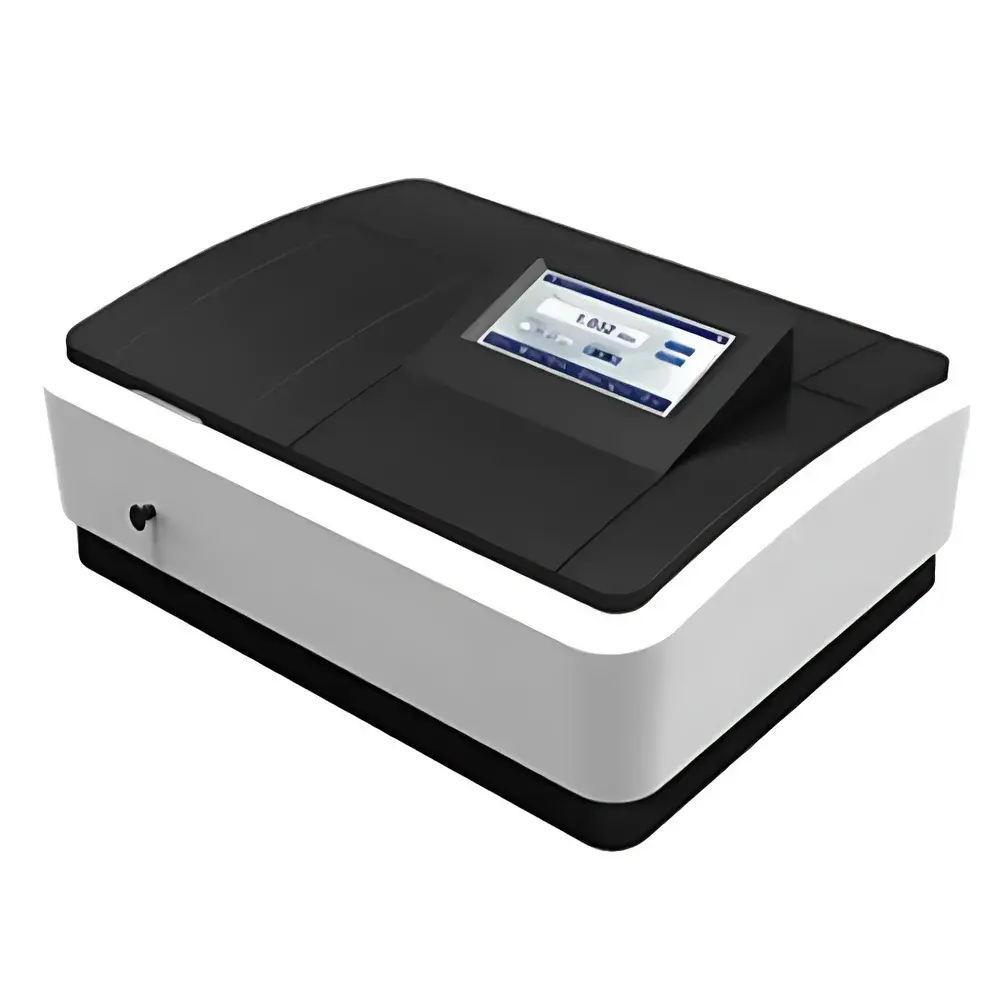
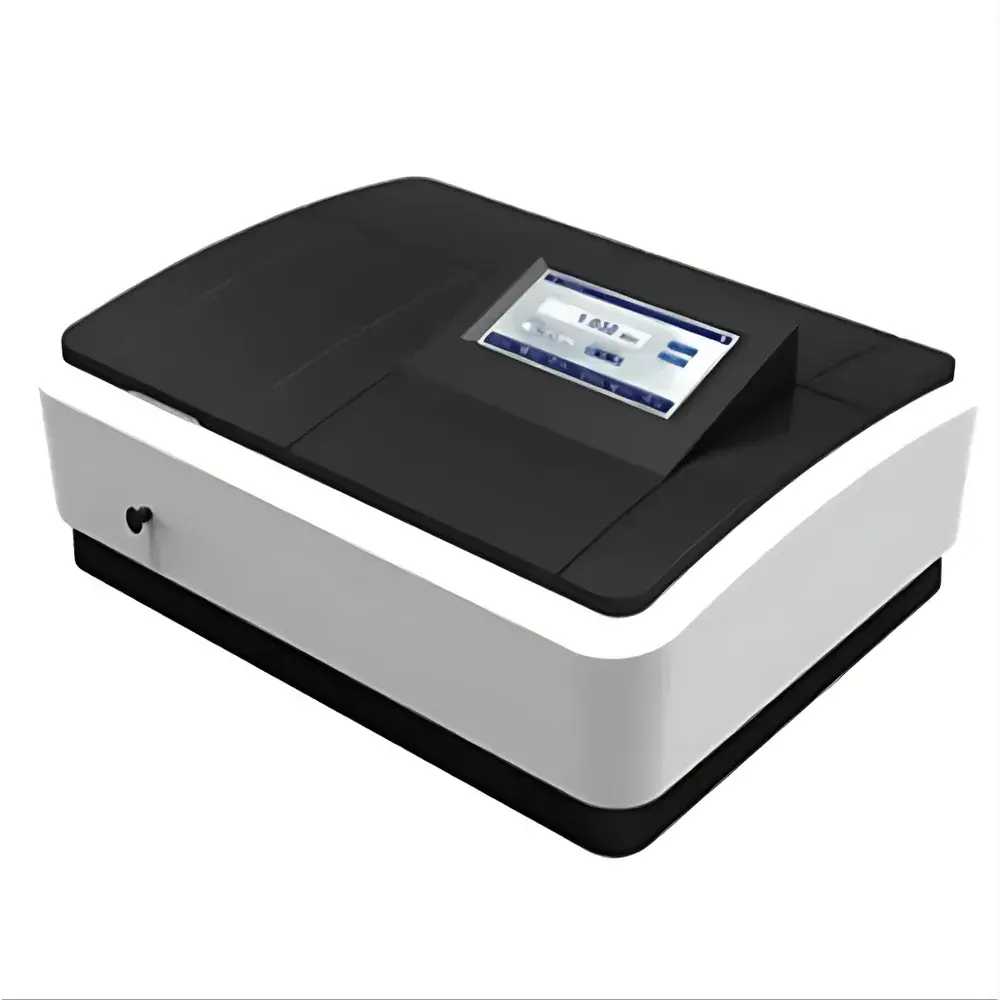
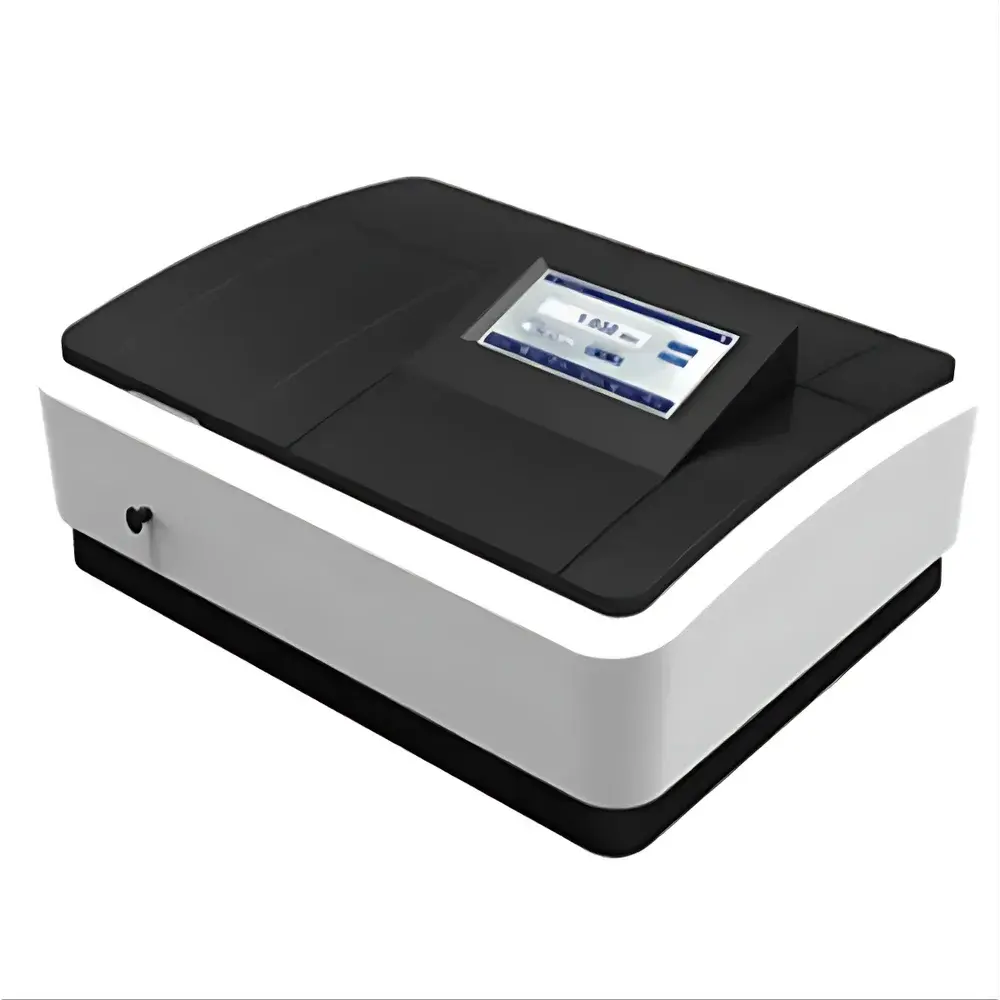
Yoke L-3800S Dual-Beam UV-Vis Spectrophotometer
| Brand | Yoke |
|---|---|
| Origin | Shanghai, China |
| Manufacturer Type | Authorized Distributor |
| Product Origin | Domestic (China) |
| Model | L-3800S |
| Instrument Architecture | Dual-Beam |
| Detector Type | Photodiode Array (PDA) |
| Wavelength Range | 190–1100 nm |
| Wavelength Accuracy | ±0.3 nm |
| Wavelength Repeatability | ≤0.1 nm |
| Spectral Bandwidth | 1 nm (fixed), with optional 0.5/2.0/4.0/5.0 nm selectable via software |
| Stray Light | ≤0.03% T at 220 nm (NaI) |
| Absorbance Range | –4 to +4 Abs |
| Display | 8-inch capacitive touchscreen (1024 × 800 resolution) |
| Internal Storage | 5000 absorbance measurements or 500 calibration curves |
| Data Export Formats | CSV, QUA, TXT, BMP |
| Compliance | GLP/GMP-ready software architecture with user management, audit trail, and electronic record retention |
Overview
The Yoke L-3800S Dual-Beam UV-Vis Spectrophotometer is an engineered analytical instrument designed for high-fidelity quantitative and qualitative analysis across research laboratories, quality control environments, and routine pharmaceutical and chemical testing facilities. Based on the dual-beam optical configuration—where sample and reference beams are measured simultaneously—the L-3800S eliminates time-dependent fluctuations in source intensity and detector response, thereby delivering superior baseline stability and photometric reproducibility over extended measurement cycles. Its core optical path integrates a holographic grating monochromator and a high-density photodiode array detector, enabling rapid spectral acquisition across the full 190–1100 nm range with minimal stray light (<0.03% T at 220 nm, measured using sodium iodide). The system utilizes imported deuterium and tungsten-halogen lamps to ensure continuous spectral coverage from deep UV through near-infrared, while its rigid aluminum optical baseplate and physically separated optical/electronic compartments mitigate mechanical drift and thermal crosstalk—critical factors in long-term instrument reliability.
Key Features
- Dual-beam CT (Czerny-Turner) optical design with real-time reference compensation for enhanced photometric accuracy and reduced baseline drift
- 8-inch high-resolution capacitive touchscreen (1024 × 800) supporting intuitive gesture-based navigation, direct spectrum visualization, and on-device method execution
- Selectable spectral bandwidths (0.5, 1.0, 2.0, 4.0, and 5.0 nm) optimized for resolution–sensitivity trade-off in diverse sample matrices
- Onboard storage capacity for up to 5,000 absorbance readings or 500 user-defined calibration curves—enabling offline operation without PC dependency
- ARM12 high-performance embedded processor ensuring responsive UI interaction, fast data processing, and stable firmware execution
- Low-stray-light optical architecture validated per ISO 9001-aligned manufacturing protocols; compliant with ASTM E275 and ISO 6223 standards for spectrophotometer performance verification
Sample Compatibility & Compliance
The L-3800S accommodates standard 10 mm rectangular cuvettes (quartz, glass, or plastic), as well as microvolume adapters and flow cells compatible with OEM and third-party accessories. It supports both transmission and reflectance measurements, making it suitable for liquid-phase analysis (e.g., enzyme kinetics, nucleic acid quantification), solid thin-film characterization, and suspension turbidity assessment. From a regulatory standpoint, the instrument’s firmware and companion PC software adhere to GLP and GMP operational frameworks: user access levels are role-based, all data modifications generate timestamped audit trails, raw spectra and processed results are stored with immutable metadata (operator ID, date/time, instrument serial number), and electronic signatures comply with FDA 21 CFR Part 11 requirements when deployed with validated software configurations.
Software & Data Management
The L-3800S operates natively via its embedded OS but achieves full functional extension through optional PC-based control software. This application provides advanced spectral processing tools—including derivative spectroscopy, multi-component analysis, kinetic time-scan modeling, and spectral library matching. All data exports retain native precision: CSV files preserve full wavelength–absorbance point pairs; QUA format enables seamless import into industry-standard platforms such as Unscrambler® or MATLAB; BMP exports maintain 1:1 pixel fidelity for publication-grade figures. Data integrity is enforced through automatic checksum validation upon USB transfer, and all exported files include embedded instrument configuration metadata to satisfy traceability mandates under ISO/IEC 17025.
Applications
- Pharmaceutical QC: Assay of active pharmaceutical ingredients (APIs) per USP and EP 2.2.25; dissolution profile monitoring; excipient interference screening
- Environmental testing: Nitrate/nitrite quantification in water per EPA Method 353.2; COD determination using dichromate oxidation
- Life sciences: DNA/RNA concentration and purity (A260/A280, A260/A230); protein quantitation via Bradford/Lowry/Biuret assays
- Materials science: Bandgap estimation of semiconductor thin films; dye degradation kinetics under UV irradiation
- Food & beverage: Colorimetric analysis of anthocyanins, carotenoids, and chlorophyll; preservative (e.g., sulfite) titration endpoints
FAQ
Does the L-3800S support wavelength calibration verification using NIST-traceable standards?
Yes—built-in calibration routines accept certified holmium oxide and didymium filters for wavelength verification per ISO 6223 Annex B.
Can the instrument perform kinetic measurements with variable time intervals?
Yes—time-scan mode supports user-defined interval programming from 0.1 s to 60 min per point, with up to 10,000 data points per run.
Is the photodiode array detector cooled to reduce dark current noise?
No—the PDA operates at ambient temperature; however, its low-noise analog front-end and digital offset correction algorithms achieve effective RMS noise <0.0003 Abs at 546 nm (1 nm SBW, 1 s integration).
What operating systems are supported by the PC control software?
Windows 10/11 (64-bit), with .NET Framework 4.8 and Microsoft Visual C++ Redistributable 2019 required.
How is firmware updated, and is version rollback supported?
Firmware updates are delivered via encrypted USB stick; full version history and signed rollback packages are available upon request for regulated environments.





