
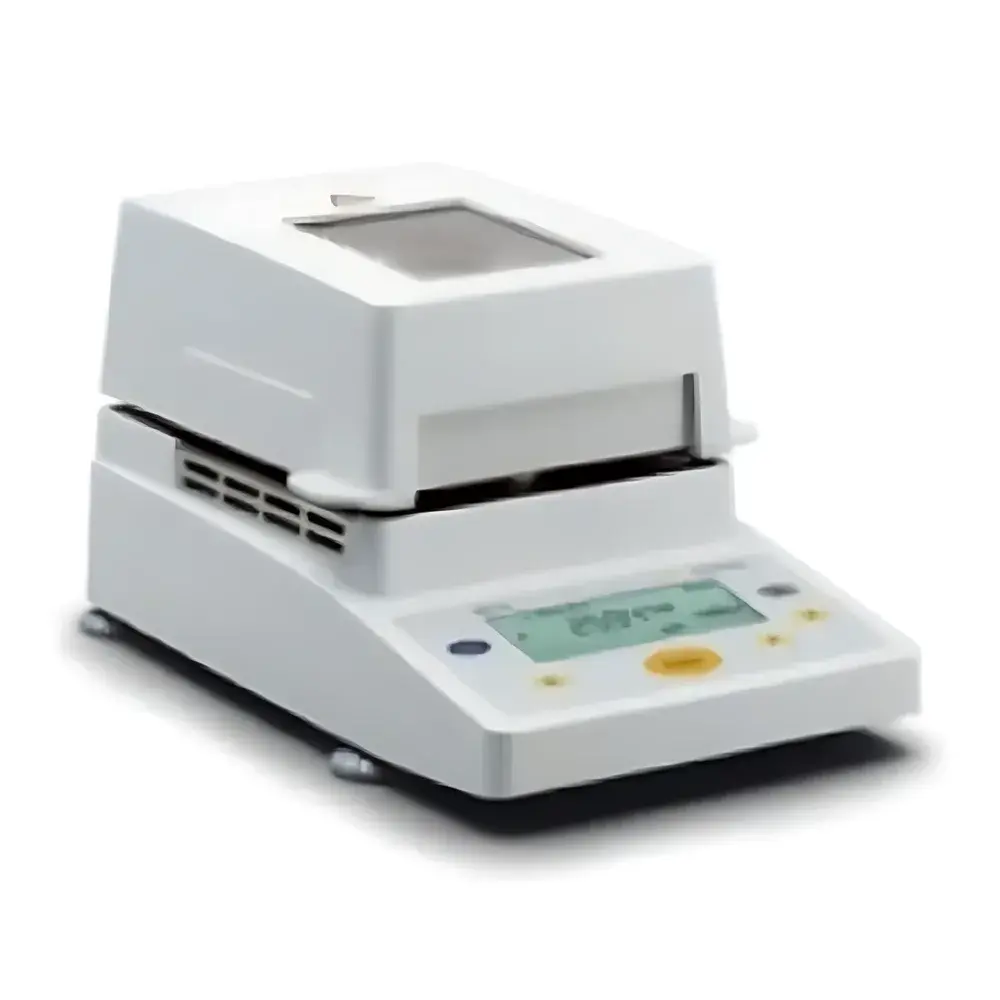
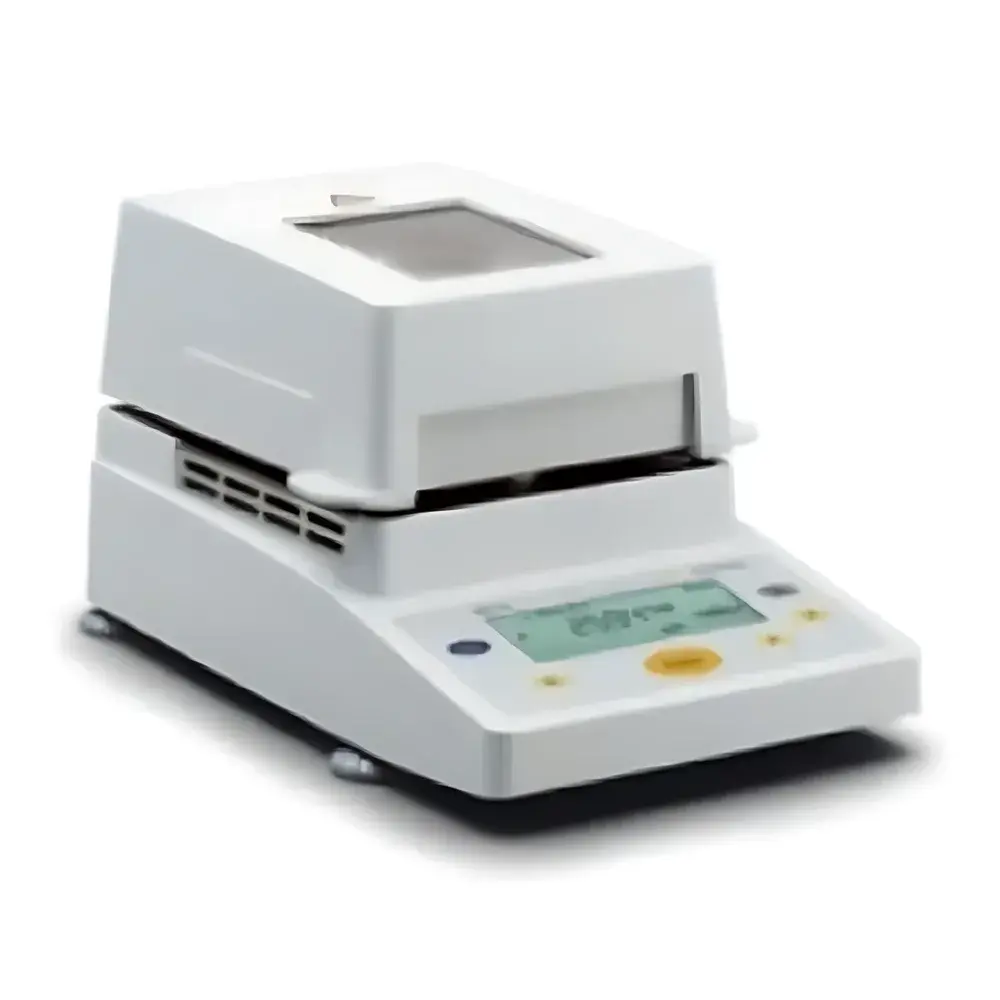
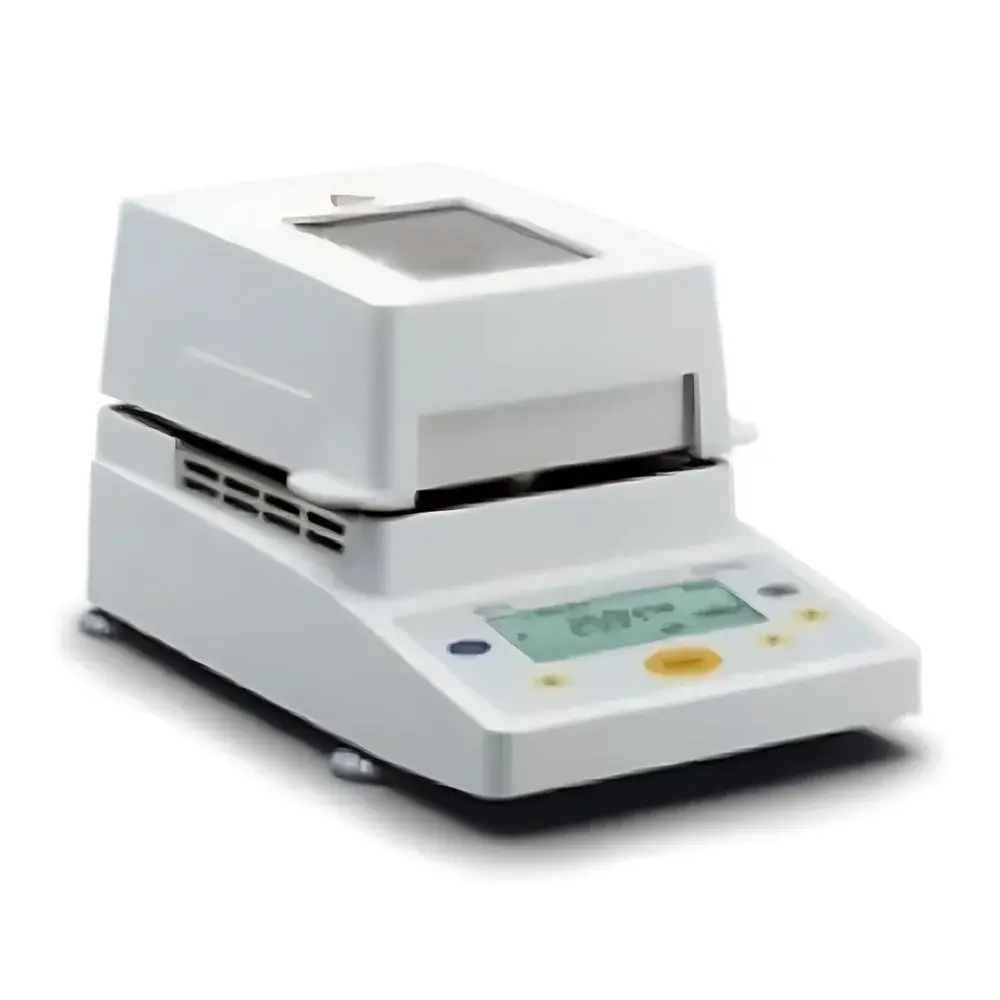
Yoke DSH-100A-1 Halogen Moisture Analyzer
| Brand | Yoke |
|---|---|
| Origin | Shanghai, China |
| Model | DSH-100A-1 |
| Heating Source | Halogen Lamp |
| Weighing Range | 0–100 g |
| Readability | 1 mg |
| Repeatability (3 g sample) | ±0.3% |
| Recommended Sample Mass | 3–10 g |
| Minimum Sample Mass | 0.5 g |
| Heating Time Setting | 1–99 min (1 min increments) |
| Temperature Range | 50–160 °C |
| End Point Control | Timer-based or Auto-termination |
| Display | Backlit dot-matrix LCD showing moisture %, solids %, weight, elapsed time |
| Pan Diameter | 100 mm |
| Dimensions (W×D×H) | 265 × 160 × 150 mm |
| Net Weight | 5 kg |
| Communication Interface | RS232 |
Overview
The Yoke DSH-100A-1 Halogen Moisture Analyzer is a precision laboratory instrument engineered for rapid, gravimetric determination of moisture content in solid and semi-solid samples via halogen lamp-assisted thermogravimetry. It operates on the principle of controlled thermal drying followed by real-time mass loss monitoring: a calibrated halogen heating element uniformly irradiates the sample at user-defined temperatures (50–160 °C), driving off volatile components—primarily water—while a high-stability, thermally isolated weighing sensor continuously records mass changes with 1 mg readability. The resulting mass loss is calculated and reported as moisture percentage (% w/w), solids content, or absolute weight change. Designed for routine quality control and R&D environments, the DSH-100A-1 meets fundamental requirements for method reproducibility, operator safety, and regulatory traceability in industries including pharmaceuticals, food processing, chemicals, and polymers.
Key Features
- Halogen lamp heating system delivering rapid, uniform thermal energy—achieving target temperature in under 60 seconds and reducing average test duration by up to 40% compared to traditional infrared or convection ovens.
- Backlit dot-matrix LCD display with high contrast and wide viewing angle, optimized for low-light laboratory conditions and extended operator use without visual fatigue.
- Thermally isolated load cell architecture minimizing thermal drift during heating cycles, ensuring stable weighing performance across temperature gradients.
- Intuitive membrane keypad interface with tactile feedback, supporting direct parameter entry—including temperature setpoint, drying time, and endpoint mode—without menu nesting.
- RS232 serial interface compliant with standard laboratory data acquisition protocols, enabling seamless integration with LIMS, ELN, or custom reporting software.
- Compact benchtop footprint (265 × 160 × 150 mm) and lightweight construction (5 kg net) suitable for shared lab spaces, QC stations, or mobile analytical setups.
Sample Compatibility & Compliance
The DSH-100A-1 accommodates a broad range of non-volatile or low-volatility matrices, including powders (e.g., APIs, excipients, catalysts), granules, pellets, pastes, and dried botanicals. Samples must be homogeneous and thermally stable below 160 °C to avoid decomposition artifacts. While not certified to ISO 17025 or ASTM E1447 out-of-the-box, the instrument supports method validation per USP , AOAC 955.04, and ISO 712:2022 when paired with documented SOPs, calibration records (including external weight verification at 10 g and 50 g), and environmental controls (draft-free enclosure recommended). Its timer- and auto-termination modes facilitate compliance with GLP documentation standards by enabling unambiguous endpoint definition and audit-ready test logs.
Software & Data Management
Data output is transmitted via RS232 in ASCII format, supporting configurable baud rates (9600 default) and carriage-return line endings. Output includes timestamp, sample ID (user-entered), initial mass, final mass, moisture %, solids %, drying time, and temperature profile summary. When connected to validated third-party software (e.g., LabX-compatible drivers or custom Python/Node.js parsers), the analyzer supports 21 CFR Part 11–compliant electronic records—including user authentication, audit trails, and electronic signatures—if deployed within a validated IT environment. Raw data export enables statistical process control (SPC) charting and trend analysis across batches.
Applications
- Pharmaceutical manufacturing: Moisture verification of active pharmaceutical ingredients (APIs) and tablet granulations prior to compression; stability-indicating testing per ICH Q1A(R2).
- Food quality assurance: Rapid moisture screening of flour, dairy powders, coffee beans, and snack foods to ensure shelf-life compliance and prevent microbial growth.
- Chemical production: Quantification of hydrate water in inorganic salts (e.g., CuSO₄·5H₂O) and residual solvent in polymer intermediates.
- Agricultural testing labs: Field-sample moisture assessment of grains, seeds, and feedstuffs in accordance with ISO 6540 and AACC Method 44-15A.
- Academic research: Teaching thermogravimetric principles and validating alternative drying protocols against reference Karl Fischer titration.
FAQ
What calibration standards are recommended for routine verification?
External weights certified to OIML R111 Class F1 (e.g., 10 g and 50 g) should be used weekly; full calibration per manufacturer’s procedure is advised every 3 months or after instrument relocation.
Can the DSH-100A-1 distinguish between water and other volatiles?
No—it reports total volatile loss as “moisture %” by default. For selective water quantification in volatile-rich matrices, coupling with Karl Fischer titration or TGA-MS is required.
Is the halogen lamp replaceable by the user?
Yes—the lamp module is field-replaceable using standard Torx tools; replacement interval is typically 5,000–8,000 hours depending on average operating temperature and duty cycle.
Does the instrument support multi-step heating programs?
No—the DSH-100A-1 implements single-stage heating only. Multi-ramp protocols require higher-tier models (e.g., Yoke DSH-200 series) or external programmable controllers.
How is thermal uniformity verified across the sample pan?
Uniformity is validated during factory calibration using a NIST-traceable surface thermometer array; users may perform spot checks with a calibrated IR thermometer at center and edge positions under steady-state 105 °C operation.






