
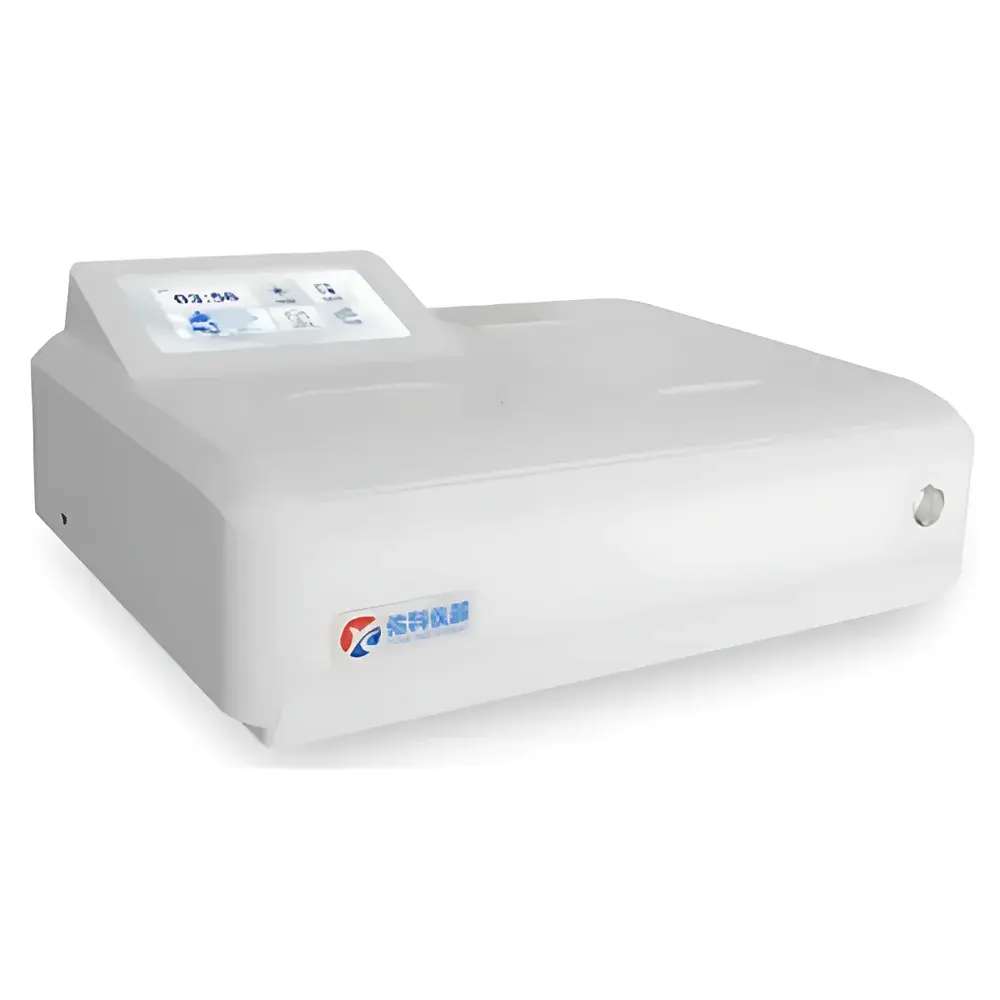
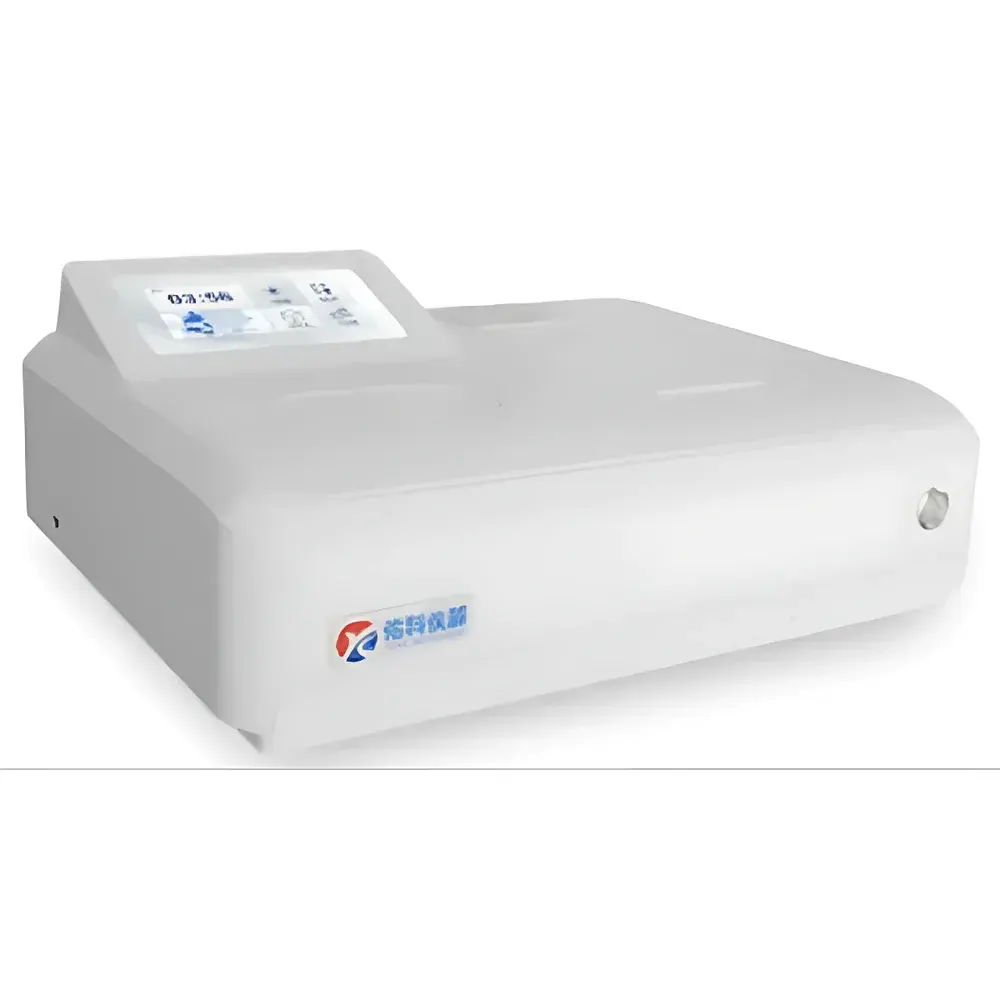
Yoke L1 Rotary-Style IoT-Enabled UV-Vis Spectrophotometer
| Brand | Yoke |
|---|---|
| Origin | Shanghai, China |
| Manufacturer Type | Authorized Distributor |
| Product Origin | Domestic (China) |
| Model | L1 |
| Instrument Architecture | Single-Beam |
| Detector Type | Photodiode Array (PDA) |
| Wavelength Range | 190–1100 nm (UV-Vis) |
| Wavelength Accuracy | ±1 nm |
| Wavelength Repeatability | ≤0.5 nm |
| Spectral Bandwidth | 2 nm (standard), 4 nm (default per spec sheet) |
| Stray Light | ≤0.5% T at 420 nm (NaNO₂ method) |
| Display | 7-inch color TFT-LCD touchscreen (1024 × 768 resolution) |
| Data Storage | 2000 spectra or absorbance readings |
| Connectivity | USB 2.0 port, integrated Wi-Fi module, Bluetooth 5.0 module |
| Software Compatibility | Yokelab PC software (optional), cloud sync via YOKE@Cloud Data app |
| Data Export | CSV/Excel-compatible format via USB flash drive |
| Compliance | Designed to support GLP-compliant workflows with timestamped audit trails, user-access logging, and exportable metadata |
Overview
The Yoke L1 Rotary-Style IoT-Enabled UV-Vis Spectrophotometer is a single-beam, microprocessor-controlled absorption spectrometer engineered for routine quantitative and qualitative analysis in academic teaching labs, QC/QA environments, and small-scale R&D settings. It operates on the principle of Beer–Lambert law-based absorbance measurement across the ultraviolet and visible spectrum (190–1100 nm), utilizing a Czerny–Turner monochromator equipped with a holographic blazed grating for high optical efficiency and spectral fidelity. The instrument employs a photodiode array detector—rather than a single photomultiplier tube—to enable rapid full-spectrum acquisition without mechanical scanning, improving throughput and reducing mechanical wear. Its core optical design prioritizes low stray light performance (<0.5% T at 420 nm, validated per NaNO₂ test per ISO 9001-aligned internal protocol), essential for accurate low-transmittance measurements in colored or turbid samples.
Key Features
- 7-inch high-resolution (1024 × 768) capacitive touchscreen interface with intuitive rotary-knob navigation—designed for glove-compatible operation and reduced screen glare under laboratory lighting.
- Integrated dual-mode connectivity: Wi-Fi and Bluetooth 5.0 modules enable secure wireless data transfer, remote instrument status monitoring, and direct thermal printing without local drivers.
- Cloud-native architecture: Seamless synchronization with YOKE@Cloud Data platform via QR-code-initiated pairing; supports encrypted, time-stamped data upload with role-based access control (RBAC) for multi-user labs.
- High-fidelity optical train: Holographic blazed grating combined with precision slit mechanics delivers consistent 2 nm spectral bandwidth (4 nm default; 2 nm optional configuration), ensuring reproducible peak resolution for standard UV-Vis applications such as protein A280 quantification or dye concentration assays.
- 24-bit analog-to-digital conversion (AD779x-series IC from Analog Devices) enables baseline stability of ≤±0.002 A over 2 hours (25 °C, 500 nm, deuterium lamp), supporting long-duration kinetic studies and low-concentration detection.
- Onboard memory stores up to 2000 absorbance spectra or concentration results and 96 independent calibration curves—including linear, quadratic, and multi-point non-linear models—with automatic curve validation and residual error reporting.
Sample Compatibility & Compliance
The L1 accommodates standard 10 mm pathlength cuvettes (glass, quartz, or plastic) and supports optional micro-volume adapters (not included). It is compatible with common aqueous, organic, and mildly acidic/basic solutions used in pharmaceutical excipient testing, water quality analysis (e.g., nitrate, phosphate), food additive verification, and educational chemistry experiments. While not certified to ISO/IEC 17025 or ASTM E275, its firmware architecture supports GLP-aligned documentation practices—including operator ID tagging, date/time stamps on all measurements, and exportable .CSV logs containing raw intensity values, processed absorbance, wavelength metadata, and instrument configuration parameters. Audit trail functionality meets minimum requirements for internal QA review and FDA 21 CFR Part 11–aligned record retention when paired with Yokelab software and networked authentication.
Software & Data Management
Yokelab PC software (Windows 10/11, 64-bit) provides advanced spectral processing: baseline correction (Rubberband, polynomial), peak integration, derivative spectroscopy, and multi-component analysis using classical least-squares (CLS) algorithms. All exported files conform to ASTM E131-22-defined spectral data format conventions and open natively in Microsoft Excel, OriginLab, or Python (via pandas.read_csv). Cloud-uploaded datasets include embedded EXIF-like metadata: instrument serial number, lamp usage hours, calibration date, ambient temperature, and user-defined sample IDs. No proprietary binary formats are used—ensuring long-term data accessibility and third-party interoperability.
Applications
- Quantitative analysis of nucleic acids and proteins using A260/A280 ratios per USP guidelines.
- Pharmaceutical dissolution testing (UV method) per USP , including real-time release monitoring when integrated into controlled lab networks.
- Environmental water testing for NO3−, NO2−, and PO43− via standardized colorimetric protocols (e.g., EPA 353.2, ISO 6776).
- Food and beverage quality control: caffeine, anthocyanin, and curcumin content verification in extracts and beverages.
- Academic instruction: Beer’s law validation, kinetics of dye degradation, and comparative spectral analysis of transition metal complexes.
FAQ
Does the L1 support compliance with FDA 21 CFR Part 11?
The standalone instrument does not provide electronic signature capability or closed audit trails required for full Part 11 compliance. However, when deployed with Yokelab software on a domain-authenticated Windows system and configured with password-protected user roles, it supports foundational elements—including electronic records, operator identification, and immutable data export—sufficient for internal GxP-aligned documentation.
Can the wavelength range be extended below 190 nm?
No. The optical path uses air-filled optics and standard fused silica cuvettes; vacuum UV operation (<190 nm) requires purged or evacuated systems and specialized detectors, which are outside the L1’s design scope.
Is the 2 nm spectral bandwidth hardware-switchable or firmware-configurable?
It is a fixed optical configuration; the 2 nm option must be selected at time of order. The 4 nm version ships by default and cannot be upgraded post-purchase without monochromator recalibration and factory revalidation.
What file formats does the cloud platform accept for batch import of calibration standards?
YOKE@Cloud Data accepts .CSV files with columns labeled “Wavelength (nm)”, “Absorbance”, and “Concentration (unit)”. Templates and validation rules are available in the platform’s Lab Admin portal.
Is Bluetooth printing compatible with iOS devices?
Yes—iOS 15+ devices can pair directly via Bluetooth and print to MFi-certified thermal printers (e.g., Star SM-L200, Zebra ZQ520) using native AirPrint emulation mode.
Related Products






