
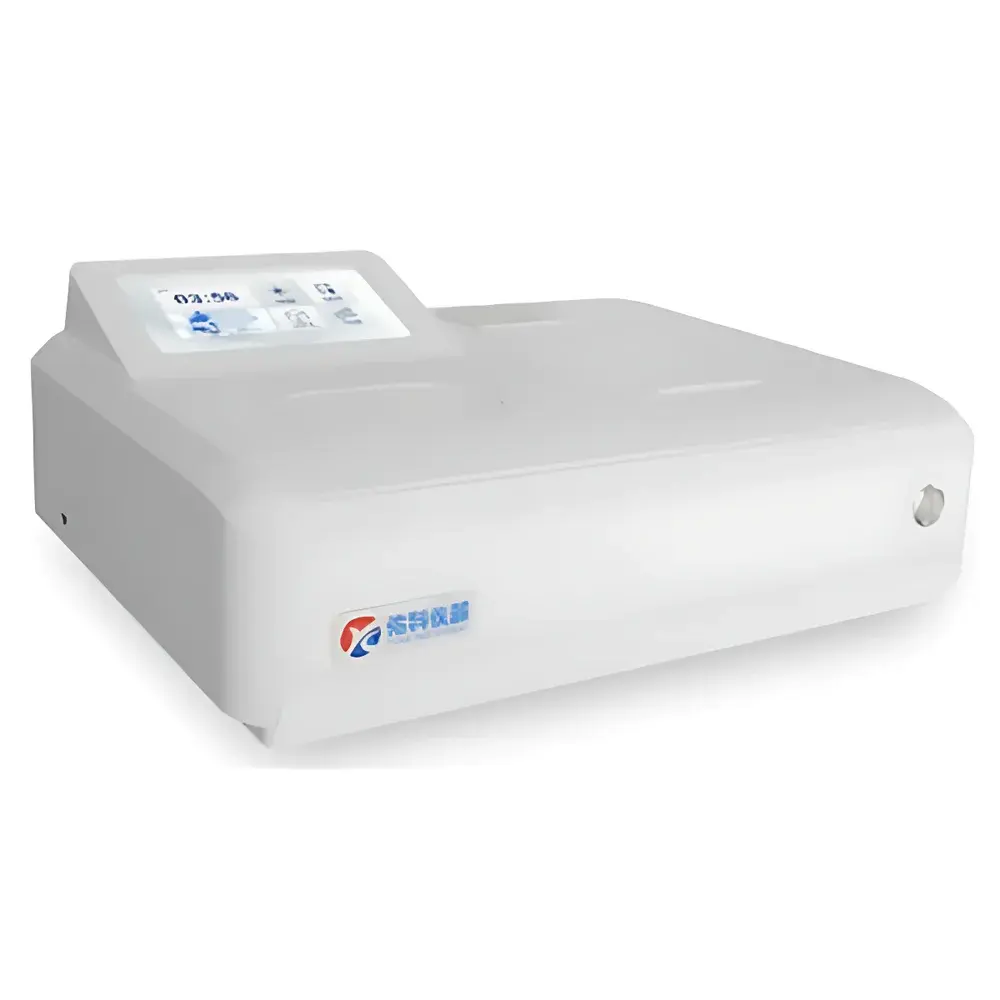
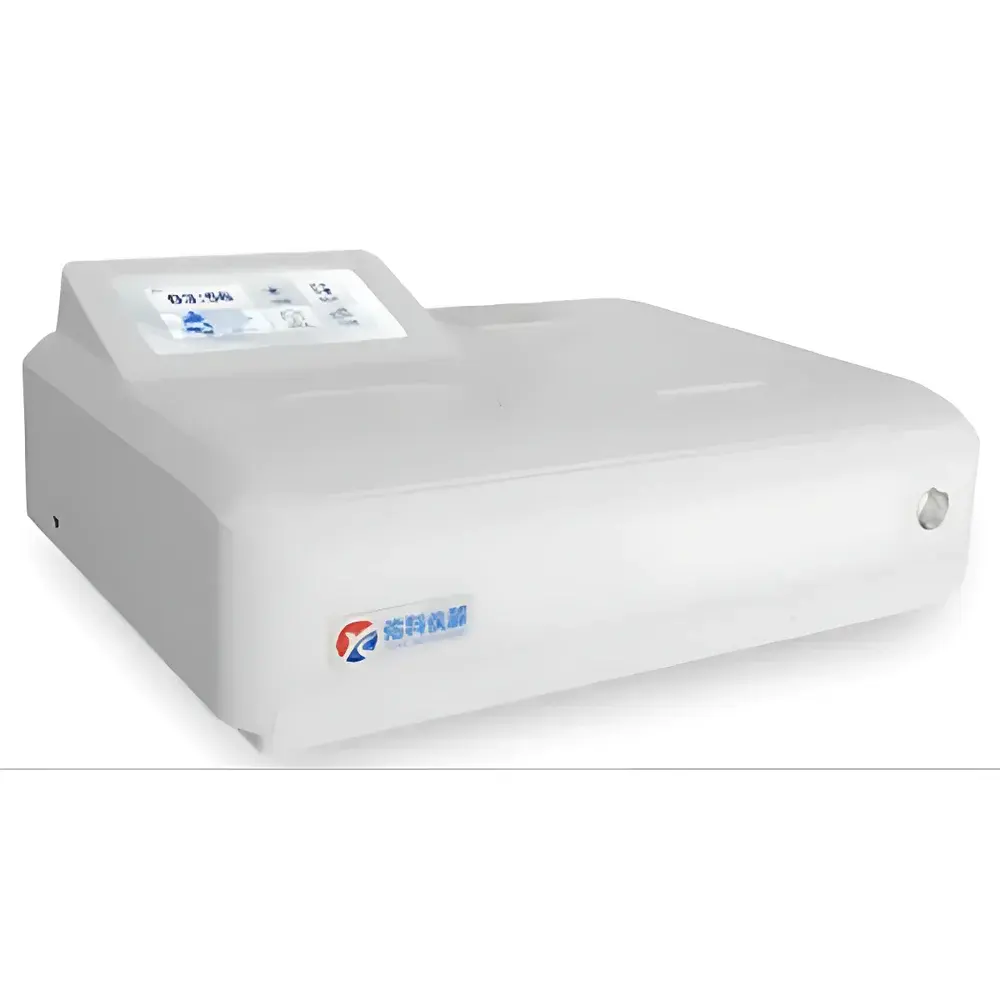
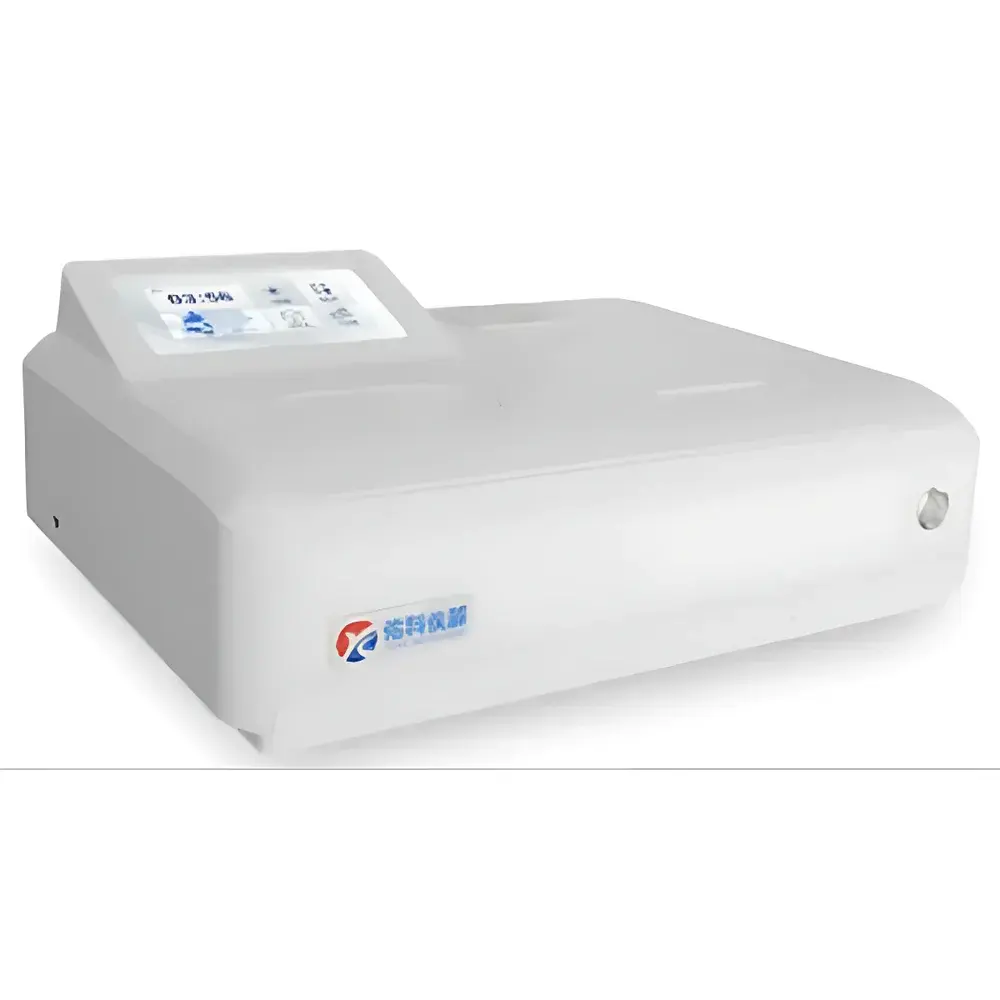
Yoke L2 Rotary-Style Intelligent UV-Vis Spectrophotometer
| Brand | Yoke |
|---|---|
| Origin | Shanghai, China |
| Model | L2 |
| Optical System | Single-beam |
| Detector | Photodiode Array (PDA) |
| Wavelength Range | 190–1100 nm |
| Wavelength Accuracy | ±1 nm |
| Wavelength Repeatability | ≤0.5 nm |
| Spectral Bandwidth | 2 nm (standard), 4 nm (optional) |
| Stray Light | ≤0.5% T at 420 nm (NaNO₂) |
| Display | 7-inch color TFT-LCD (1024 × 768) with capacitive touch |
| Data Storage | 2000 spectra + 96 calibration curves |
| Connectivity | USB 2.0, Wi-Fi 802.11 b/g/n, Bluetooth 4.2 |
| Software Interface | Yokelab PC software (optional), YOKE@Cloud Data mobile app (QR-code enabled) |
| Output Format | CSV/Excel-compatible export via USB drive |
Overview
The Yoke L2 Rotary-Style Intelligent UV-Vis Spectrophotometer is a single-beam, microprocessor-controlled analytical instrument engineered for routine and research-grade quantitative and qualitative analysis in the ultraviolet and visible spectral regions (190–1100 nm). It employs a Czerny-Turner monochromator equipped with a holographic blazed grating to deliver high optical resolution and consistent spectral fidelity. The photodiode array (PDA) detector enables rapid full-spectrum acquisition without mechanical scanning, supporting high throughput and reproducible absorbance measurements. Designed for laboratories requiring regulatory-compliant operation without premium cost, the L2 integrates hardware-level stability (photometric noise < 0.002 A at 500 nm, 1 s integration) with digital infrastructure for secure data handling and remote accessibility.
Key Features
- 7-inch high-resolution (1024 × 768) capacitive touchscreen display with intuitive rotary-knob interface—optimized for glove-compatible operation and reduced visual fatigue during extended use.
- Holographic blazed grating monochromator with 2 nm nominal spectral bandwidth (4 nm optional), delivering low stray light performance (≤0.5% T at 420 nm using NaNO₂ reference) per ASTM E387 and ISO 9022-10 standards.
- 24-bit analog-to-digital conversion (AD) circuitry from Analog Devices ensures high dynamic range (≥3.0 A optical density) and linearity across full wavelength range.
- Onboard memory stores up to 2000 spectral scans and 96 user-defined calibration curves—including linear, quadratic, and multi-point non-linear regression models.
- Integrated dual-mode connectivity: USB 2.0 host port for direct flash-drive export (CSV format, natively readable in Microsoft Excel and MATLAB); Wi-Fi and Bluetooth 4.2 modules support wireless printing, cloud synchronization, and remote instrument status monitoring.
- YOKE@Cloud Data platform accessible via QR-code scan—enables encrypted cloud backup, cross-device access, and audit-ready timestamped metadata (ISO/IEC 17025 traceability support).
Sample Compatibility & Compliance
The L2 accommodates standard 10 mm pathlength cuvettes (glass, quartz, or plastic), as well as optional micro-volume adapters (e.g., 50 µL capillary cells) and flow-through cells for continuous monitoring applications. Its optical design meets key international specifications for UV-Vis instrumentation, including ASTM E275 (describing spectrophotometer terminology and performance criteria), ISO 6425 (for laboratory equipment robustness), and USP (Ultraviolet-Visible Spectroscopy). While not inherently 21 CFR Part 11 compliant out-of-the-box, the Yokelab PC software (optional add-on) provides electronic signature capability, audit trail logging, and role-based user access control—facilitating GLP/GMP-aligned workflows in pharmaceutical QC and contract testing labs.
Software & Data Management
Data acquisition, processing, and reporting are supported through three interoperable layers: (1) embedded firmware with real-time baseline correction, peak detection, and derivative spectroscopy; (2) Yokelab desktop software (Windows/macOS) offering advanced curve fitting, spectral subtraction, and method validation tools—including limit-of-detection (LOD) and limit-of-quantitation (LOQ) calculation per ICH Q2(R2); and (3) YOKE@Cloud Data—a browser-accessible portal enabling secure sharing of calibrated methods, collaborative review of spectra, and automated report generation with customizable templates. All exported CSV files contain embedded metadata: instrument ID, operator name, date/time stamp, wavelength calibration checksum, and environmental sensor readings (ambient temperature/humidity, if enabled).
Applications
- Quantitative analysis of nucleic acids (A260/A280 ratio), proteins (Bradford/Lowry assays), and enzyme kinetics (NADH/NADPH monitoring at 340 nm).
- Pharmaceutical dissolution testing per USP , excipient compatibility screening, and stability-indicating assay development.
- Environmental water quality assessment (nitrate, phosphate, COD estimation) and food safety testing (sulfite, nitrite, anthocyanin content).
- Educational laboratories: teaching Beer-Lambert law fundamentals, spectral deconvolution, and multicomponent analysis using classical least-squares algorithms.
- Industrial QC: incoming raw material verification, batch release testing, and cleaning validation (residue detection down to 0.1 ppm with optimized pathlength).
FAQ
Does the L2 support GLP-compliant data integrity requirements?
Yes—when paired with Yokelab PC software, it supports 21 CFR Part 11-compliant electronic records, including user authentication, immutable audit trails, and electronic signatures.
Can the instrument perform kinetic measurements?
Yes—the firmware supports time-scan mode with adjustable interval (0.1–60 s) and up to 10,000 data points per run, suitable for enzyme activity and reaction rate studies.
Is quartz cuvette calibration required before each use?
No—baseline correction is performed automatically using air or solvent blank; however, periodic wavelength calibration with holmium oxide or didymium filters is recommended per ISO/IEC 17025 every 6 months.
What is the maximum sampling rate in full-spectrum mode?
Full 190–1100 nm scan completes in ≤1.2 seconds with 1 nm data interval, limited only by PDA readout speed and USB/Wi-Fi transfer latency.
Can third-party software interface with the L2?
Yes—SCPI command set and documented API allow integration with LabVIEW, Python (PySerial), and MATLAB via USB virtual COM port or TCP/IP over Wi-Fi.





