
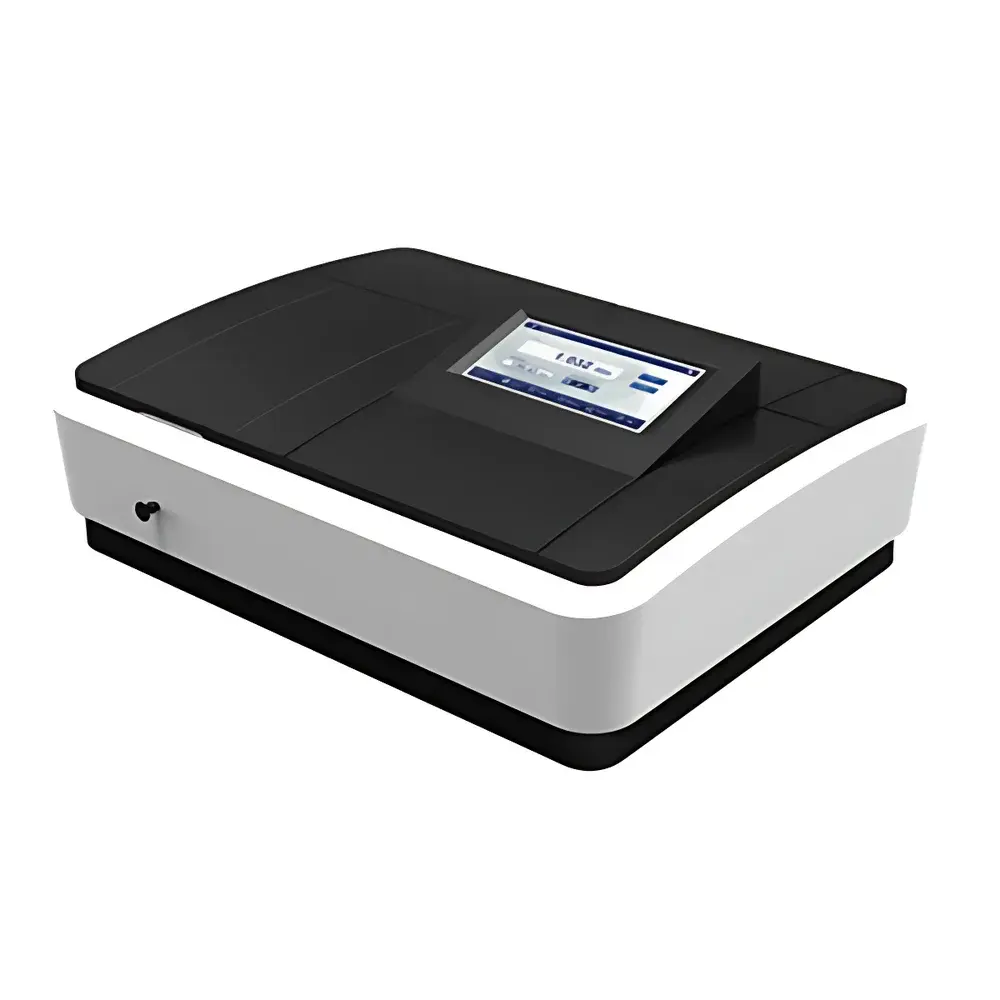
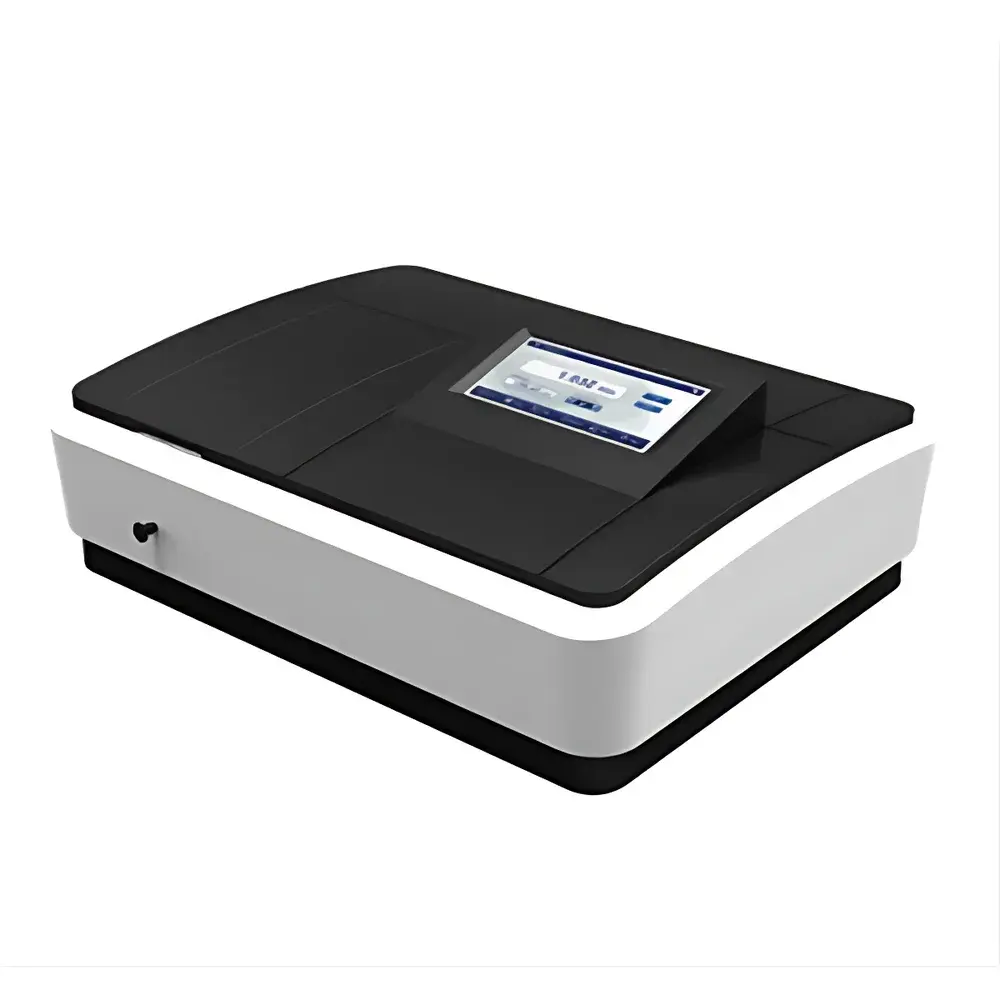
Yoke M700S Dual-Beam Ultraviolet-Visible Spectrophotometer
| Brand | Yoke |
|---|---|
| Origin | Shanghai, China |
| Manufacturer Type | Authorized Distributor |
| Product Origin | Domestic (China) |
| Model | M700S |
| Instrument Architecture | Dual-Beam |
| Detector Type | Photomultiplier Tube (PMT) |
| Wavelength Range | 190–1100 nm |
| Wavelength Accuracy | ±0.3 nm |
| Wavelength Repeatability | ≤0.1 nm |
| Spectral Bandwidth | 1 nm |
| Stray Light | ≤0.03% at 220 nm (using NaI solution) |
| Photometric Range | –4 to +4 Abs |
| Photometric Resolution | 0.00001 Abs |
| Wavelength Scanning Automation | Fully Automatic |
| Display Interface | 11-inch 2.8K resolution tablet with integrated Bluetooth connectivity |
| Software Language Support | Auto-switching between English and Chinese |
Overview
The Yoke M700S Dual-Beam Ultraviolet-Visible Spectrophotometer is an engineered optical analytical instrument designed for high-fidelity absorbance, transmittance, and reflectance measurements across the ultraviolet, visible, and near-infrared spectral regions (190–1100 nm). Its dual-beam optical architecture continuously compares sample and reference beam intensities in real time, effectively compensating for source drift, detector instability, and environmental fluctuations—ensuring long-term photometric stability and measurement reproducibility. The system employs a precision Czerny-Turner monochromator with a holographic grating, coupled with a high-gain, low-noise photomultiplier tube (PMT) detector optimized for sensitivity across the full wavelength range. This configuration enables trace-level quantification in routine QC, academic research, and regulatory-compliant environments where baseline stability and spectral fidelity are critical.
Key Features
- Dual-beam optical path with real-time reference compensation, minimizing baseline drift during extended scans or kinetic assays.
- High-resolution 11-inch 2.8K tablet interface with intuitive multi-mode GUI; supports automatic language switching (English/Chinese) and seamless Bluetooth pairing with peripheral devices.
- Photometric resolution of 0.00001 Abs, enabling detection of minute concentration changes in dilute biological and pharmaceutical samples.
- Fully automated wavelength scanning, peak search, and spectral calibration routines—reducing operator dependency and inter-user variability.
- Integrated hardware diagnostics and remote alerting: configurable email/SMS notifications triggered by instrument fault codes or out-of-spec measurement results.
- Robust mechanical design with temperature-stabilized optical bench and vibration-damped housing for consistent performance in non-ideal laboratory environments.
Sample Compatibility & Compliance
The M700S accommodates a broad spectrum of sample formats—including cuvettes (standard 10 mm, microvolume, and variable-pathlength), solid films, powders (via integrating sphere), and reflective surfaces—through its modular accessory ecosystem. Optional accessories include a Peltier-controlled thermostatic cell holder (±0.1 °C stability), a 6-position automatic cuvette changer, a 360° rotating solid-sample stage, and a calibrated optical integrating sphere for diffuse reflectance and total transmittance measurements. The instrument complies with core international standards relevant to spectrophotometric validation, including ISO 9001:2015 (quality management), ASTM E275 (describing spectrophotometer terminology and practice), and USP (Ultraviolet-Visible Spectrophotometry). While not pre-certified for 21 CFR Part 11, the software architecture supports audit-trail-enabled user accounts, electronic signatures, and data export in CSV, XML, and PDF formats—facilitating integration into GLP/GMP workflows with appropriate site-specific validation.
Software & Data Management
The embedded software suite provides native support for all standard UV-Vis measurement modes: photometric analysis, quantitative determination (single/multi-point calibration, Beer-Lambert regression), kinetic time-course monitoring, full-spectrum scanning (up to 1200 nm/min), multi-wavelength quantitation, and 3D contour mapping (wavelength × time × absorbance). Data acquisition includes real-time smoothing algorithms (Savitzky-Golay, moving average), baseline correction tools (linear, polynomial, rubberband), and peak deconvolution functions. All raw and processed datasets are timestamped, user-logged, and stored locally on the tablet’s encrypted internal memory. Export options include ASCII-compatible formats compatible with LIMS integration and third-party statistical packages (e.g., OriginLab, MATLAB, JMP). Audit trail functionality records operator actions, parameter modifications, and calibration events—supporting traceability requirements under ISO/IEC 17025 and internal QA protocols.
Applications
The M700S serves as a versatile platform across multiple domains: nucleic acid and protein quantification (A260/A280 ratios, extinction coefficient-based concentration calculation); enzyme kinetics (NADH/NADPH oxidation/reduction monitoring at 340 nm); pharmaceutical assay development (dissolution testing, excipient interference studies); water quality analysis (nitrate, phosphate, COD determination); polymer characterization (UV degradation profiling); and thin-film optical thickness estimation via interference fringe analysis. Its high stray light rejection (<0.03% at 220 nm) ensures reliable measurements in low-transmittance regions critical for aromatic compound analysis and high-concentration dye work.
FAQ
Does the M700S support compliance with FDA 21 CFR Part 11?
The instrument does not ship with preconfigured Part 11 compliance features, but its software architecture permits implementation of electronic signature workflows, role-based access control, and immutable audit trails when validated per site-specific SOPs.
Can the M700S perform DNA/RNA purity assessment?
Yes—it includes dedicated nucleic acid analysis modules that calculate A260/A280 and A260/A230 ratios, reference-standard calibration curves, and contamination flagging based on user-defined thresholds.
Is external PC connectivity required for data export?
No—data can be exported directly via USB, Wi-Fi, or Bluetooth to network drives, cloud storage, or LIMS endpoints without requiring a separate computer.
What maintenance is recommended for long-term PMT performance?
Annual verification of wavelength accuracy and photometric linearity using NIST-traceable standards (e.g., Holmium oxide filter, potassium dichromate solution) is advised; PMT gain calibration is performed automatically during startup.
Are method files transferable between M700S units?
Yes—methods, calibration curves, and instrument configurations are saved as portable .mth files and can be loaded across identical M700S systems without reconfiguration.





