
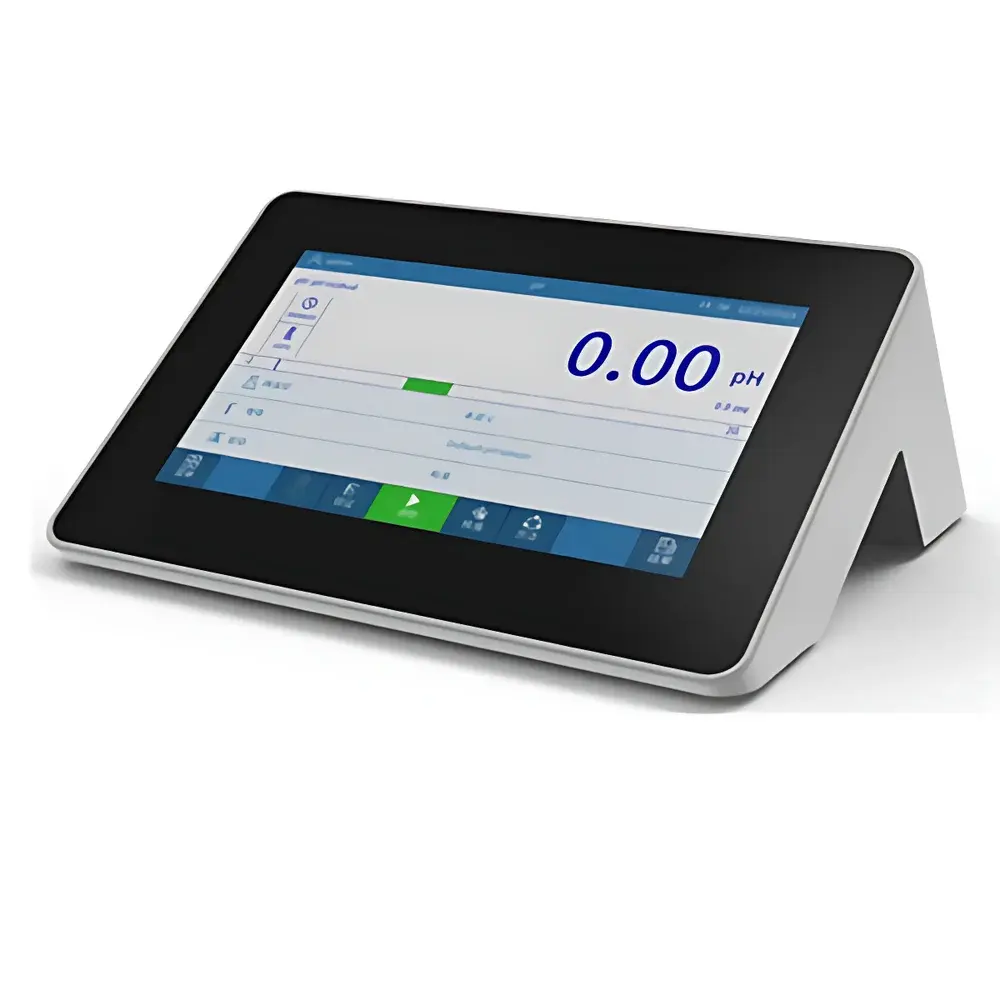
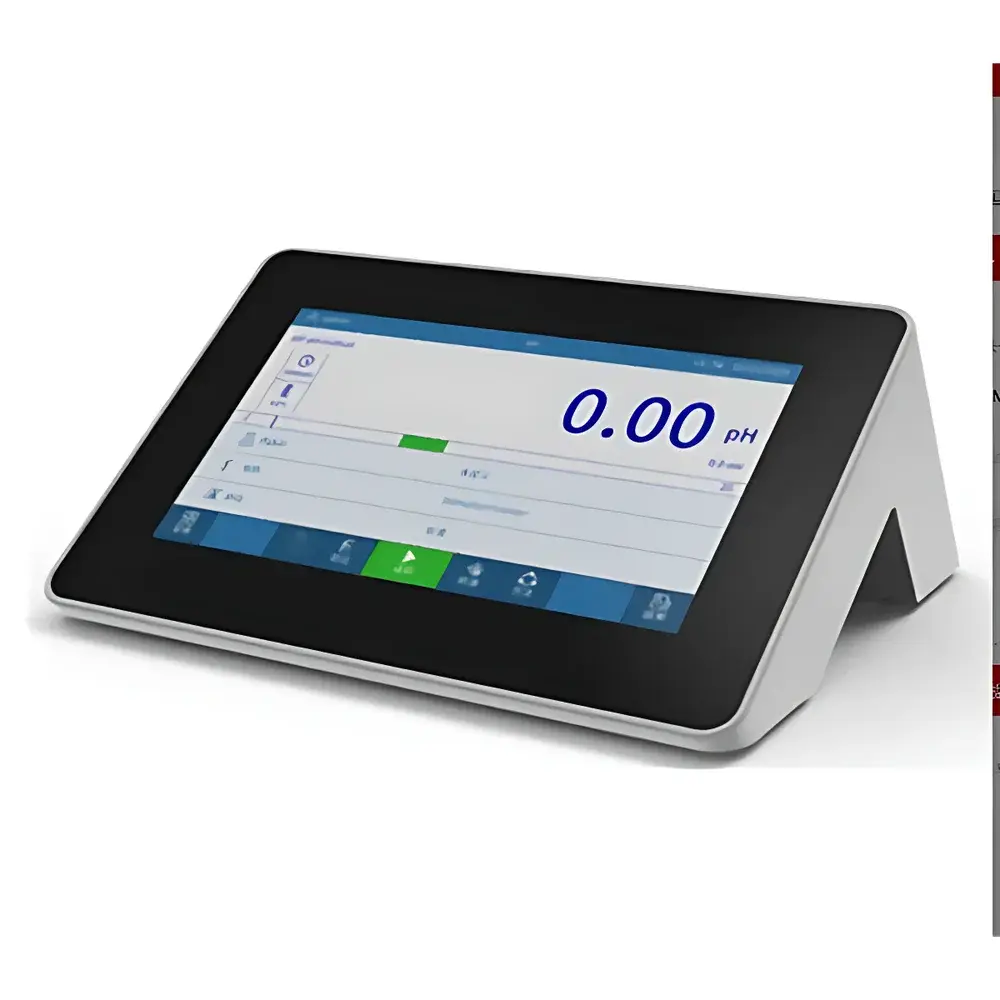
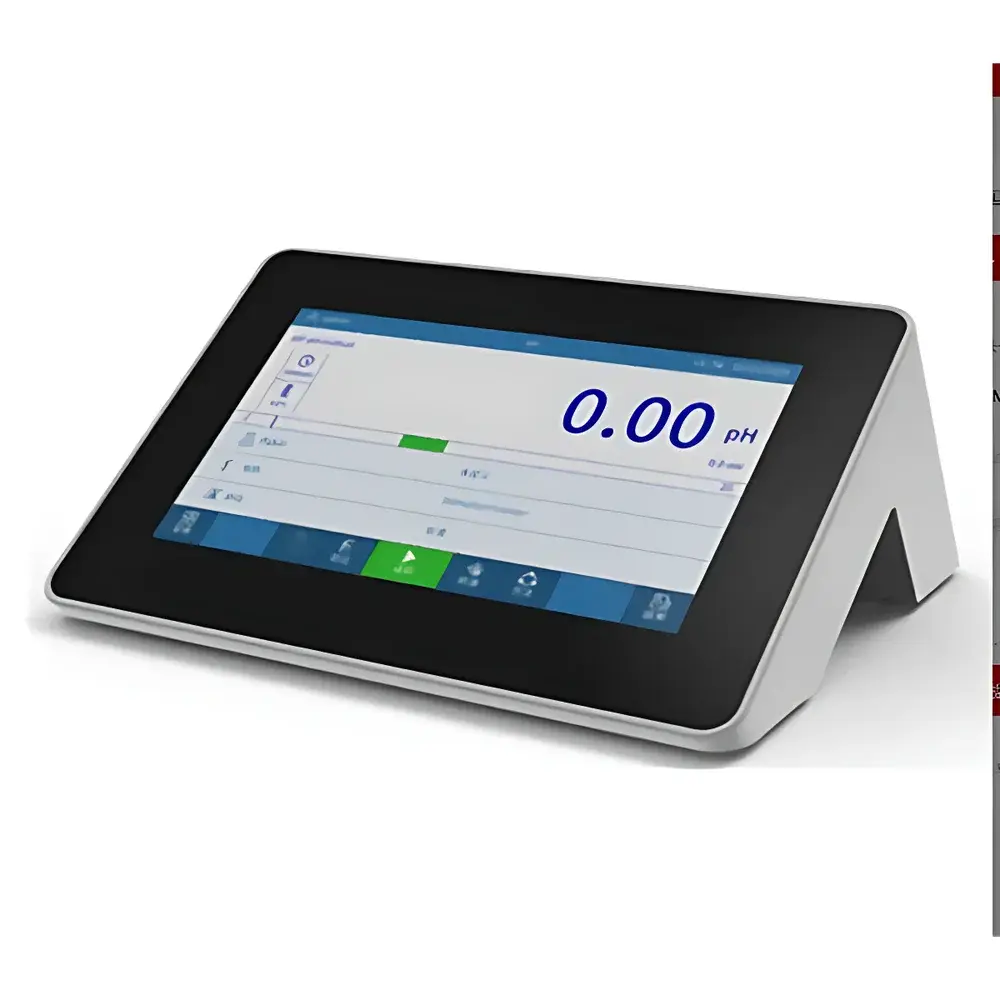
Yoke M907 Portable Fluorescence-Based Dissolved Oxygen and Multi-Ion Analyzer
| Brand | Yoke |
|---|---|
| Origin | Shanghai, China |
| Model | M907 |
| Instrument Type | Portable |
| Measurement Principle | Fluorescence Quenching |
| DO Range | 0–99.00 mg/L |
| DO Detection Limit | 0.01 mg/L |
| DO Accuracy | ±0.5% of reading (ion concentration) |
| Repeatability | ≤±0.2% |
| Display | 7-inch color capacitive touchscreen |
| pH/pX Range | −2.00 to 20.00 |
| pH/pX Resolution | 0.01 (default), selectable to 0.001 or 0.1 |
| mV Range | −1999.9 to +1999.9 mV |
| mV Resolution | 0.1 mV (selectable to 0.01 or 1) |
| Temperature Compensation | Automatic/manual with integrated high-stability temperature electrode |
| Data Management | GLP-compliant storage, audit trail, method recall, USB/printer/PC connectivity |
| Enclosure Rating | IP54 |
| Ion Modes | Direct concentration, standard addition, sample addition, Gran plot |
| Supported Ions | H⁺, Ag⁺, Na⁺, K⁺, NH₄⁺, Cl⁻, F⁻, and user-definable |
| Units | mg/L, g/L, mol/L, pX |
| Calibration Tracking | Auto-log with expiry alert |
| Stirring | Integrated magnetic stirrer |
| Endpoint Detection | Configurable stability criteria |
Overview
The Yoke M907 is a portable, multi-parameter benchtop-to-field analyzer engineered for high-precision water quality assessment in environmental monitoring, municipal wastewater treatment, aquaculture, and regulatory compliance laboratories. Unlike conventional electrochemical dissolved oxygen (DO) sensors subject to membrane fouling and oxygen consumption, the M907 employs solid-state fluorescence quenching technology—measuring the phase shift and intensity decay of ruthenium-based luminophore emission under modulated blue light excitation. This optical method eliminates electrolyte depletion, reduces drift, and delivers stable, maintenance-light DO quantification across full range (0–99.00 mg/L) with a detection limit of 0.01 mg/L. Simultaneously, its integrated ion-selective electrode (ISE) platform supports potentiometric measurement of pH, redox potential (mV), and up to nine common aqueous ions—including H⁺, Ag⁺, Na⁺, K⁺, NH₄⁺, Cl⁻, and F⁻—with configurable resolution (0.001–0.1 pH; 0.01–1 mV) and multiple quantification strategies (direct readout, standard addition, sample addition, Gran plot). Designed for field-deployable rigor without sacrificing laboratory-grade traceability, the M907 bridges the gap between portable convenience and metrological integrity.
Key Features
- 7-inch high-brightness color capacitive touchscreen with intuitive icon-driven workflow—guides users stepwise through calibration, verification, sample measurement, and report generation.
- Integrated high-stability temperature sensor with automatic or manual temperature input; enables real-time temperature compensation per ISO 5814 and ASTM D888 standards.
- Configurable endpoint detection: user-defined stability thresholds (e.g., ΔpH < 0.002 over 10 s) ensure consistent reading timing across variable matrix conditions.
- Magnetic stirrer built-in—ensures homogeneous sample mixing during ISE measurements, critical for accurate standard addition and low-concentration ion analysis.
- GLP-compliant data governance: auto-timestamped calibration logs, electrode usage tracking with expiry alerts, full audit trail, and electronic signature-ready method storage.
- Multi-unit flexibility: seamless switching among mg/L, g/L, mol/L, and pX for all supported ions; supports custom buffer recognition and user-defined calibration curves.
- IP54-rated enclosure—dust-resistant and protected against water splashes from any direction, enabling reliable operation in humid field environments or wet lab benches.
Sample Compatibility & Compliance
The M907 is validated for use with freshwater, seawater (with salinity compensation), wastewater effluents, drinking water, and process streams containing suspended solids up to 500 mg/L TSS. Its fluorescence DO probe exhibits minimal interference from chloride, hydrogen sulfide, or heavy metals—unlike Clark-type electrodes—making it suitable for industrial discharge monitoring per EPA Method 4500-O G and ISO 5815-2. For ion analysis, the instrument complies with ISO 10523 (pH), ISO 14911 (fluoride), and ASTM D6919 (chloride), and supports FDA 21 CFR Part 11–ready data export when paired with validated PC software. All calibrations adhere to NIST-traceable reference standards, and electrode performance is verified using certified reference materials (CRMs) per ISO/IEC 17025 requirements.
Software & Data Management
Data handling conforms to Good Laboratory Practice (GLP) and current Good Manufacturing Practice (cGMP) documentation standards. The M907 stores ≥10,000 measurement records with full metadata: date/time, operator ID, electrode serial number, calibration history, temperature, and method parameters. USB-C port enables direct export of CSV or PDF reports to flash drives or printers; optional YokeLink PC software provides advanced statistical analysis (mean, SD, RSD, linear regression), trend plotting, and secure network transfer via encrypted FTP or local LAN. Stored methods—including electrode types, slope acceptance criteria, unit selections, and endpoint logic—can be recalled instantly, eliminating reconfiguration errors and supporting ISO/IEC 17025 method validation protocols.
Applications
- Regulatory compliance testing for municipal wastewater discharge permits (e.g., NPDES) requiring DO and nutrient ion reporting.
- Aquaculture facility management—real-time DO optimization and ammonium toxicity risk assessment in recirculating systems.
- Drinking water distribution network monitoring—trace fluoride and chloride profiling for corrosion control and disinfection byproduct mitigation.
- Environmental site assessment—field screening of contaminated groundwater plumes for metal cations (Ag⁺, Pb²⁺ via indirect ISE) and anions (Cl⁻, F⁻).
- Educational laboratories—teaching potentiometric theory, Gran plot analysis, and fluorescence-based sensing principles with reproducible, low-maintenance instrumentation.
FAQ
Does the M907 require membrane replacement or electrolyte refilling for DO measurement?
No—the fluorescence-based DO sensor contains no consumable membranes or internal electrolytes; only periodic optical window cleaning is recommended.
Can the instrument store and apply different calibration curves for the same ion across multiple sample matrices?
Yes—up to 20 user-named methods can be saved, each with unique calibration points, units, temperature coefficients, and endpoint logic.
Is the magnetic stirrer speed adjustable?
Yes—three fixed speeds (low/medium/high) are selectable per method to optimize response time without inducing cavitation or vortex artifacts.
How does the system validate electrode health before measurement?
It evaluates slope (%/decade), asymmetry potential, and response time against user-defined acceptance limits; alerts if values fall outside configured thresholds.
Does the M907 support LIMS integration?
Via optional YokeLink software with HL7 or ASTM E1384-compliant export templates, enabling direct ingestion into laboratory information management systems.







