
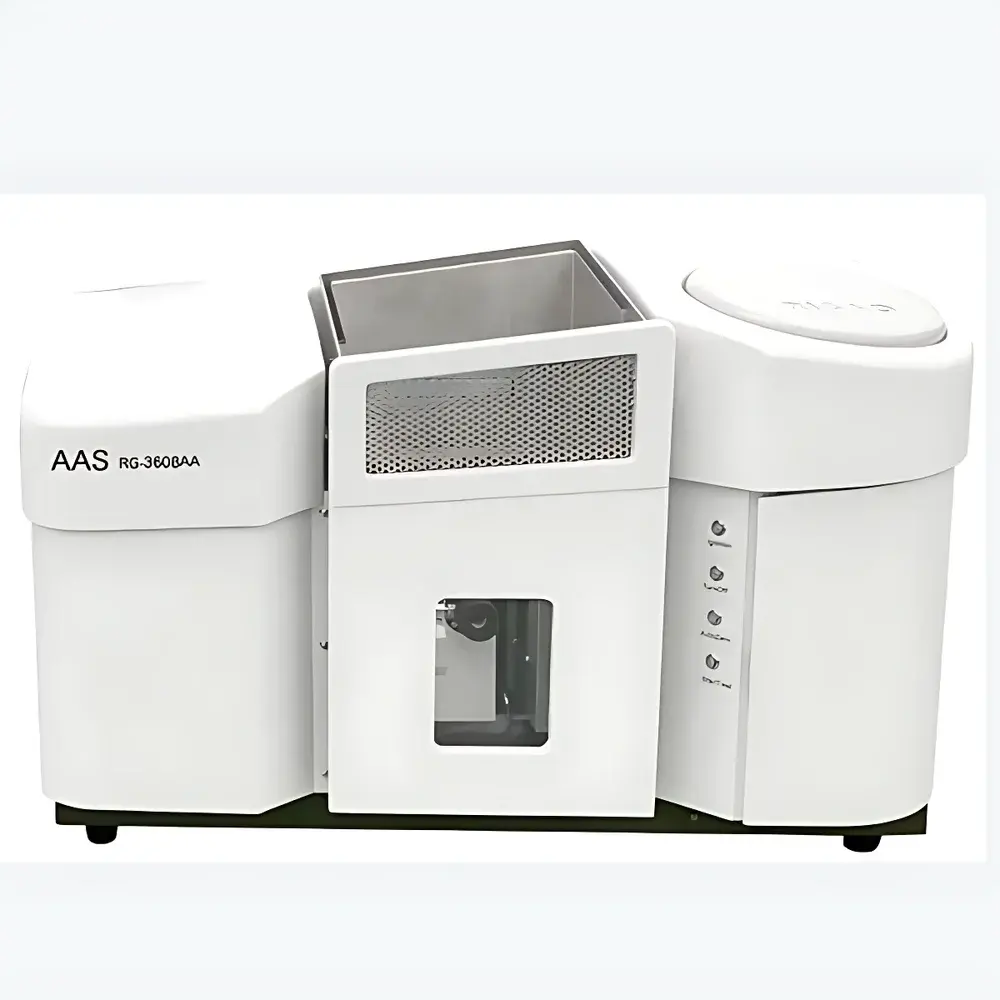
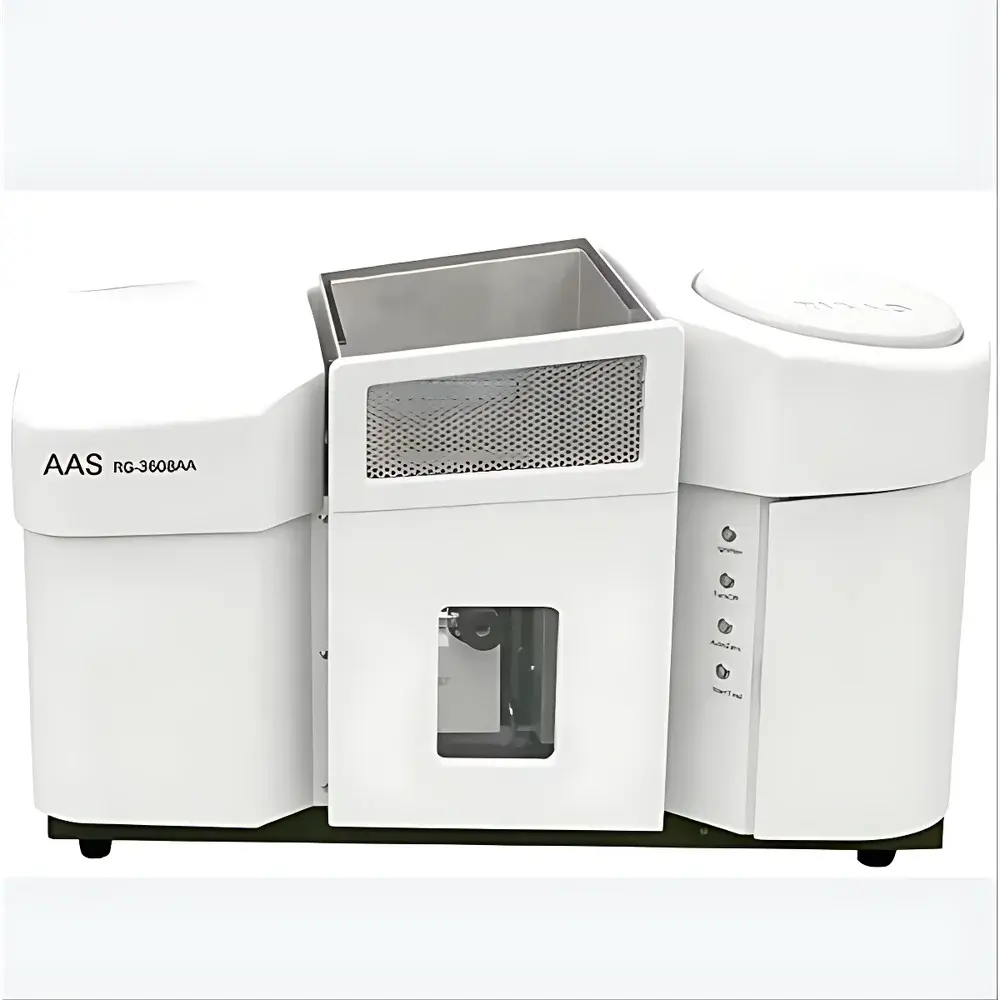
Yoke RG-3638AA Flame and Graphite Furnace Atomic Absorption Spectrophotometer
| Brand | Yoke |
|---|---|
| Origin | Shanghai, China |
| Model | RG-3638AA |
| Wavelength Range | 190–900 nm |
| Wavelength Repeatability | ≤0.05 nm |
| Wavelength Accuracy | ±0.1 nm |
| Photometric Range | 0–2.0 A (Absorbance) |
| Optical System | Single-beam |
| Lamp Positions | 8-position rotating turret (360° rotation, compatible with high-performance hollow cathode lamps) |
| Background Correction | Dual-mode — D₂ lamp + self-reversal (SR) full-spectrum background correction |
Overview
The Yoke RG-3638AA is a dual-mode atomic absorption spectrophotometer engineered for quantitative elemental analysis in laboratory and quality control environments. It supports both flame atomic absorption spectroscopy (FAAS) and graphite furnace atomic absorption spectroscopy (GFAAS), enabling trace-level detection (sub-ppt range in GFAAS mode) and routine ppm-level analysis (in FAAS mode) across environmental, pharmaceutical, food safety, geological, and metallurgical applications. The instrument operates on the fundamental principle of measuring ground-state atomic vapor absorption at element-specific resonance wavelengths—generated by hollow cathode lamps—and quantifies analyte concentration via Beer–Lambert law correlation. Its single-beam optical architecture incorporates a high-efficiency all-reflective optical path, minimizing chromatic aberration and photon loss while maximizing signal-to-noise ratio (SNR) across the 190–900 nm spectral range.
Key Features
- All-reflective optical system with precision-aligned mirrors and low-stray-light monochromator, delivering high photometric stability and SNR essential for low-concentration measurements.
- Intelligent gas control module with real-time pressure monitoring and fail-safe interlocks for acetylene, nitrous oxide, and argon—compliant with EN ISO 15001 and OSHA-compliant combustion safety protocols.
- Dual-background correction capability: simultaneous D₂-lamp continuum correction (for broadband molecular absorption) and self-reversal (SR) correction (for structured, line-specific background), ensuring accuracy in complex matrices such as soil digests or biological fluids.
- 8-position motorized lamp turret with 360° continuous rotation and automatic lamp identification—enabling rapid multi-element sequential analysis without manual intervention.
- Modular atomizer design featuring interchangeable flame and graphite furnace systems; integrated vertical lift mechanism with position feedback ensures reproducible burner head alignment and graphite tube centering.
- Comprehensive flame and furnace temperature programming, including drying, ashing, atomization, and cleaning steps with ramp/hold control—fully customizable per method in accordance with ASTM D3917 and ISO 11170.
Sample Compatibility & Compliance
The RG-3638AA accommodates liquid samples (aqueous and organic solvents), acid-digested solids, and slurries—compatible with standard 10–100 µL sample volumes in GFAAS and 3–5 mL nebulized solutions in FAAS. Sample introduction includes pneumatic nebulization (with adjustable flow rates) and autosampler-ready interfaces (e.g., AS-3600 compatibility). The system meets core regulatory expectations for analytical instrumentation: it supports audit-trail-enabled method storage, user-access-level management (administrator/operator/guest), and electronic signature functionality aligned with FDA 21 CFR Part 11 requirements when deployed with validated RG-WinAAS software configurations. All calibration and QC data comply with ISO/IEC 17025 documentation standards for testing laboratories.
Software & Data Management
RG-WinAAS is a Windows-based, CE-marked application designed specifically for AAS operation and data integrity. It provides intuitive method development—including wavelength selection, slit width optimization, lamp current tuning, and background correction mode assignment—as well as automated calibration curve generation (linear, quadratic, or forced-zero intercept). Raw absorbance/time profiles, peak area/height integration, and matrix-matched standard addition are supported. Data export conforms to ASTM E1382-compliant ASCII and CSV formats; optional LIMS integration via ODBC drivers enables seamless transfer to enterprise laboratory information management systems. Software validation packages—including IQ/OQ documentation templates—are available upon request for GLP/GMP-regulated facilities.
Applications
- Environmental monitoring: Pb, Cd, As, Hg, Cr quantification in wastewater, leachates, and airborne particulate filters (per EPA Method 200.7/200.9).
- Pharmaceutical QC: Catalyst residue testing (e.g., Pd, Pt, Ni) in active pharmaceutical ingredients (APIs) per USP and .
- Food and agriculture: Na, K, Ca, Mg, Fe, Zn profiling in fortified cereals and infant formula; toxic metal screening in spices and seafood.
- Geochemical analysis: Rare earth element (REE) determination in rock digests using GFAAS-enhanced sensitivity.
- Metallurgical process control: Cu, Mn, Si, Al analysis in aluminum alloys and steel melts via flame AAS with air-acetylene or N₂O-acetylene flames.
FAQ
Does the RG-3638AA support hydride generation or cold vapor techniques?
No—the RG-3638AA is configured exclusively for flame and graphite furnace atomization. Hydride generation (HG-AAS) and cold vapor (CV-AAS) require dedicated accessories not included in the base configuration.
Is RG-WinAAS compliant with 21 CFR Part 11 out-of-the-box?
The software includes foundational controls (user authentication, audit trail, electronic signatures); however, full Part 11 compliance requires site-specific validation, documented SOPs, and IT infrastructure alignment—services available through Yoke’s certified validation support team.
What maintenance intervals are recommended for the graphite furnace system?
Graphite tubes should be replaced after 200–500 firings depending on matrix aggressiveness; platform conditioning and furnace cleaning are advised before each analytical batch. Annual optical alignment and gas system leak verification are recommended.
Can the instrument operate without a dedicated exhaust hood?
Flame operation mandates certified fume extraction meeting local occupational health codes (e.g., ANSI Z9.5); graphite furnace mode requires only ambient ventilation but benefits from localized capture during ashing/atomization due to volatile matrix emissions.





