
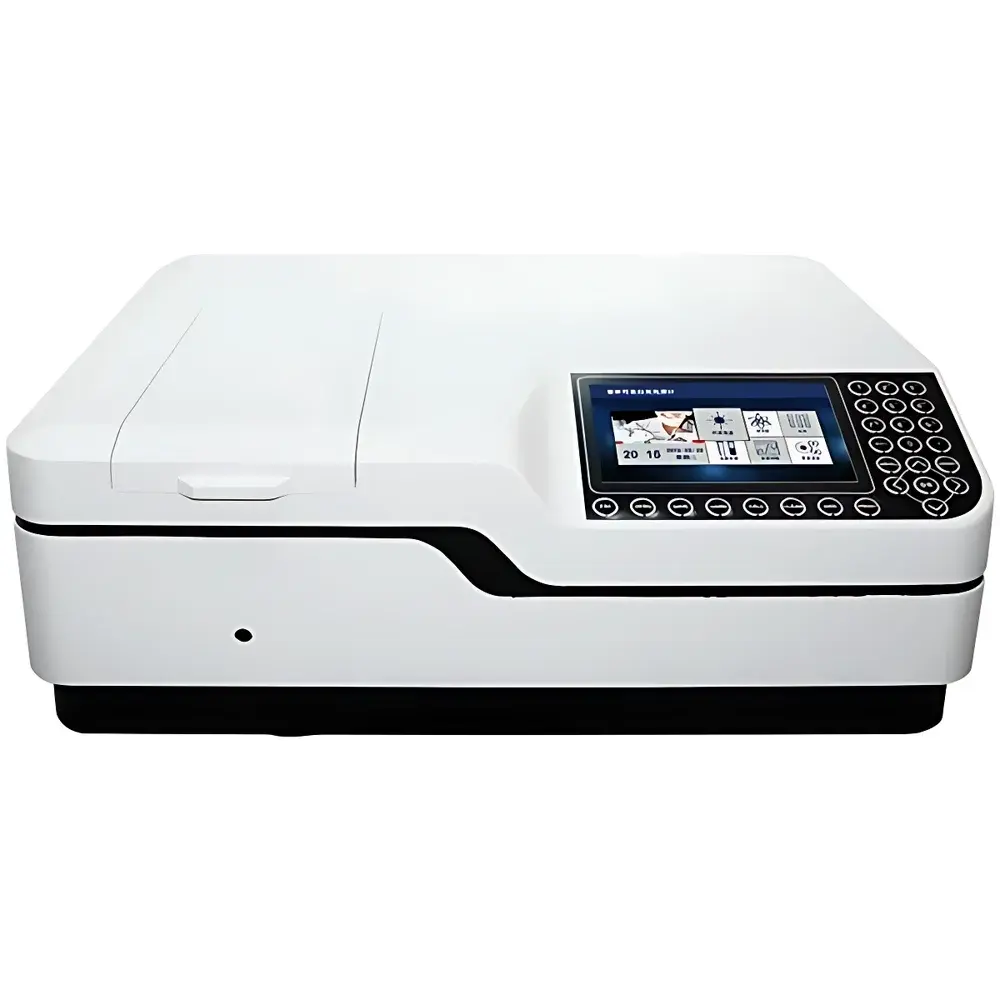
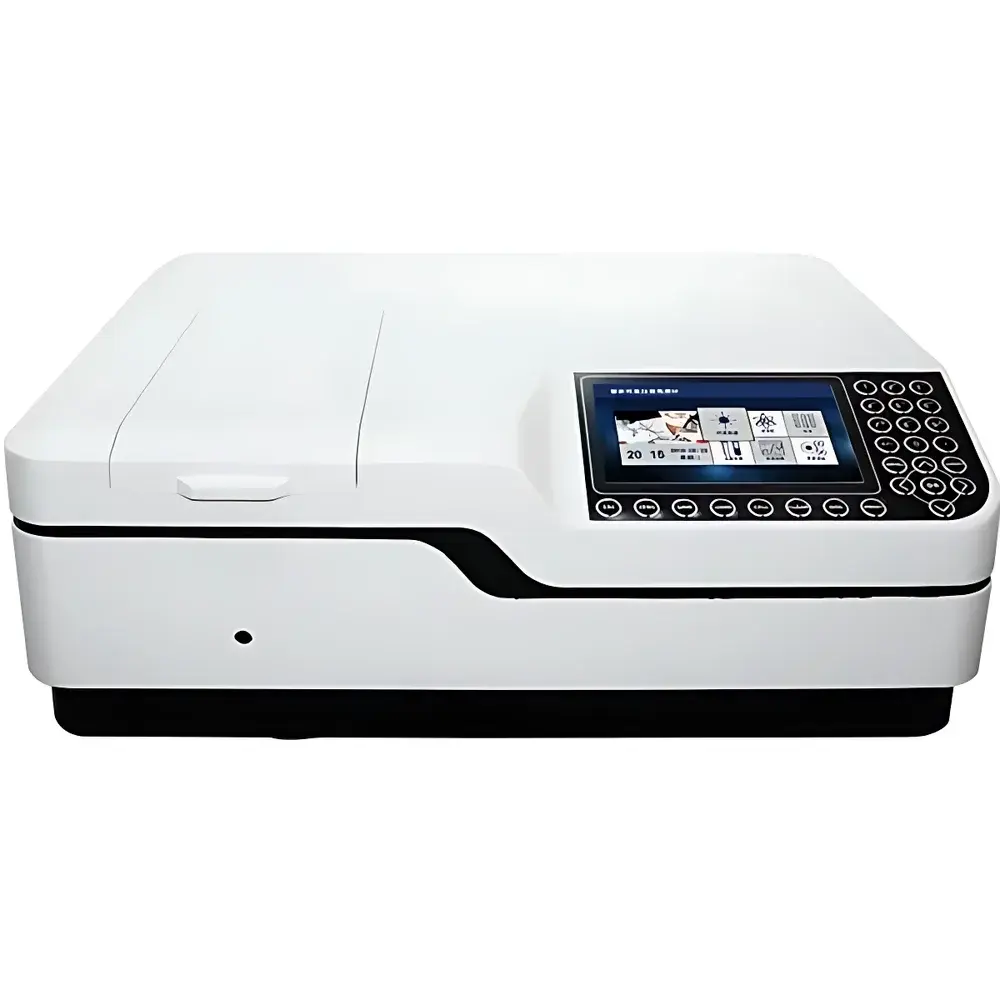
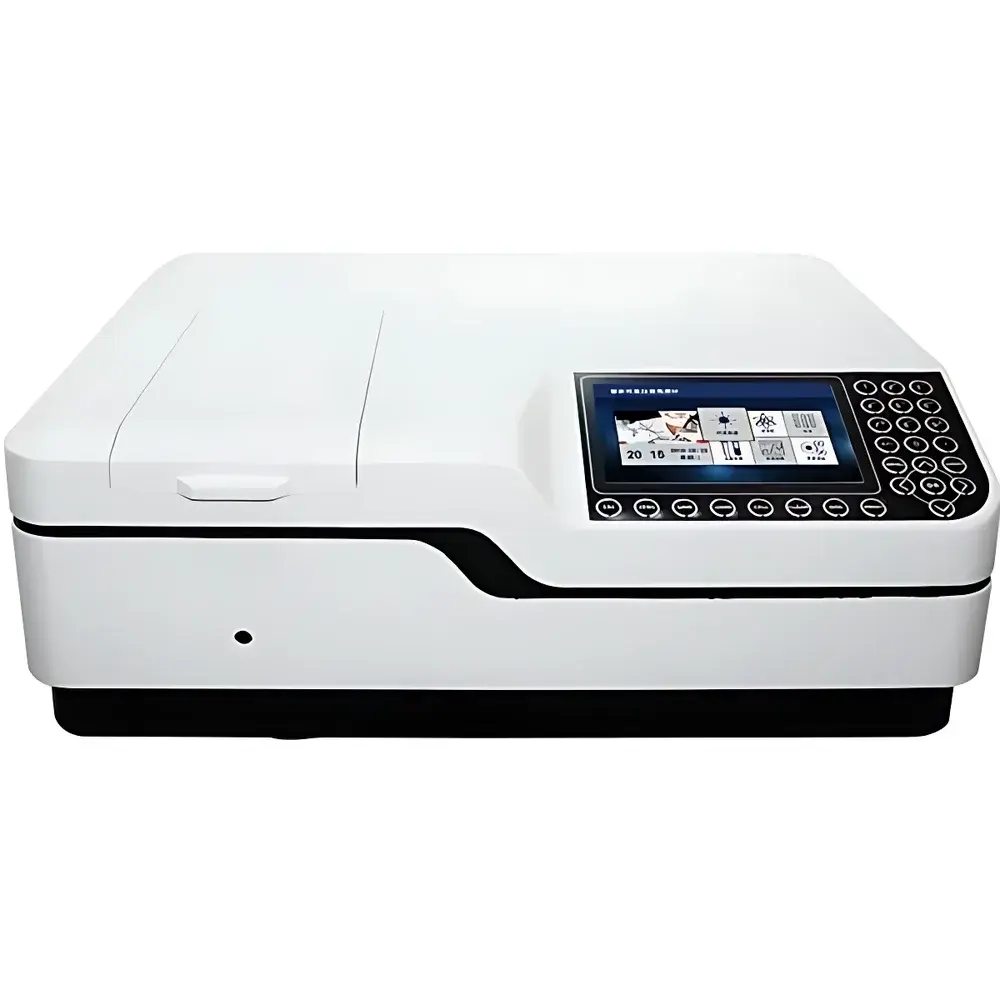
Yoke T2602S Dual-Beam Ultraviolet-Visible Spectrophotometer
| Brand | Yoke |
|---|---|
| Origin | Shanghai, China |
| Model | T2602S |
| Optical System | Dual-beam |
| Detector | Photomultiplier Tube (PMT) |
| Wavelength Range | 190–1100 nm |
| Wavelength Accuracy | ±0.3 nm |
| Wavelength Repeatability | ≤0.1 nm |
| Spectral Bandwidth | 0.5 / 1 / 2 / 4 / 5 nm (selectable) |
| Stray Light | ≤0.03% (at 220 nm, using NaI solution) |
| Display | 7-inch TFT true-color LCD |
| Data Storage | Internal 16 GB + USB flash drive support |
| Connectivity | RS-232C, USB Device, USB Host |
| Processor | ARM11 |
| Data Capacity | Up to 2000 absorbance measurements or 500 calibration curves |
| Optional Accessories | 8-position rotating cuvette holder, integrated auto-sampler flow path |
Overview
The Yoke T2602S Dual-Beam Ultraviolet-Visible Spectrophotometer is an analytical instrument engineered for precision quantitative and qualitative analysis across the ultraviolet and visible spectral regions (190–1100 nm). Based on the dual-beam optical architecture, it continuously splits incident light into sample and reference beams using a high-stability quartz-coated beam splitter, enabling real-time compensation for source intensity drift, lamp aging, and electronic fluctuations. This design ensures high photometric stability and long-term measurement reproducibility—critical for compliance-driven environments such as pharmaceutical QC labs operating under USP , ISO/IEC 17025, or GLP protocols. The system employs a high-sensitivity photomultiplier tube (PMT) detector with low dark current and fast response time, optimized for low-light signal acquisition at short UV wavelengths (e.g., 190–220 nm), where stray light suppression and signal-to-noise ratio are most challenging.
Key Features
- 7-inch TFT true-color LCD touchscreen interface with intuitive navigation and real-time spectral visualization—supports full-spectrum scanning, kinetic assays, multi-wavelength quantitation, and derivative spectroscopy.
- Dual-beam optical path with suspended optical assembly mounted on reinforced aluminum baseplate—mechanically isolates optical components from chassis vibration and thermal expansion, enhancing wavelength fidelity and baseline stability.
- Selectably adjustable spectral bandwidth (0.5 / 1 / 2 / 4 / 5 nm) allows optimization of resolution versus signal intensity depending on analyte absorption profile and matrix complexity.
- Embedded ARM11 processor with 16 GB internal flash memory—stores up to 2000 single-point measurements or 500 user-defined calibration curves with metadata (date/time, operator ID, method name).
- Multi-interface connectivity: RS-232C for legacy printers, USB Device for PC control via compliant spectrophotometer software, and USB Host for direct data export to FAT32-formatted flash drives.
- Native file export in four formats: CSV (for spreadsheet import), QUA (Yoke native format), TXT (ASCII tab-delimited), and BMP (static spectrum image)—no proprietary viewer required.
- Optional accessories include an 8-position motorized rotating cuvette changer (ensuring consistent beam alignment through each cell) and a built-in flow-through autosampler module compatible with standard 1-mm to 10-mm pathlength flow cells.
Sample Compatibility & Compliance
The T2602S accommodates standard 10-mm square cuvettes (quartz, glass, or plastic), semi-micro cells (3.5 mm pathlength), and optional flow cells for continuous monitoring applications. Its ≤0.03% stray light specification at 220 nm (validated per ASTM E387 and ISO 9022-11) ensures accurate quantification of highly absorbing samples—including nucleic acids, proteins, and transition-metal complexes—without significant spectral distortion. The instrument meets essential requirements for routine use in regulated laboratories: audit-trail-ready data logging (with timestamp and operator identification), non-editable raw data storage, and compatibility with 21 CFR Part 11-compliant third-party LIMS integration when operated via USB Device mode with validated drivers.
Software & Data Management
While the T2602S operates autonomously via its onboard interface, it supports bidirectional communication with Windows-based spectral analysis software (e.g., Yoke SpectraSuite or third-party tools compliant with HID class USB protocols). All exported files retain embedded acquisition parameters—including slit width, scan speed, integration time, and zero-reference method—enabling full traceability. Internal storage enforces write-once-read-many (WORM) logic for raw absorbance/transmittance arrays, preventing accidental overwrites. Exported CSV files conform to ASTM E131-22 conventions for spectral data exchange, facilitating interoperability with chemometric platforms such as Unscrambler or MATLAB-based PLS regression toolboxes.
Applications
- Pharmaceutical: Assay of active pharmaceutical ingredients (APIs) per USP monographs; dissolution testing; excipient interference screening.
- Environmental: Quantification of nitrate, phosphate, and heavy metal chelates (e.g., Fe-phenanthroline) in wastewater per EPA Method 365.3 and ISO 15681-1.
- Life Sciences: DNA/RNA concentration and purity assessment (A260/A280, A260/A230); enzyme kinetics (NADH/NADPH oxidation at 340 nm); protein quantitation via Bradford or BCA assays.
- Food & Beverage: Colorimetric determination of antioxidants (e.g., anthocyanins at 520 nm), preservatives (sulfites via formaldehyde complexation), and adulterants.
- Academic Research: Teaching fundamental spectroscopic principles; validating computational chemistry predictions of π→π* transitions; characterizing nanomaterial extinction coefficients.
FAQ
What wavelength calibration standards are recommended for routine verification?
We recommend NIST-traceable holmium oxide (Ho₂O₃) and didymium filters for wavelength accuracy checks at 241.1, 279.4, 287.5, 333.7, 360.9, 418.5, 460.0, 485.8, 536.2, and 637.5 nm.
Is the PMT detector thermally stabilized?
No—the PMT operates at ambient temperature; however, the optical bench is thermally isolated and the detector housing includes passive heat-sink fins to minimize thermal drift during extended scans.
Can the instrument perform kinetic measurements with variable time intervals?
Yes—user-defined time points (from 0.1 s to 9999 s per interval) and total duration (up to 24 hours) are fully programmable, with automatic data stamping and CSV export per cycle.
Does the T2602S support GLP-compliant electronic signatures?
The standalone unit does not implement digital signature functionality; however, when interfaced with validated LIMS or ELN systems via RS-232C or USB, full 21 CFR Part 11 compliance—including role-based access control and electronic audit trails—is achievable through the host software layer.
What is the maximum scan speed in full-spectrum mode?
At 1 nm spectral bandwidth and 2 nm/s scan velocity, the full 190–1100 nm range completes in approximately 455 seconds with <0.001 AU photometric noise (RMS) under standard lab conditions (23 °C, <60% RH).





