
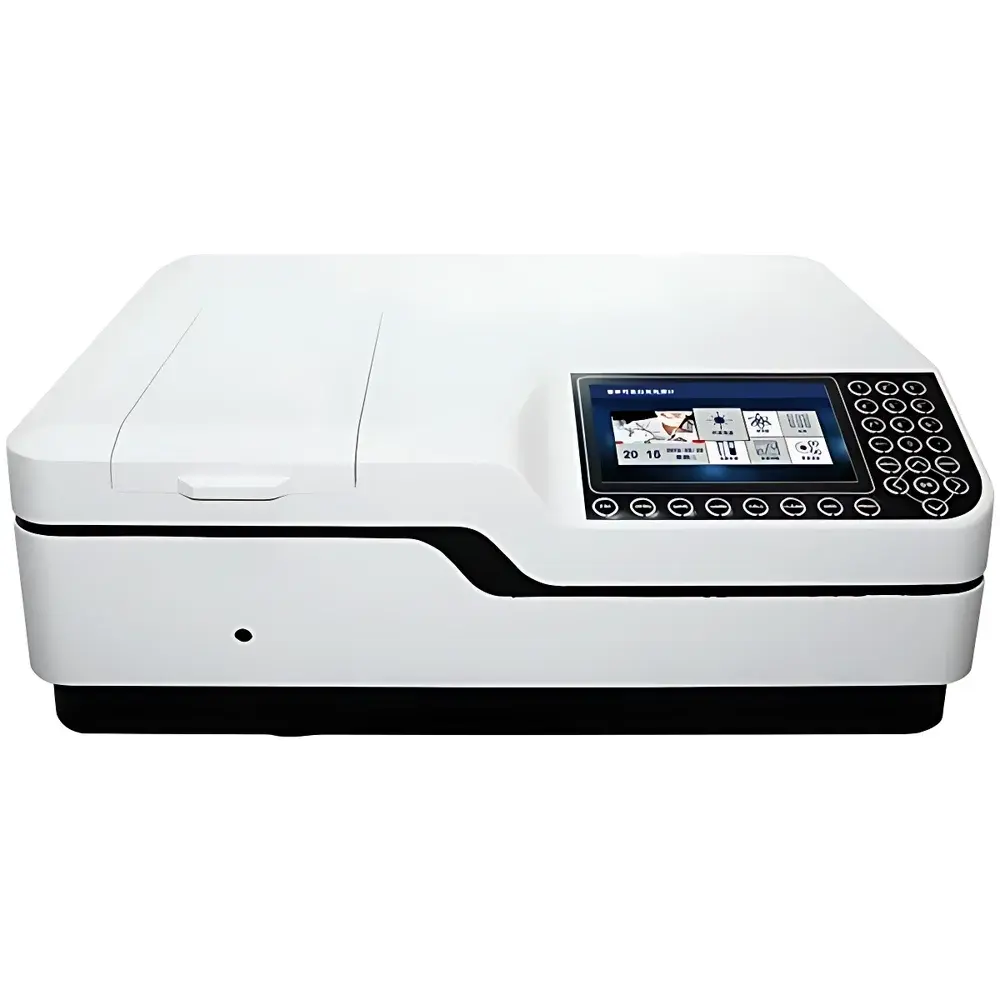
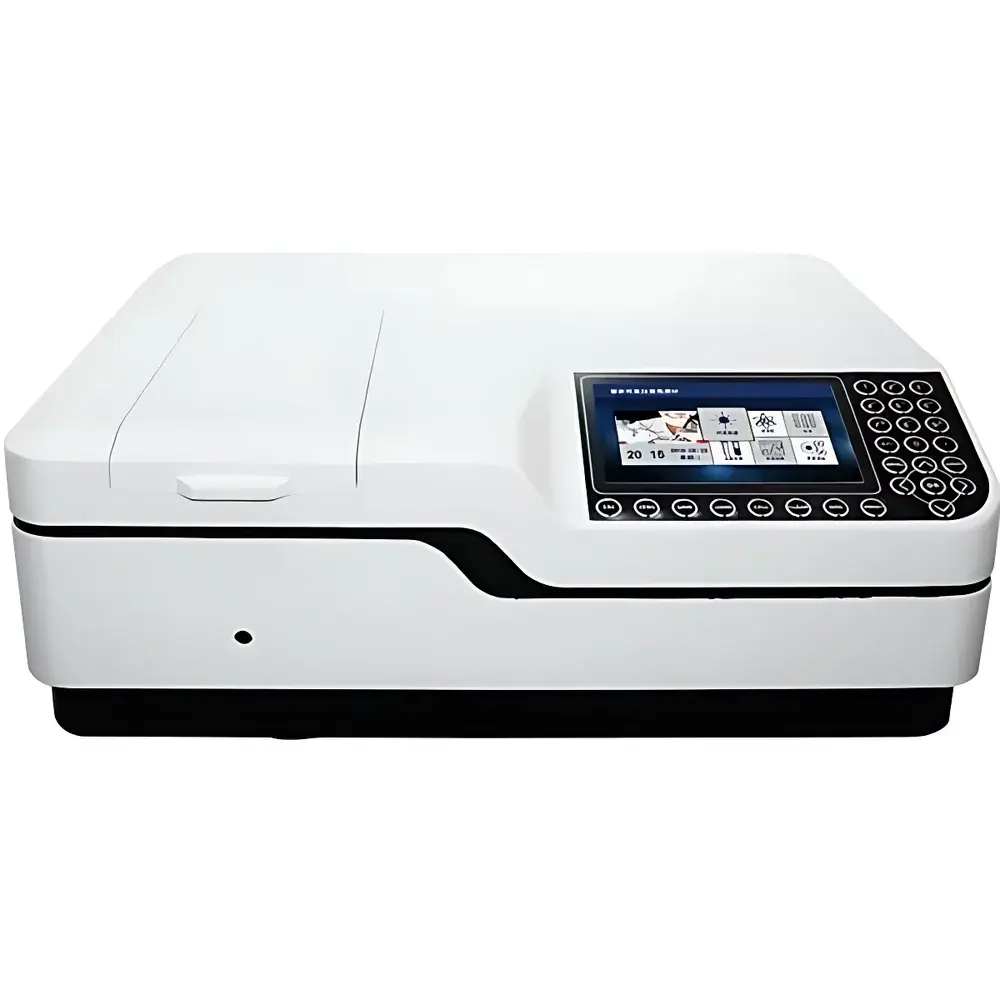
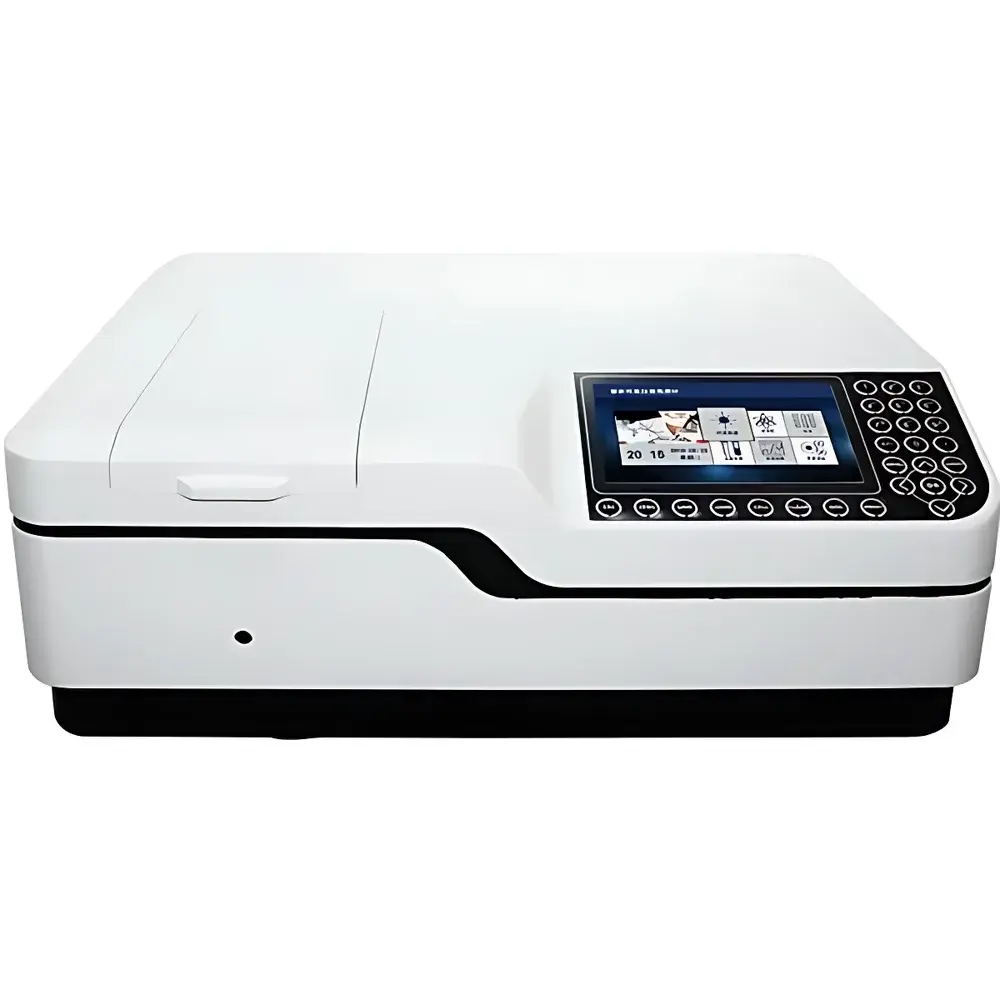
Yoke T-U6S Dual-Beam Ultraviolet-Visible Spectrophotometer
| Brand | Yoke |
|---|---|
| Origin | Shanghai, China |
| Model | T-U6S |
| Optical System | Dual-beam with CT monochromator |
| Detector | Hamamatsu photomultiplier tube (PMT) |
| Wavelength Range | 190–1100 nm |
| Spectral Bandwidth | 1 nm (fixed) |
| Wavelength Accuracy | ±0.3 nm |
| Wavelength Repeatability | ≤0.1 nm |
| Stray Light | ≤0.03% at 220 nm (NaI) |
| Display | 7-inch TFT-LCD (1024×768) with Omron tactile keypad |
| Internal Storage | 32 GB flash memory |
| Data Capacity | Up to 5,000 absorbance measurements or 500 calibration curves |
| Processor | 32-bit ARM Cortex-M3 @ 120 MHz |
| Interface | RS-232C (printer), USB Device (PC connection), USB Host (U-disk support) |
| File Export Formats | CSV, QUA, TXT, BMP |
Overview
The Yoke T-U6S Dual-Beam Ultraviolet-Visible Spectrophotometer is a precision optical instrument engineered for high-stability quantitative and qualitative analysis across the ultraviolet and visible spectral regions (190–1100 nm). It operates on the dual-beam optical principle—splitting incident light into sample and reference paths using a rotating mirror or beam splitter—enabling real-time compensation for source intensity drift, lamp aging, and environmental fluctuations. This architecture ensures superior baseline stability and measurement reproducibility compared to single-beam systems. The instrument employs a Czerny-Turner (CT) monochromator design with high-efficiency holographic gratings and a Hamamatsu photomultiplier tube (PMT) as the detector, delivering exceptional sensitivity and low-noise performance—particularly critical for trace-level absorbance measurements in dilute biological or pharmaceutical samples. Its fixed 1 nm spectral bandwidth meets standard requirements for routine UV-Vis applications defined in ASTM E275, ISO 6223, and USP , while its ±0.3 nm wavelength accuracy and ≤0.1 nm repeatability support method validation under GLP and GMP environments.
Key Features
- Dual-beam CT optical system with real-time reference correction, minimizing photometric drift during extended scans or kinetic measurements.
- Hamamatsu PMT detector optimized for quantum efficiency across 190–900 nm, enabling detection limits suitable for low-concentration nucleic acid and protein assays.
- 7-inch high-resolution TFT-LCD (1024×768) with industrial-grade Omron tactile keypad—enabling full instrument control, spectrum scanning, kinetics, and multi-wavelength quantitation without external PC dependency.
- Onboard 32 GB flash storage supporting up to 5,000 absorbance readings or 500 user-defined calibration curves; data export via USB Host to FAT32-formatted U-disk in CSV, QUA, TXT, and BMP formats.
- Suspended optical bench architecture mounted on reinforced aluminum baseplate—mechanically isolating the optical path from chassis vibration and thermal expansion effects.
- 32-bit ARM Cortex-M3 microcontroller (120 MHz clock) with dedicated firmware for rapid spectral acquisition, smoothing algorithms (Savitzky-Golay optional), and real-time noise suppression.
Sample Compatibility & Compliance
The T-U6S accommodates standard 10 mm pathlength quartz, glass, or plastic cuvettes (including matched pairs for ratio-based measurements), as well as microvolume adapters (not included) for 0.5–2 µL samples. It supports both transmission and reflectance modes (with optional accessories). All optical components comply with RoHS Directive 2011/65/EU. The instrument’s stray light specification (≤0.03% at 220 nm, measured per NaI solution per ASTM E387) ensures reliable quantification of highly absorbing samples—such as colored dyes, transition metal complexes, or degraded pharmaceuticals—without significant deviation from Beer-Lambert linearity. Its wavelength accuracy and photometric linearity are verified against NIST-traceable standards, making it suitable for IQ/OQ/PQ protocols in regulated laboratories.
Software & Data Management
While fully functional as a standalone instrument, the T-U6S includes PC-compatible software for advanced spectral processing, including peak identification, derivative spectroscopy, spectral subtraction, and multi-component analysis using classical least-squares (CLS) algorithms. Data files adhere to ASTM E131-compliant metadata tagging (wavelength, absorbance, date/time, operator ID). Audit trail functionality—including user login timestamps, parameter change logs, and result modification history—is available when operated in networked mode with validated software (requires optional license). The instrument supports 21 CFR Part 11-compliant electronic signatures when integrated with qualified LIMS or ELN platforms via RS-232 or USB virtual COM port.
Applications
- Pharmaceutical QC: Assay of active pharmaceutical ingredients (APIs), dissolution testing, excipient compatibility studies, and stability-indicating methods per ICH Q2(R2).
- Life sciences: DNA/RNA quantification (A260/A280), Bradford/Lowry/BCA protein assays, enzyme kinetics (e.g., NADH oxidation at 340 nm), and cell culture density monitoring.
- Environmental analysis: Nitrate/nitrite determination (via diazotization), phosphate (as molybdenum blue), and heavy metal speciation (e.g., Cr(VI) with diphenylcarbazide).
- Food & beverage: Colorimetric analysis of anthocyanins, carotenoids, sulfites, and antioxidant capacity (FRAP, DPPH).
- Academic research: Teaching spectroscopy fundamentals, ligand-binding studies, and photochemical reaction monitoring.
FAQ
Does the T-U6S support variable spectral bandwidth?
No—the T-U6S features a fixed 1 nm spectral bandwidth, optimized for balance between resolution and signal-to-noise ratio in routine UV-Vis applications.
Is the instrument compliant with FDA 21 CFR Part 11?
The hardware supports Part 11 requirements (audit trail, electronic signature readiness); full compliance requires validated software deployment and procedural controls per organizational SOPs.
Can the T-U6S perform kinetic measurements?
Yes—it supports time-scan mode with user-defined interval (0.1–999.9 s), enabling enzyme activity assays and reaction rate determination.
What is the maximum scan speed?
Full 190–1100 nm scan completes in ≤12 seconds at 1 nm step interval and medium scan speed setting.
Are NIST-traceable calibration certificates available?
Yes—optional factory calibration with NIST-traceable wavelength and photometric standards is available upon request (certified per ISO/IEC 17025).






