
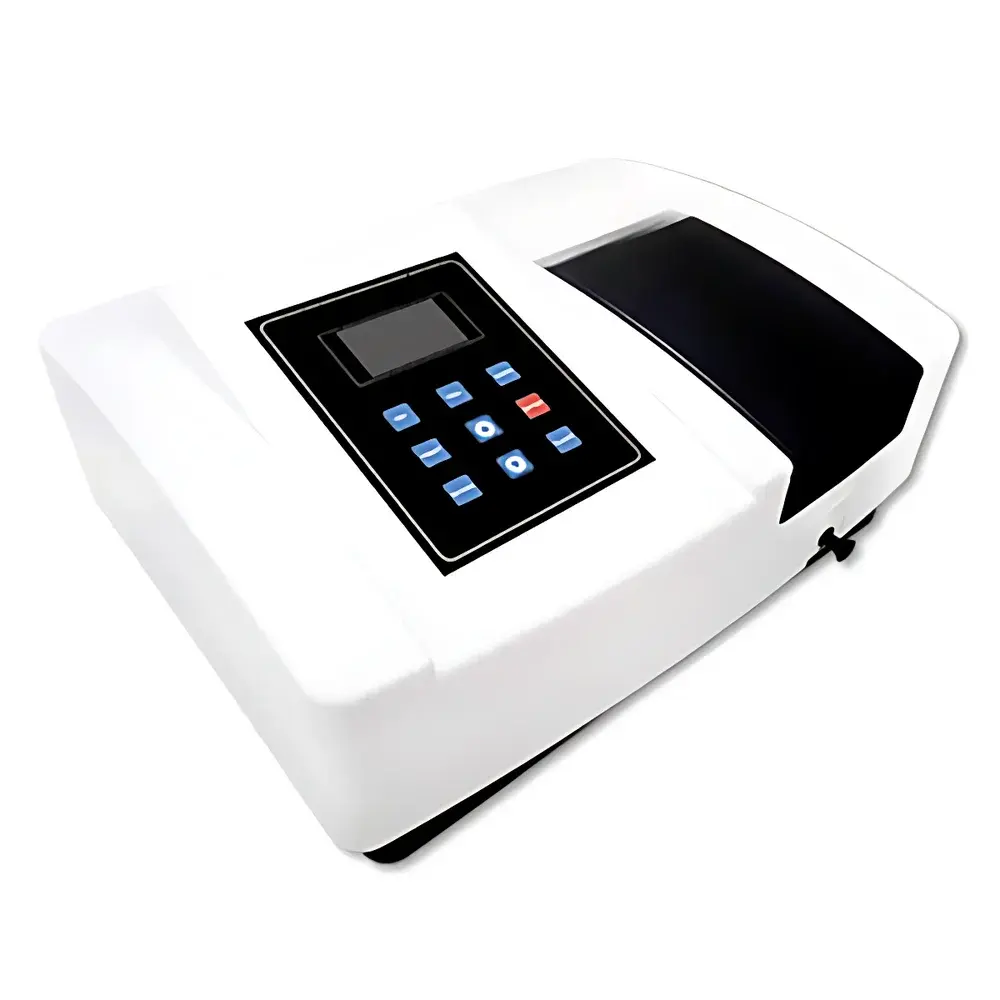
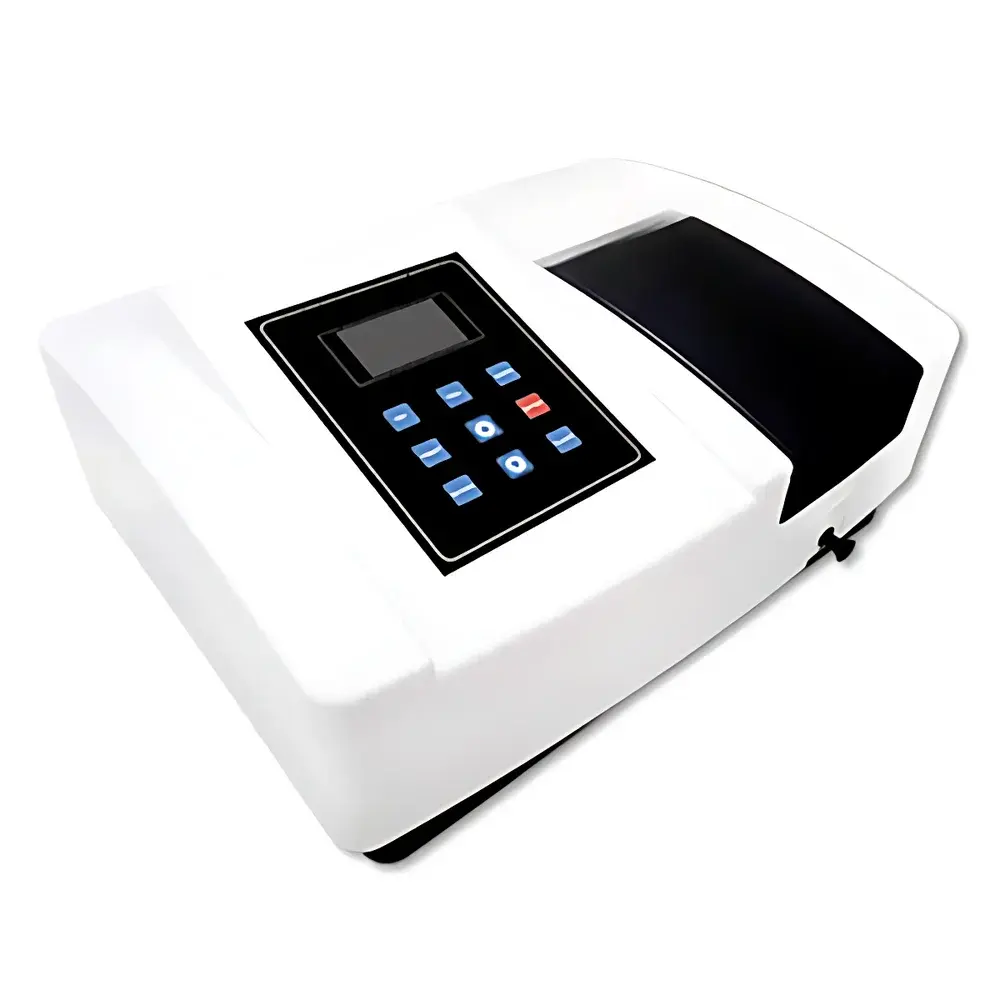
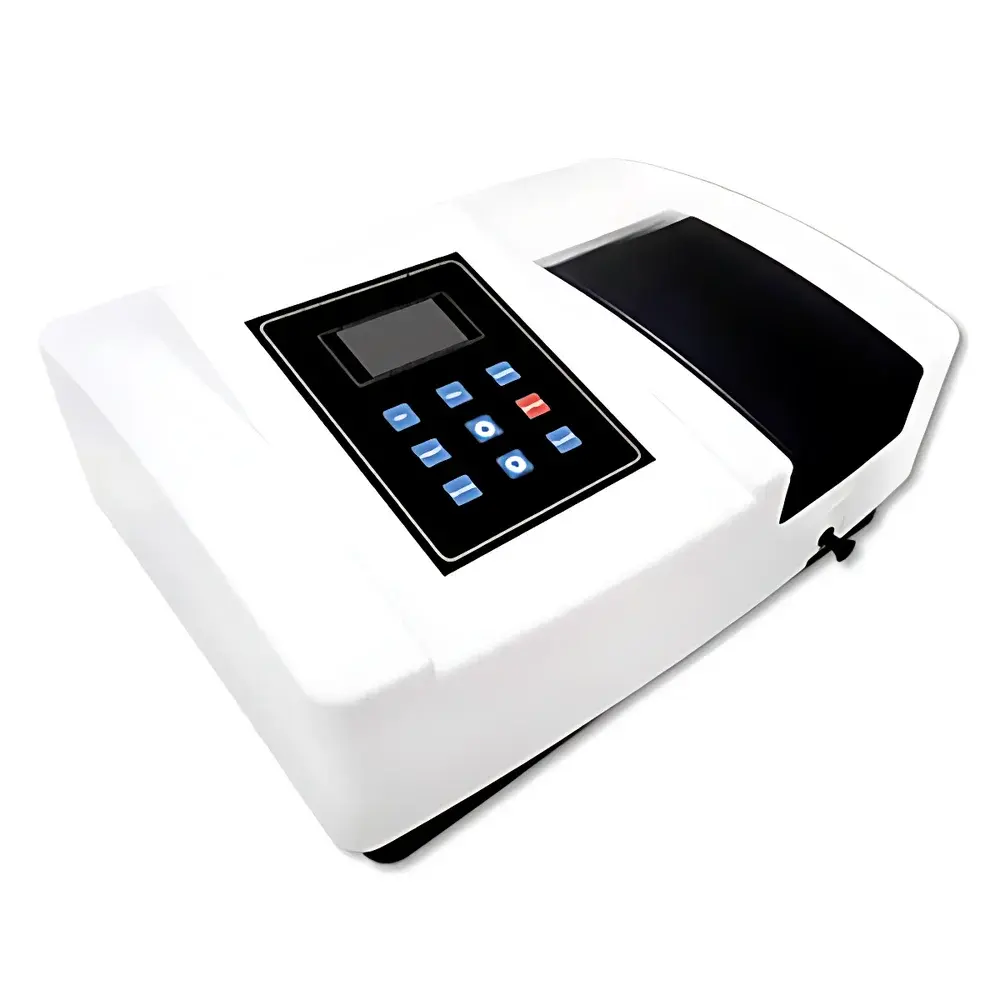
Yoke UV754N Ultraviolet-Visible Spectrophotometer
| Brand | Yoke |
|---|---|
| Origin | Shanghai, China |
| Model | UV754N |
| Optical System | Single-beam |
| Detector Type | Photodiode Array |
| Wavelength Range | 190–1100 nm |
| Wavelength Accuracy | ±2 nm |
| Wavelength Repeatability | 0.5 nm |
| Spectral Bandwidth | 4 nm |
| Stray Light | ≤0.3% T at 220 nm and 360 nm |
| Automation Level | Automatic Wavelength Scanning |
| Data Storage | Onboard Microcontroller (51-series) with Curve & Measurement Memory |
| Compliance | Designed for GLP-supporting labs |
Overview
The Yoke UV754N Ultraviolet-Visible Spectrophotometer is a single-beam, microprocessor-controlled spectrophotometric instrument engineered for routine quantitative and qualitative analysis in regulated and academic laboratory environments. It operates on the fundamental principle of Beer–Lambert law-based absorbance measurement, utilizing a fixed-slit optical path and photodiode array detection to deliver reliable transmittance and absorbance data across the ultraviolet and visible spectrum (190–1100 nm). Its robust mechanical design, combined with a stable tungsten-halogen and deuterium lamp dual-source configuration, ensures consistent photometric performance over extended operational cycles. The UV754N is not intended for high-throughput or research-grade spectral resolution applications—rather, it serves as a cost-optimized, maintenance-efficient platform for QC laboratories requiring traceable, repeatable absorbance measurements under standard operating conditions.
Key Features
- Single-beam optical architecture with automatic wavelength scanning driven by stepper-motor-controlled monochromator
- Integrated 51-series microcontroller enabling onboard storage of up to 100 calibration curves and 500 measurement records
- Self-diagnostic firmware that verifies lamp status, detector response, and wavelength encoder functionality during startup and operation
- Non-volatile memory with power-failure protection—retains calibration parameters and user settings after unexpected shutdown
- Built-in application software supporting multiple operational modes: photometric (A/T/%T), quantitative (single/multi-point calibration), kinetic (time-scan at fixed λ), spectral scanning (190–1100 nm), multi-wavelength analysis, and nucleic acid/protein quantification (A260/A280 ratio calculation)
- Standard RS-232 serial interface (compliant with EIA/TIA-232-F) and parallel printer port (Centronics-compatible) for external data export and hardcopy generation
Sample Compatibility & Compliance
The UV754N accommodates standard 10 mm rectangular quartz or glass cuvettes (pathlength 10 mm) and supports optional variable-pathlength cells (5–50 mm) via adapter fixtures. It is validated for use with aqueous, organic, and buffered solutions meeting typical UV-Vis transparency requirements. Instrument performance aligns with key international standards: wavelength accuracy and repeatability meet ASTM E275 Class B specifications; stray light levels satisfy ISO 6425 Category II criteria for general-purpose spectrophotometers; and photometric linearity conforms to USP guidelines for pharmaceutical excipient and active ingredient assay. While the device does not include native 21 CFR Part 11 audit trail or electronic signature capabilities, its deterministic firmware behavior and parameter-locking functions support manual GLP/GMP documentation workflows when operated within validated SOPs.
Software & Data Management
All analytical functions are executed locally via embedded firmware—no PC dependency is required for basic operation. Data files (absorbance spectra, calibration tables, kinetic traces) are stored in ASCII-encoded format accessible via RS-232 connection using terminal emulation software (e.g., Tera Term, PuTTY). Exported datasets include timestamp, wavelength grid, and raw detector counts—enabling post-acquisition processing in MATLAB, Python (NumPy/Pandas), or commercial chemometrics packages. Firmware versioning and calibration history are logged internally and retrievable through diagnostic mode. For laboratories implementing LIMS integration, the RS-232 protocol supports custom scripting for automated data ingestion, provided host-side parsing accounts for fixed-field response formatting.
Applications
The UV754N is routinely deployed in quality control laboratories for concentration determination of pharmaceutical actives (e.g., paracetamol, caffeine), environmental monitoring of nitrate/nitrite in water (EPA Method 353.2), protein quantification via Bradford or Lowry assays, enzyme kinetics (e.g., NADH oxidation at 340 nm), and purity assessment of nucleic acid preparations. In academic teaching labs, it serves as an instructional platform for validating Beer’s law, evaluating filter photometry principles, and introducing students to spectral interpretation fundamentals. Its 4 nm spectral bandwidth provides adequate resolution for most small-molecule absorptions while maintaining signal-to-noise ratios suitable for routine batch release testing.
FAQ
Does the UV754N support USB connectivity?
No—only RS-232 serial and parallel printer interfaces are provided.
Can the instrument perform baseline correction automatically?
Yes—zeroing against solvent blank is performed manually before each measurement series; no dynamic baseline drift compensation is implemented.
Is quartz cuvette mandatory for UV measurements below 240 nm?
Yes—standard optical glass absorbs strongly below ~350 nm; fused silica or synthetic quartz cuvettes are required for measurements between 190–240 nm.
What is the maximum scan speed for full-spectrum acquisition?
Approximately 120 nm/min at 4 nm bandwidth; scan rate is fixed and non-adjustable.
How frequently should wavelength calibration be verified?
Per ASTM E275, verification using holmium oxide or didymium filters is recommended prior to each day’s critical measurements or after instrument relocation.
Related Products




