
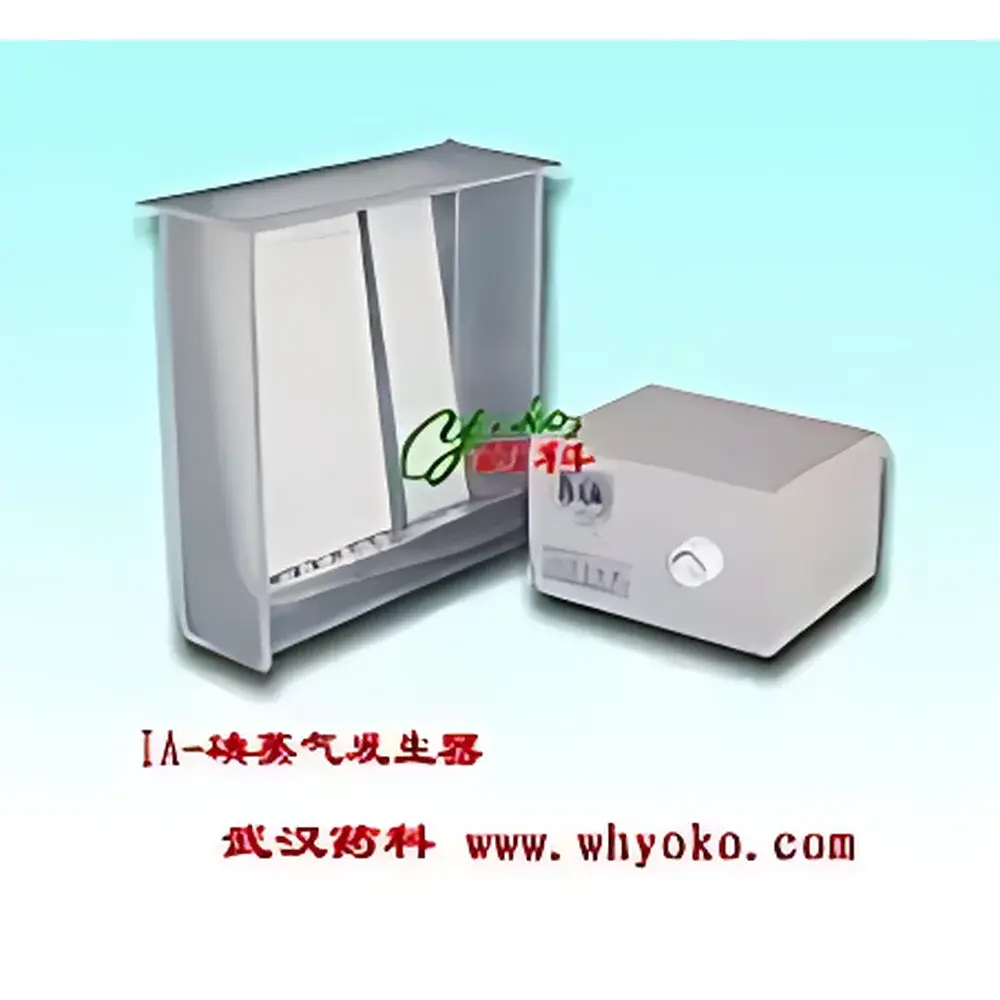
YOKO-IA Iodine Vapor Generator for Thin-Layer Chromatography
| Brand | YOKO |
|---|---|
| Origin | Hubei, China |
| Manufacturer Type | Authorized Distributor |
| Country of Manufacture | China |
| Model | YOKO-IA |
| Instrument Type | TLC Developing Chamber Accessory |
| Operation Mode | Manual |
| Input Voltage Range | 100–220 V AC |
| Rated Voltage | 220 V AC |
| Power Consumption | 60 W |
| Heating Platform | Anodized Aluminum Base with Stainless Steel Surface |
| Temperature Control | Continuously Adjustable via Potentiometer |
Overview
The YOKO-IA Iodine Vapor Generator is a dedicated auxiliary device engineered for post-development visualization in thin-layer chromatography (TLC) workflows. It operates on the principle of controlled thermal sublimation: solid iodine crystals (I₂) are placed directly onto a heated platform, where precise resistive heating induces vapor-phase generation without decomposition. The resulting iodine vapor diffuses uniformly within an enclosed chamber—typically a standard glass or acrylic TLC developing tank—interacting reversibly with organic compounds (e.g., alkenes, terpenes, alkaloids, lipids) to form transient charge-transfer complexes that appear as brown-yellow spots. Unlike destructive reagents (e.g., sulfuric acid charring), iodine staining is non-destructive and fully reversible upon air exposure, preserving sample integrity for subsequent scraping, extraction, or spectroscopic analysis. The unit is not a standalone chromatograph but a purpose-built vapor source designed for integration into existing TLC laboratories requiring rapid, reproducible, and operator-controlled visualization.
Key Features
- Manually adjustable voltage regulation (100–220 V AC) enables fine-tuned control over heating rate and equilibrium vapor pressure—critical for balancing development speed against spot diffusion or over-staining.
- 60 W low-power resistive heating element embedded in a thermally stable anodized aluminum base ensures uniform heat distribution across the stainless steel contact surface, minimizing hot-spot formation and enhancing iodine sublimation consistency.
- Compact, benchtop footprint (approx. 120 × 90 × 75 mm) allows seamless placement beneath standard TLC tanks or inside fume hoods without spatial interference.
- No moving parts, microprocessors, or firmware—designed for mechanical reliability, ease of maintenance, and compatibility with ISO/IEC 17025-accredited laboratory environments where instrument qualification focuses on physical parameter traceability rather than software validation.
- Stainless steel heating surface resists corrosion from residual iodine condensate and facilitates rapid cleaning between runs using ethanol or acetone wipe-downs.
Sample Compatibility & Compliance
The YOKO-IA is compatible with all standard silica gel, alumina, and cellulose-based TLC plates (including precoated 20 × 20 cm and 10 × 20 cm formats). It supports visualization of a broad range of compound classes including hydrocarbons, steroids, fatty acids, glycosides, and heterocyclic molecules—provided they possess electron-donating moieties capable of forming weak Lewis acid–base adducts with molecular iodine. While iodine vaporization itself does not require regulatory certification, its use in analytical workflows must comply with institutional chemical hygiene plans (CHPs) per OSHA 29 CFR 1910.1200. The generator’s manual operation avoids electronic logging requirements under FDA 21 CFR Part 11; however, when used in GLP or GMP-regulated settings (e.g., pharmaceutical stability testing per ICH Q5C), operators must document vapor exposure time, ambient temperature, and plate batch numbers in hard-copy lab notebooks per SOP-ANAL-027.
Software & Data Management
This device incorporates no embedded software, firmware, or digital interfaces. All operational parameters—including applied voltage, estimated surface temperature (derived from empirical calibration curves), and exposure duration—are recorded manually by the analyst. Data integrity is maintained through standardized procedural documentation: users log settings in bound, page-numbered laboratory notebooks with witness signatures, satisfying ALCOA+ principles (Attributable, Legible, Contemporaneous, Original, Accurate, Complete, Consistent, Enduring, Available) for audit readiness. No data export, cloud synchronization, or electronic signature functionality is provided or required.
Applications
- Routine qualitative screening of reaction mixtures in synthetic organic chemistry labs.
- Monitoring progress of column chromatography fractions via parallel TLC analysis.
- Teaching laboratories where visual, non-hazardous detection methods support pedagogical safety protocols.
- Preparative TLC workflows where intact spot recovery is essential for NMR or MS analysis.
- Field-deployable forensic analysis kits when paired with portable UV lamps for dual-mode detection (iodine + fluorescence quenching).
FAQ
Is the YOKO-IA suitable for quantitative densitometric analysis?
No—it provides qualitative or semi-quantitative visualization only. Quantitation requires integration with a calibrated TLC scanner (e.g., CAMAG TLC Scanner 4) and validated calibration standards.
Can it be used with chloroform or ethyl acetate mobile phases?
Yes, provided the TLC plate is fully dried prior to iodine exposure; residual solvents may accelerate iodine corrosion or cause uneven vapor condensation.
What is the typical iodine consumption per run?
Approximately 0.2–0.5 g of crystalline iodine (I₂) suffices for 5–10 consecutive developments in a standard 20 × 20 cm chamber, depending on ambient humidity and exposure duration.
Does the unit include a vapor containment hood or exhaust adapter?
No—users must operate it inside a certified chemical fume hood or connect the chamber outlet to a dedicated iodine scrubber system (e.g., activated carbon filter) per local EHS guidelines.
How frequently should the stainless steel surface be cleaned?
After each day’s use, or immediately following visible iodine residue accumulation, using lint-free wipes saturated with anhydrous ethanol.




