
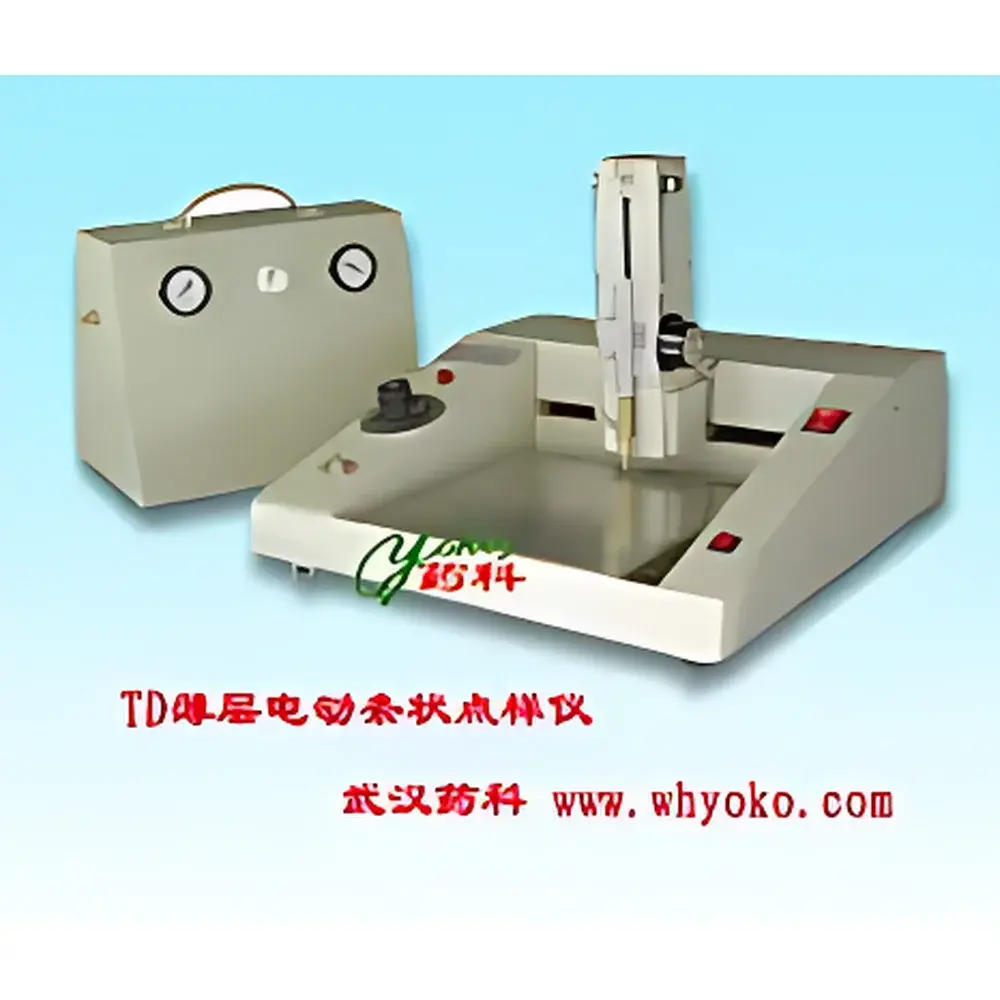
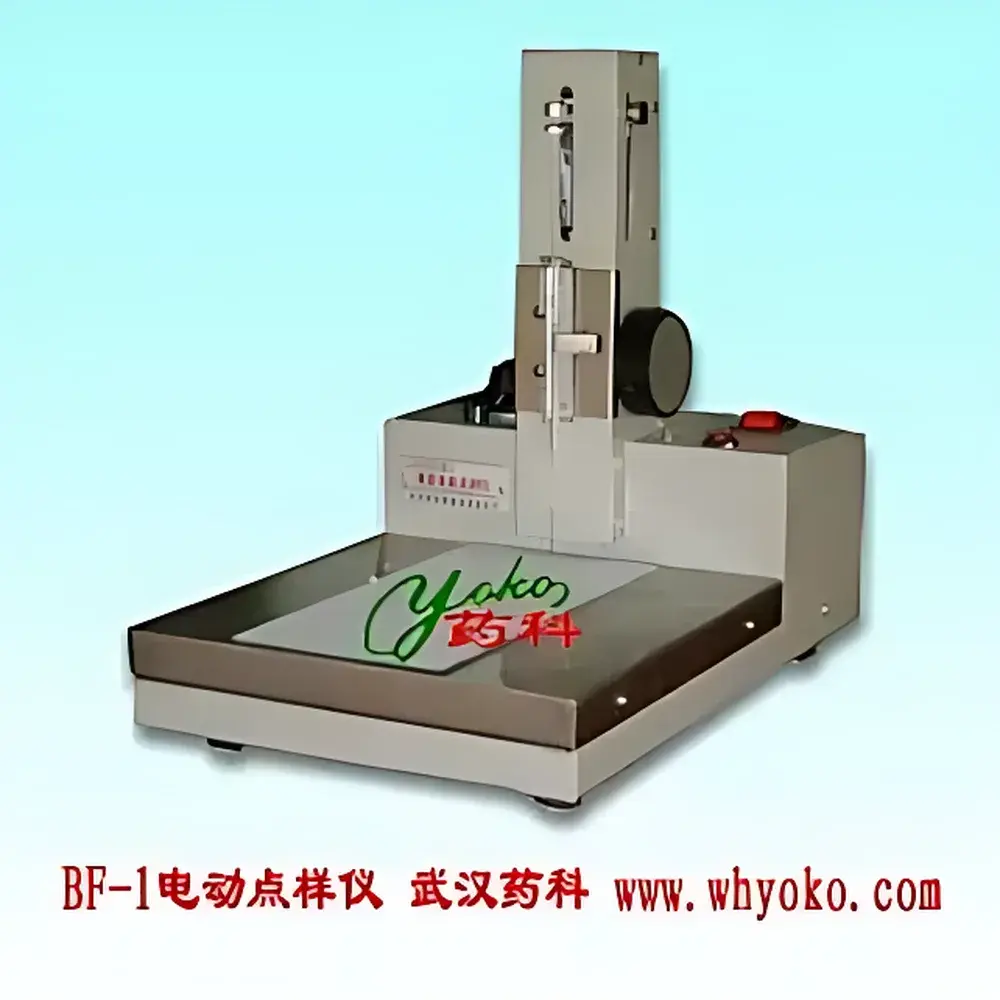
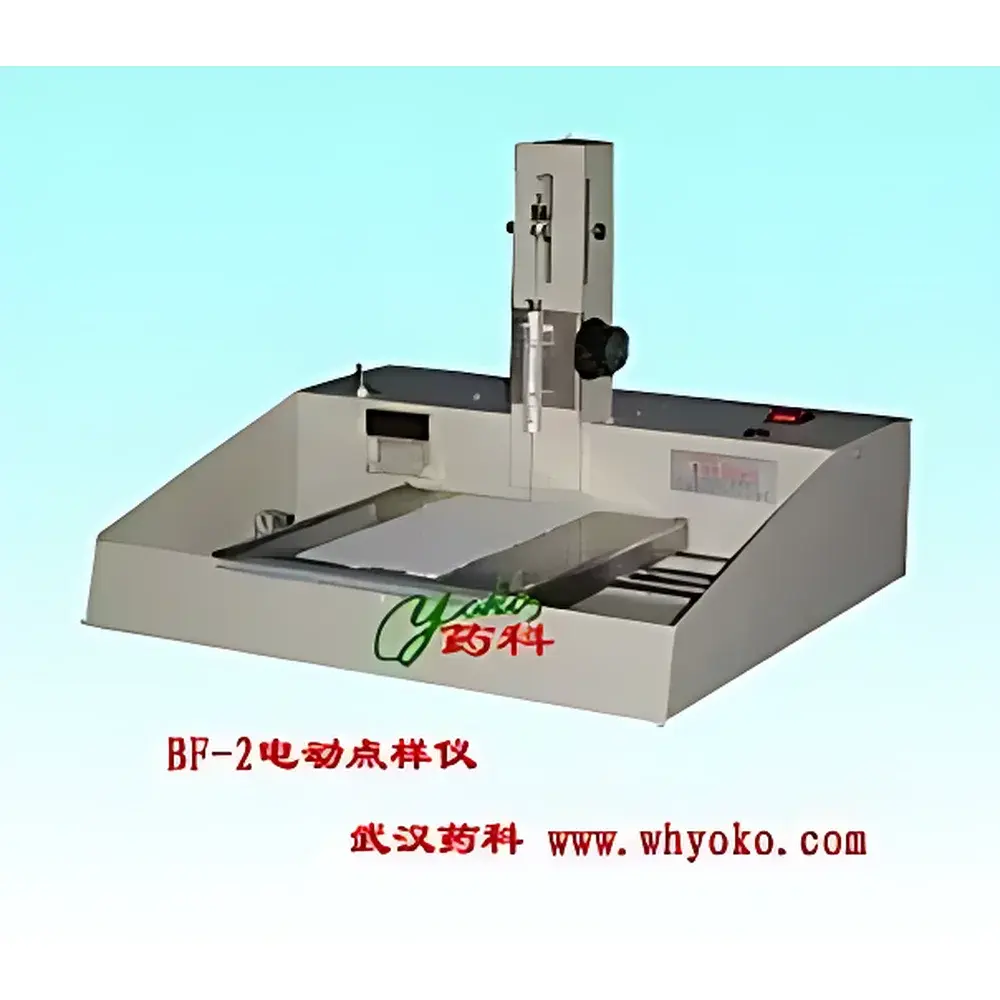
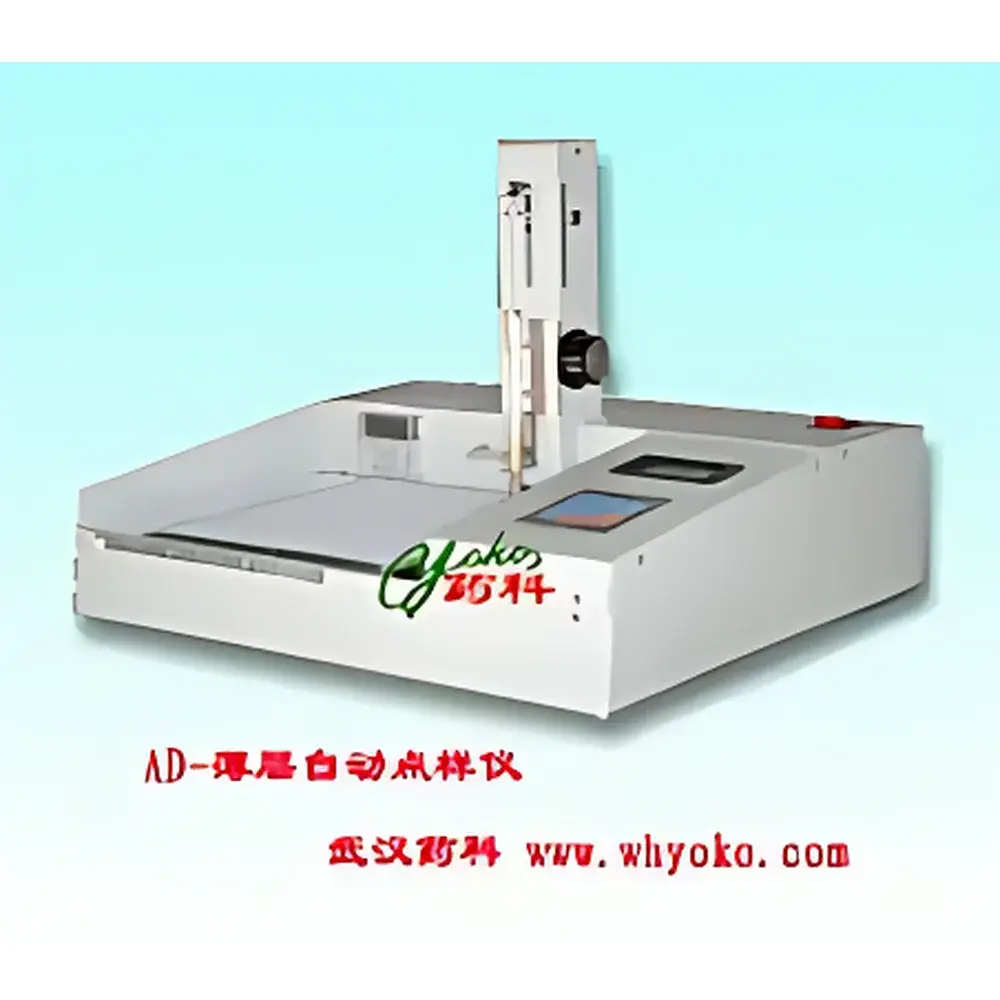
YOKO TD-1 Thin-Layer Electrospray Linear Sample Applicator
| Brand | YOKO |
|---|---|
| Model | TD-1 |
| Origin | Hubei, China |
| Type | Electrospray-based linear applicator for thin-layer chromatography (TLC) |
| Sample Delivery | Non-contact pneumatic spray |
| Spot/Strip Modes | Single-spot, multi-spot, continuous linear strip (0–180 mm) |
| Maximum Plate Size | 200 × 200 mm |
| Heating Platform | Stainless steel, 35–200 °C (±0.5 °C stability), 600 W |
| Motion Control | Synchronous stepper motors with end-stop protection (X-axis translation, Z-axis needle actuation) |
| Syringe Compatibility | 10 µL, 50 µL standard |
| Accuracy | <1.0% RSD |
| Precision (repeatability) | <1.5% RSD |
| Air Supply | Oil-free compressor, 0–0.12 MPa adjustable, gas flow 0.1–2.0 L/min |
| Power | 220 V ±10%, 50–60 Hz, 630 W |
| Dimensions (L×W×H) | 400 × 390 × 290 mm |
| Weight | 16 kg |
Overview
The YOKO TD-1 Thin-Layer Electrospray Linear Sample Applicator is an engineered solution for precise, reproducible sample deposition in planar chromatography workflows—specifically optimized for analytical and semi-preparative thin-layer chromatography (TLC) and high-performance thin-layer chromatography (HPTLC). Unlike conventional contact-based capillary or syringe-tip applicators, the TD-1 employs a non-contact electrospray delivery mechanism driven by regulated compressed air. This principle eliminates physical interaction between the dispensing tip and the stationary phase surface, thereby preventing mechanical damage to silica or alumina layers, avoiding spot deformation or crater formation, and ensuring uniform solvent dispersion across the applied zone. The system supports both discrete spot application and continuous linear band deposition—critical for gradient development, overloading studies, and preparative fraction collection. Its integrated thermostatic heating platform maintains precise, uniform temperature control (35–200 °C) during sample drying, directly influencing analyte migration kinetics, resolution, and inter-run reproducibility—key performance indicators in validated chromatographic methods per ICH Q2(R2) and USP .
Key Features
- Non-contact electrospray deposition: Eliminates layer abrasion and improves plate integrity, especially on fragile HPTLC plates.
- Dual-mode operation: Programmable single-spot, multi-spot, and continuous linear strip application (0–180 mm length), supporting both analytical quantitation and semi-preparative isolation.
- Thermostatically controlled stainless steel heating stage: Delivers rapid, uniform thermal conditioning (±0.5 °C stability) to accelerate solvent evaporation and stabilize retention behavior across repeated runs.
- Motorized XYZ motion system: Synchronous stepper-driven X-axis translation and Z-axis needle actuation with hard-limit end-stop protection ensure positional repeatability and mechanical safety.
- Modular syringe compatibility: Standard 10 µL and 50 µL glass syringes included; optional 25 µL and 100 µL configurations accommodate varied loading volumes without recalibration.
- Adjustable pneumatic delivery: Oil-free air supply (0–0.12 MPa, 0.1–2.0 L/min) enables fine-tuned droplet size and spray density—critical for viscous or particulate-containing samples.
- Self-locking footswitch interface: Supports both gated (intermittent) and continuous actuation modes, reducing operator fatigue during high-throughput screening.
Sample Compatibility & Compliance
The TD-1 accommodates a broad range of sample matrices—including polar and non-polar organic extracts, aqueous solutions, suspensions, and derivatized compounds—without clogging or cross-contamination, thanks to its open-flow pneumatic architecture and easily removable syringes. It is compatible with standard commercial TLC/HPTLC plates (e.g., Merck Silica Gel 60 F254, Macherey-Nagel Polygram® SIL G, and custom-coated substrates up to 200 × 200 mm). While not intrinsically GLP- or GMP-certified, the instrument’s deterministic motion control, traceable temperature regulation, and repeatable volumetric delivery support method validation under ISO/IEC 17025 and FDA 21 CFR Part 11-compliant environments when paired with audit-trail-enabled laboratory information management systems (LIMS). Documentation packages—including calibration certificates for temperature and volume verification—can be supplied upon request.
Software & Data Management
The TD-1 operates via hardware-integrated manual controls (no proprietary software required), prioritizing robustness and operational transparency in regulated labs. All parameters—including spray duration, travel speed, heating setpoint, and dwell time—are adjusted via calibrated analog dials and digital displays. For laboratories requiring electronic recordkeeping, optional RS-232 or USB-to-serial interfaces enable integration with third-party scripting environments (e.g., Python-based automation frameworks) or LIMS platforms for timestamped parameter logging and run metadata capture. System diagnostics—including motor status, heater feedback loop integrity, and pressure sensor output—are accessible via front-panel LED indicators, facilitating preventive maintenance and troubleshooting without service intervention.
Applications
- Quantitative densitometric analysis: Uniform linear bands improve peak shape and integration accuracy in HPTLC-densitometry workflows aligned with European Pharmacopoeia monographs.
- Semi-preparative TLC isolation: 180 mm strip capability enables direct transfer to preparative plates for compound purification prior to NMR or MS characterization.
- Method development: Rapid evaluation of solvent strength, mobile phase composition, and stationary phase interactions via systematic band deposition and parallel development.
- Stability-indicating assays: Controlled thermal drying minimizes analyte degradation during sample conditioning—essential for forced degradation studies per ICH Q1A(R2).
- Teaching laboratories: Intuitive operation and visual process feedback support hands-on training in chromatographic theory and Good Laboratory Practice (GLP) fundamentals.
FAQ
Does the TD-1 require dedicated software to operate?
No. It is designed for standalone, hardware-controlled operation using front-panel dials and switches—ideal for environments where software validation overhead must be minimized.
Can the TD-1 be used with corrosive solvents such as concentrated acids or halogenated hydrocarbons?
Yes, provided compatible syringes (e.g., PTFE-plunger glass syringes) and corrosion-resistant tubing are installed; standard configuration uses chemically inert PEEK and stainless-steel wetted components.
What maintenance is required to sustain long-term accuracy?
Monthly cleaning of the spray nozzle and syringe port with appropriate solvents, biannual verification of heating stage uniformity using IR thermography, and annual calibration of pressure and temperature sensors are recommended.
Is the instrument suitable for regulated pharmaceutical QC labs?
It meets functional requirements for TLC sample application in QC settings; full compliance with 21 CFR Part 11 requires integration with validated electronic record systems and documented IQ/OQ/PQ protocols.
How does the TD-1 compare to contact-based applicators in terms of spot resolution?
Non-contact spraying produces broader but more homogeneous deposition zones—reducing tailing and improving baseline separation in overloaded lanes, particularly beneficial for complex natural product extracts.
Related Products





