
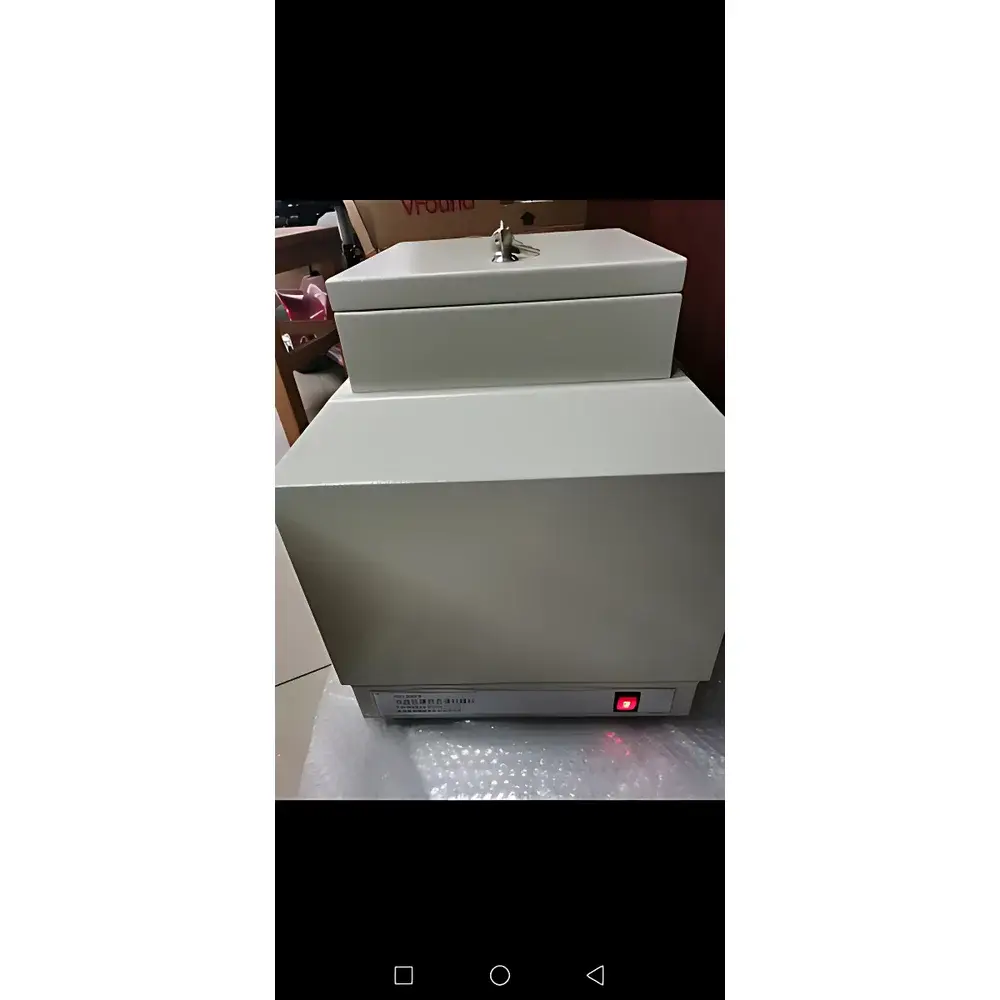
YOKO YOKO-2005 Dual-Wavelength Thin-Layer Chromatography Scanner
| Brand | YOKO |
|---|---|
| Model | YOKO-2005 |
| Origin | Hubei, China |
| Instrument Type | TLC Scanner |
| Operation Mode | Automatic |
| Detection Modes | Reflectance, Fluorescence (Transmittance optional) |
| Wavelength Range | 200–720 nm |
| Minimum Spatial Resolution | 10 µm |
| Sample Stage | 10 × 20 cm Pre-coated TLC Plates |
Overview
The YOKO YOKO-2005 Dual-Wavelength Thin-Layer Chromatography (TLC) Scanner is a precision optical densitometer engineered for quantitative and qualitative analysis of compounds separated on planar stationary phases. It operates on the principle of reflectance and fluorescence densitometry—measuring light absorption or emission intensity at defined wavelengths across developed TLC plates. Designed specifically to support pharmaceutical quality control, herbal medicine standardization, and academic research, the system delivers high spatial resolution (down to 10 µm), low optical noise, and excellent linearity over broad dynamic ranges. Its dual-wavelength scanning capability enables ratiometric correction for background interference—critical for complex matrices such as traditional Chinese medicine extracts—while maintaining full compliance with pharmacopoeial requirements (e.g., Chinese Pharmacopoeia ChP 2020, USP , EP 2.2.27). The instrument integrates a stable broadband light source, a high-precision motorized X-Y translation stage, and a spectrally tunable detection module covering 200–720 nm, allowing flexible method development without hardware modification.
Key Features
- Dual-wavelength and multi-channel scanning modes for simultaneous or sequential acquisition at user-defined wavelengths—enabling background subtraction, ratio imaging, and multi-analyte quantification.
- Automated linear scanning with programmable step size (adjustable down to 10 µm), ensuring reproducible spot localization and Rf value calculation with ±0.005 precision.
- Reflectance and fluorescence detection modes; transmittance mode available as optional configuration for transparent supports (e.g., polyester-backed plates).
- Integrated calibration routines including optical flat-field correction, wavelength validation via mercury-argon lamp reference, and photometric linearity verification using neutral density filters.
- Real-time image preview with adjustable contrast, brightness, saturation, and arbitrary rotation—facilitating manual spot annotation and region-of-interest (ROI) definition prior to quantitation.
- Comprehensive quantitation algorithms: normalization, external standard (single-point linear and two-point quadratic calibration), and internal standard methods—all validated per ICH Q2(R2) guidelines for analytical procedure validation.
Sample Compatibility & Compliance
The YOKO-2005 accommodates standard 10 × 20 cm pre-coated TLC plates—including silica gel G, GF254, H, HF254, aluminum-backed G, and polyester-supported GF254. Its mechanical stage ensures uniform pressure distribution and minimal plate deformation during scanning. The system supports GMP-aligned workflows through audit-trail-enabled software logging (user actions, parameter changes, calibration events), electronic signature compatibility, and data export in CSV, PDF, and TIFF formats compliant with FDA 21 CFR Part 11 requirements when deployed with appropriate IT infrastructure. All quantitation reports include Rf values, peak areas, relative percentages, and annotated chromatographic images—fully traceable and suitable for regulatory submissions under ChP, USP, and ISO/IEC 17025-accredited laboratories.
Software & Data Management
The YOKO TLC Workstation software runs natively on Windows 2000/XP platforms and provides a fully localized English interface with context-sensitive help and embedded tutorial modules. It features unlimited spectral and chromatographic database storage with metadata tagging (sample ID, batch number, analyst, date/time stamp, method version). Data integrity is maintained via hierarchical user access control (administrator, analyst, reviewer), automatic backup scheduling, and checksum-verified file export. Raw scan data (.yok), processed results (.csv), and annotated reports (.pdf) are timestamped and cryptographically hashed to prevent post-acquisition tampering. Software validation documentation—including IQ/OQ protocols and performance qualification test scripts—is provided to support laboratory qualification under GLP and GMP environments.
Applications
- Quantitative assay of active pharmaceutical ingredients (APIs) and marker compounds in herbal formulations (e.g., ginsenosides, berberine, puerarin).
- Stability-indicating method development for forced degradation studies—detecting oxidative, hydrolytic, and photolytic degradants via dual-wavelength tracking.
- Identity confirmation and purity assessment of synthetic intermediates and natural product isolates in R&D laboratories.
- Educational use in undergraduate and graduate chromatography courses—demonstrating planar separation principles, detection physics, and quantitative data treatment.
- Batch release testing in small-to-medium pharmaceutical manufacturers seeking cost-effective, pharmacopoeia-compliant alternatives to HPLC for routine QC checks.
FAQ
Does the YOKO-2005 support USP or EP-compliant thin-layer chromatography methods?
Yes—the instrument’s reflectance/fluorescence densitometry engine, wavelength accuracy (<±1 nm), and algorithm suite (including external standard calibration with quadratic regression) align with USP and Ph. Eur. 2.2.27 requirements for TLC quantitation.
Can raw scan data be reprocessed with updated calibration parameters?
Yes—raw .yok files retain uncorrected pixel intensity values and metadata; all photometric corrections (flat-field, wavelength shift, background subtraction) are applied non-destructively during post-processing.
Is transmittance detection included as standard or optional?
Transmittance mode is optional and requires a modified optical path assembly and compatible transparent supports (e.g., polyester or glass plates); it is not enabled by default in the base configuration.
What validation documentation is supplied with the system?
A complete set of factory-verified IQ/OQ protocols, wavelength accuracy certificates, linearity test reports, and software validation summaries are delivered with each unit—ready for adaptation into site-specific PQ protocols.
How is data security managed in multi-user laboratory environments?
Role-based access control, encrypted local database storage, session timeout enforcement, and immutable audit logs ensure compliance with ISO/IEC 27001-informed data governance policies.






