
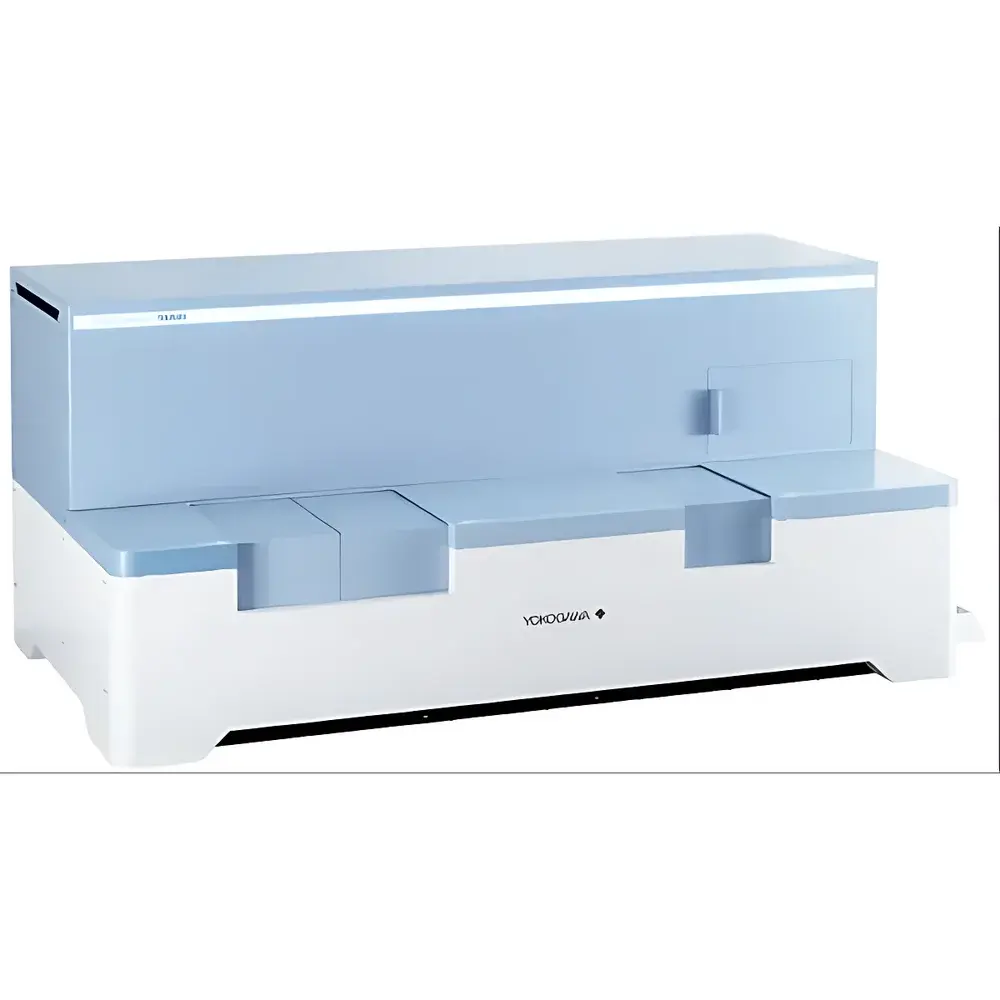
Yokogawa SS2000 Subcellular Sampling System
| Brand | Yokogawa |
|---|---|
| Origin | USA |
| Manufacturer Type | Authorized Distributor |
| Origin Category | Imported |
| Model | SS2000 |
| Automation Level | Fully Automatic |
| Imaging Modality | Confocal Microscopy (Nipkow Disk-Based) |
| Sample Transfer Options | PCR Plates, Microtiter Plates, Glass Capillaries |
| Environmental Control | Integrated Stage Heater, Humidity Regulation, CO₂ Gas Mixing |
| Cooling Function | On-Stage Sample Cooling at Collection Point |
| Compliance Context | Designed for GLP/GMP-aligned workflows, compatible with FDA 21 CFR Part 11–ready software platforms |
Overview
The Yokogawa SS2000 Subcellular Sampling System is an integrated live-cell imaging and precision microsampling platform engineered for spatially resolved molecular analysis at the single-cell and subcellular level. It combines Yokogawa’s proprietary Nipkow-disk confocal microscopy architecture with automated micromanipulation and environmental control to enable non-disruptive, location-preserving sampling directly within physiologically relevant culture environments. Unlike conventional dissociation-based workflows, the SS2000 operates without detaching cells from their native substrate or extracellular matrix—thereby retaining critical spatial context, morphological integrity, and intercellular positional relationships. The system employs a dual-rotating disk confocal design featuring a micro-lens array and a 20,000-hole pinhole disk arranged in a logarithmic spiral pattern, enabling parallelized illumination of ~1,000 laser spots per frame. This architecture delivers high-speed, low-phototoxicity 3D time-lapse imaging under controlled incubation conditions (37 °C, 5% CO₂, regulated humidity), making it suitable for longitudinal studies of dynamic cellular processes such as mitosis, organelle trafficking, or response to pharmacological stimuli.
Key Features
- Fully automated subcellular targeting and aspiration using real-time confocal image guidance and coordinate-based positioning
- Nipkow-disk confocal imaging with <100 ms frame acquisition for volumetric time-lapse capture up to 4D (x, y, z, t)
- Integrated environmental chamber: stage-integrated heater, humidified gas delivery (O₂/CO₂/N₂ mixing), and on-demand CO₂ concentration regulation
- Cooling-enabled sampling tip: localized thermoregulation at the glass capillary interface to suppress enzymatic degradation during aspiration
- Multi-modal sample output: direct deposition into 96-/384-well PCR plates, microtiter arrays, or retention within sterile glass capillaries for downstream processing
- Co-registration capability: synchronized timestamped imaging metadata (pre-, intra-, and post-sampling frames) linked to each sampled aliquot for correlative analysis
Sample Compatibility & Compliance
The SS2000 supports adherent and semi-adherent mammalian cell types cultured on standard glass-bottom dishes, collagen-coated substrates, or hydrogel matrices. It accommodates monolayer cultures, spheroids up to 200 µm in diameter, and organoid fragments when mounted in low-melting-point agarose. All fluidic pathways are biocompatible and sterilizable via autoclave or ethanol flush. The system architecture complies with ISO 13485 design principles for in vitro diagnostic instrumentation and supports audit-trail generation required for GLP-compliant preclinical research. When paired with validated software modules, it meets documentation requirements aligned with FDA 21 CFR Part 11 for electronic records and signatures—enabling traceable sample provenance from acquisition through nucleic acid extraction or mass spectrometry injection.
Software & Data Management
Control and acquisition are managed via Yokogawa’s CellVoyager Studio software suite, which provides a unified interface for microscope configuration, robotic path planning, environmental parameter logging, and metadata tagging. Image datasets are stored in OME-TIFF format with embedded acquisition parameters (laser power, Z-step size, pinhole diameter, exposure time). Sampling event logs include XYZ coordinates, timestamp, capillary ID, well destination, and associated image thumbnails. Export options include CSV-based sample mapping files compatible with LIMS integration and HDF5 containers for large-scale 4D dataset archiving. Optional API access enables programmatic workflow orchestration with third-party analysis tools (e.g., Python-based segmentation pipelines or MATLAB-based kinetics modeling).
Applications
- Single-cell multi-omics: targeted nucleus, cytoplasm, or organelle isolation for parallel RNA-seq, ATAC-seq, and metabolite profiling
- Clonal expansion studies: retrieval of phenotypically defined cells (e.g., GFP+ mitotic cells) for subsequent colony formation assays
- Pharmacodynamic validation: time-resolved sampling before/after drug addition to quantify intracellular drug accumulation or target engagement kinetics
- Neuronal subcompartment analysis: axonal vs. dendritic sampling from primary neuron co-cultures maintaining synaptic architecture
- CRISPR screening follow-up: retrieval of edited cells identified via live-reporter fluorescence for genotyping and functional validation
FAQ
Can the SS2000 perform sampling under hypoxic conditions?
Yes—the integrated gas mixer supports precise O₂ modulation from 0.1% to 21%, enabling sampling under physiologically relevant hypoxia (e.g., 1–5% O₂) while maintaining CO₂ and humidity control.
Is the system compatible with fluorescent dyes requiring UV excitation?
The SS2000 optical path supports 405 nm laser excitation and includes dichroic filters optimized for DAPI, Hoechst, and CFP; UV-sensitive probes require careful phototoxicity calibration due to inherent limitations of spinning-disk throughput at shorter wavelengths.
What is the minimum viable sample volume that can be reliably aspirated?
The system achieves consistent aspiration of volumes ≥10 pL using calibrated glass capillaries with inner diameters of 0.5–2.0 µm, verified by gravimetric calibration and fluorescent bead recovery assays.
Does the SS2000 support multiplexed sampling across multiple wells in one run?
Yes—users can define sequential sampling protocols across up to 96 wells with independent coordinate sets, environmental presets, and destination mapping per well.
How is sterility maintained during long-term time-lapse experiments?
The chamber seals with silicone gaskets and incorporates HEPA-filtered air recirculation; all consumables (capillaries, plates) are gamma-irradiated and loaded via laminar-flow-compatible ports to minimize contamination risk over multi-day acquisitions.




