
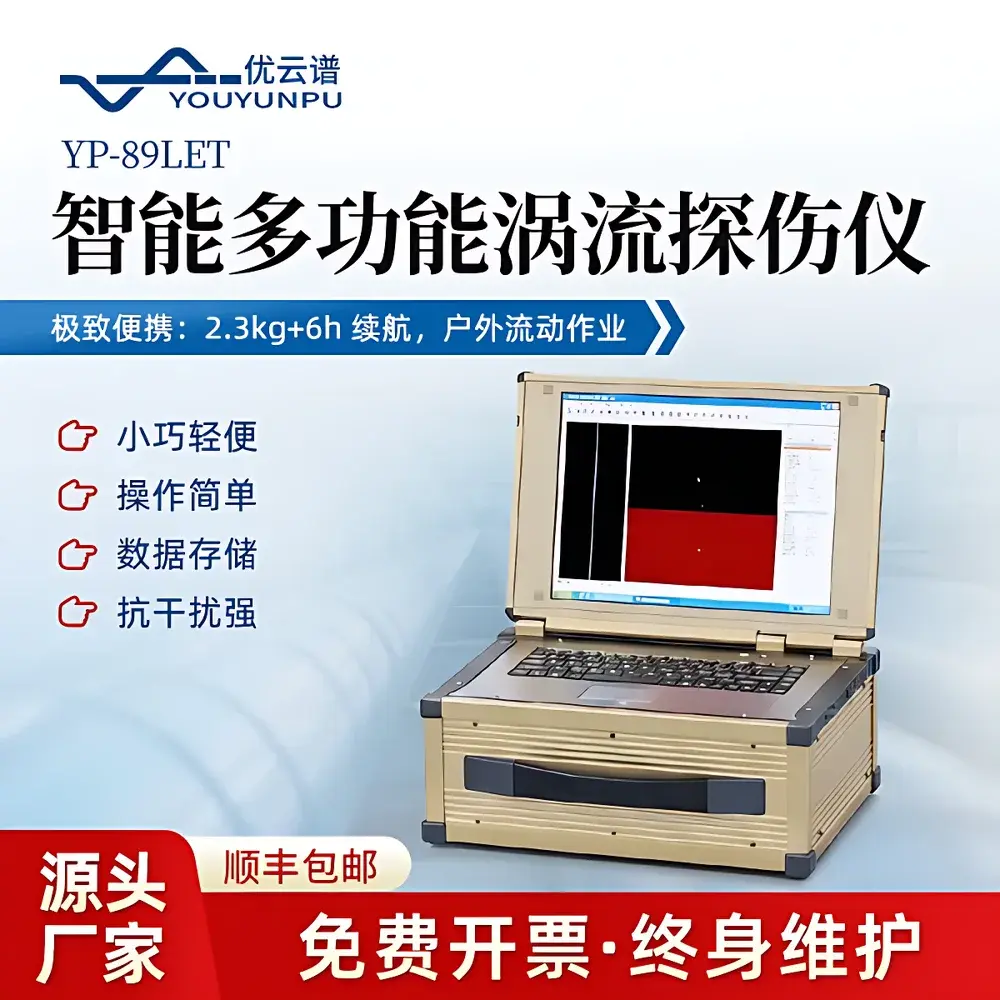
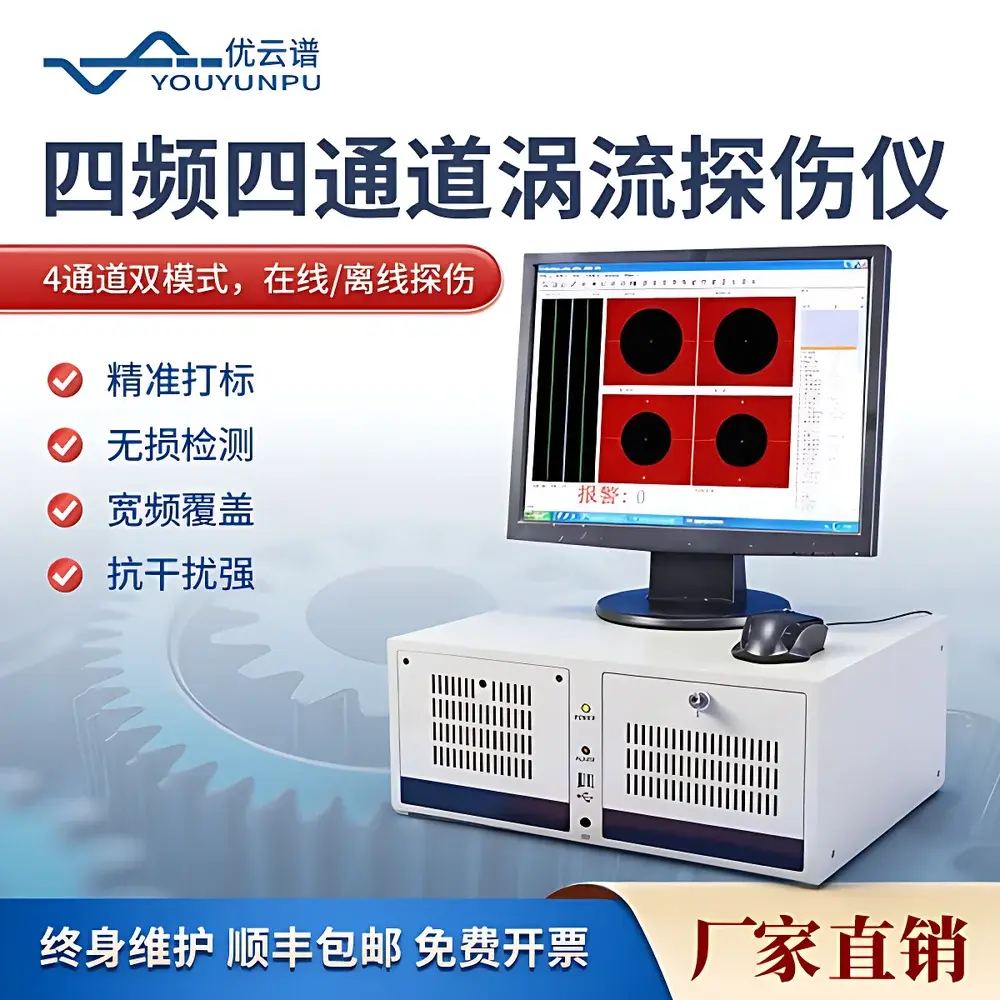
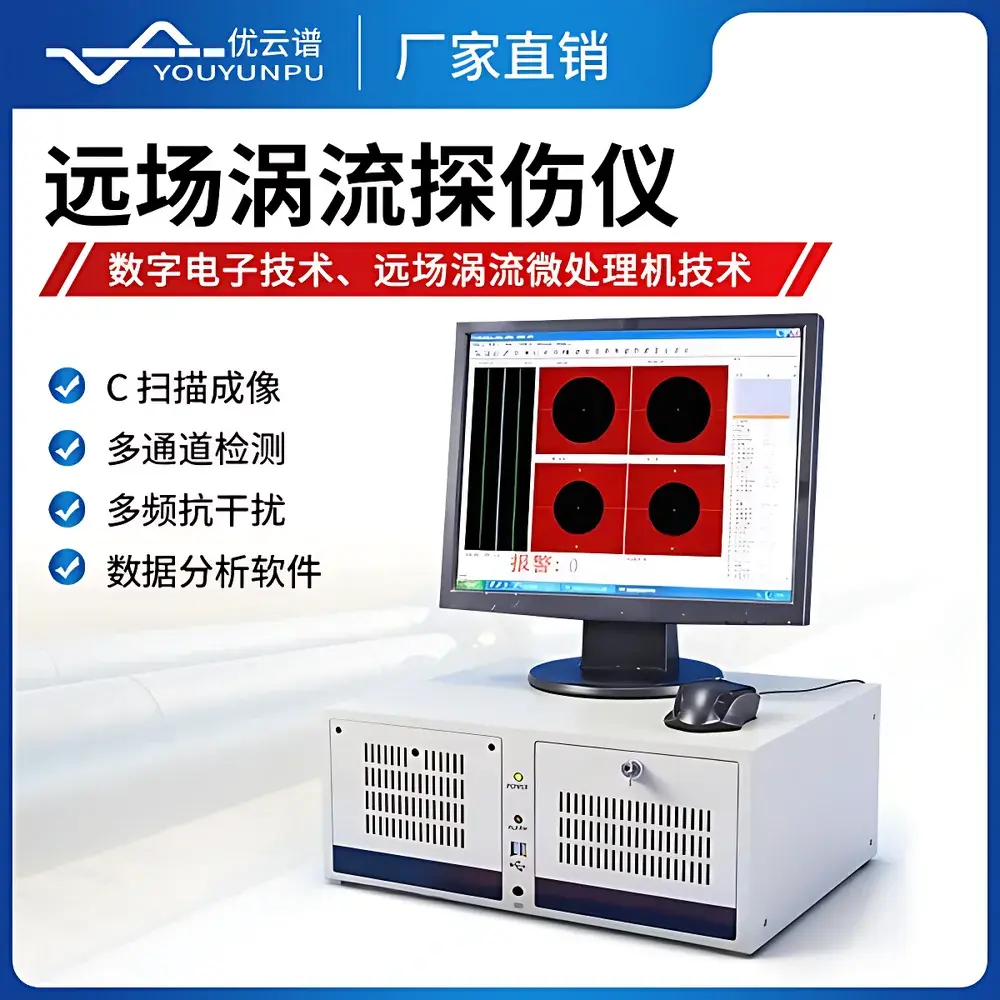
Youyunpu YP-371 Intelligent Digital Eddy Current Testing System
| Brand | Youyunpu |
|---|---|
| Origin | Shandong, China |
| Manufacturer Type | Direct Manufacturer |
| Country of Origin | China |
| Model | YP-371 |
| Detection Method | Automated Eddy Current Inspection |
| Form Factor | Benchtop |
| Frequency Range | 50 Hz – 10 MHz |
| Gain Adjustment | 0 dB – 99 dB (continuous) |
| Phase Rotation | 0° – 359° (continuous) |
| X/Y Gain Ratio | 0.1 – 10.0 |
| Phase Amplification Factor | 1 – 10 (patented) |
| Probe Drive Level | 1 – 8 (adjustable) |
| Probe Matching Level | 0 – 3 (adjustable) |
| Maximum Scan Speed | 10 m/s |
| Operating Temperature | −10 °C to +50 °C |
| Probe Operating Temperature | −20 °C to +50 °C |
| Enclosure | Sealed plastic housing with protective rubber boot |
| Weight (with battery) | 2.3 kg |
| Battery Runtime | Up to 6 hours |
| Charging Time | 2–4 hours (on-screen status indicator) |
| Power Input | 100–240 V AC, 50–60 Hz |
| Power Consumption | 20 W |
| Dimensions | 240 mm × 150 mm × 70 mm |
| Data Management | Auto-save and auto-replay of inspection records |
Overview
The Youyunpu YP-371 Intelligent Digital Eddy Current Testing System is a benchtop eddy current instrument engineered for high-reproducibility non-destructive evaluation (NDE) of conductive materials. It operates on the principle of electromagnetic induction: an alternating current applied to a probe coil generates a time-varying magnetic field, inducing eddy currents in nearby conductive specimens. Discontinuities—such as surface or near-surface cracks, corrosion, thickness variations, or material property deviations—alter the flow and amplitude of these eddy currents, producing measurable impedance changes in the probe coil. The YP-371 digitizes and processes these impedance signals across a wide frequency spectrum (50 Hz to 10 MHz), enabling precise discrimination between defect signatures and lift-off, edge, or metallurgical noise.
Key Features
- Two independent digital mixing units for simultaneous multi-frequency signal suppression—optimized for rejecting lift-off, vibration, and temperature drift artifacts in complex geometries such as turbine blades, wheel hubs, and weld zones.
- Patented phase amplification (1×–10×) enhances angular resolution of impedance plane trajectories, improving detection sensitivity for tight fatigue cracks and micro-defects in aluminum, titanium, and stainless steel components.
- Eight-level adjustable probe drive and three-level matching control ensure optimal excitation and signal coupling across diverse probe types—including absolute, differential, reflection, and pencil probes—without hardware reconfiguration.
- Integrated rechargeable Li-ion battery supports up to six hours of continuous field operation; full charge achieved in under four hours with real-time on-screen status feedback.
- Benchtop form factor (240 × 150 × 70 mm) with IP54-rated sealed plastic enclosure and overmolded rubber protection enables deployment in workshop, hangar, or production-line environments without external power dependency.
- Pre-configured parameter sets allow rapid method recall: operators select application-specific presets (e.g., “Aircraft Skin Corrosion”, “Weld Crack Screening”, “Coating Thickness”)—eliminating need for operator-level calibration expertise.
Sample Compatibility & Compliance
The YP-371 is validated for use on non-ferromagnetic and weakly ferromagnetic conductors including aluminum alloys (2000/6000/7000 series), titanium Grade 5, austenitic stainless steels (304, 316), copper, brass, and magnesium. It detects surface-breaking and sub-surface flaws down to 0.1 mm depth in non-ferrous metals, measures non-conductive coatings (e.g., anodize, paint, thermal barrier) from 5 µm to 200 µm, and quantifies wall loss in tubing with ±2% repeatability under controlled conditions. While not certified to ISO 12718 or ASTM E309 per se, its signal processing architecture aligns with core requirements of EN 13663 and MIL-STD-2175B for eddy current system performance verification. All stored inspection data include timestamp, probe ID, frequency/gain settings, and operator ID—supporting GLP-compliant traceability when integrated into enterprise QA workflows.
Software & Data Management
The embedded firmware includes automated data logging with configurable triggers (time-based, distance-based, or event-driven). Each inspection record captures raw impedance vectors (real/imaginary), filtered C-scan projections, and annotated A-scan waveforms. Export formats include CSV (for post-processing in MATLAB or Python), PNG (for report embedding), and proprietary .ECT binary files compatible with Youyunpu’s desktop analysis suite (v3.2+). Audit trail functionality logs user login, parameter changes, and file export events—meeting foundational requirements for FDA 21 CFR Part 11 alignment when deployed in regulated manufacturing environments. No cloud connectivity or remote telemetry is implemented; all data remain resident on-device unless explicitly exported via USB 2.0 port.
Applications
- Aerospace: Detection of fatigue cracks in compressor/turbine blades, lap-joint corrosion in aluminum fuselage skins, and interlaminar degradation in bonded structures.
- Power Generation: In-service inspection of steam generator tubing, heat exchanger tubes, and nuclear fuel cladding integrity assessment.
- Automotive: Quality assurance of suspension knuckles, brake calipers, and cast aluminum engine blocks prior to machining.
- Manufacturing: Sorting of alloy batches by conductivity (e.g., distinguishing 6061-T6 from 6063-T5), verifying anodized coating uniformity on extrusions, and detecting grinding burns in hardened shafts.
- Rail & Infrastructure: Rapid screening of rail head defects, axle ultrasonic backup verification, and weld seam evaluation in bridge girders.
FAQ
Does the YP-371 support array probes or multiplexed scanning?
No—the YP-371 is designed for single-channel, manual or motorized scanner-coupled operation. It does not interface with phased-array or matrix probe systems.
Can it inspect ferromagnetic materials such as carbon steel?
It provides limited capability on low-permeability ferritic stainless steels (e.g., 430) at lower frequencies (<10 kHz), but is not suitable for carbon steel or high-permeability alloys due to excessive magnetic permeability interference.
Is probe calibration required before each test?
No—factory-calibrated reference standards are embedded per probe type; users perform only nulling (lift-off compensation) at the start of each inspection session.
What documentation accompanies the instrument?
Each unit ships with a traceable calibration certificate (per ISO/IEC 17025-accredited lab), CE Declaration of Conformity, operating manual in English, and USB stick containing firmware update tools and sample analysis templates.
Is technical support available outside China?
Yes—Youyunpu maintains authorized service partners in Germany, Singapore, and the United States for hardware diagnostics, firmware updates, and application engineering consultation.



