
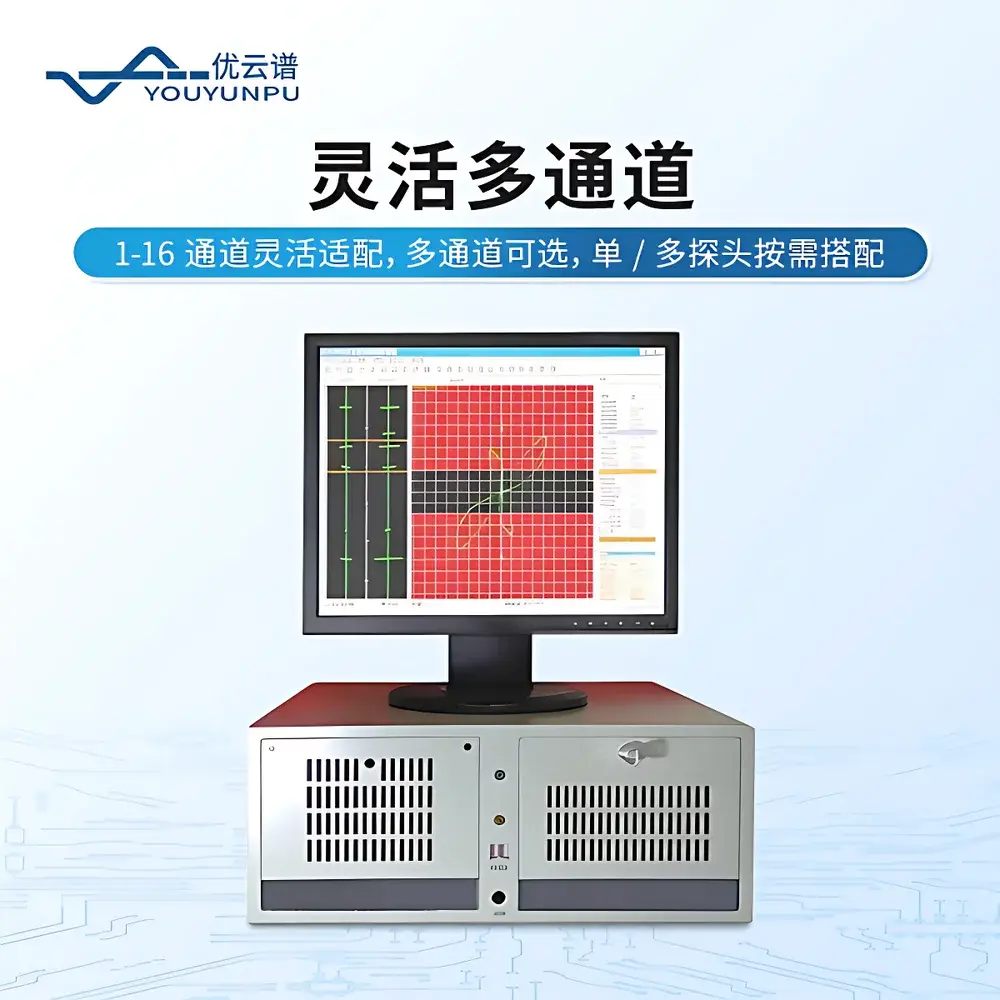
Youyunpu YP-41 Quad-Frequency Quad-Channel Automated Eddy Current Testing System for Bearing Rings
| Brand | Youyunpu |
|---|---|
| Origin | Shandong, China |
| Manufacturer Type | Direct Manufacturer |
| Country of Origin | China |
| Model | YP-41 |
| Detection Method | Fully Automated Eddy Current Inspection |
| Eddy Current Signal Type | Multi-Frequency (Quad-Frequency) |
| Instrument Form Factor | Benchtop |
| Number of Channels | 4 |
| Maximum Inspection Speed | >200 m/min |
| Frequency Range | 50 Hz to 10 MHz (continuously adjustable) |
| Gain Range | 0–99.0 dB (continuously adjustable, 0.1 dB step) |
Overview
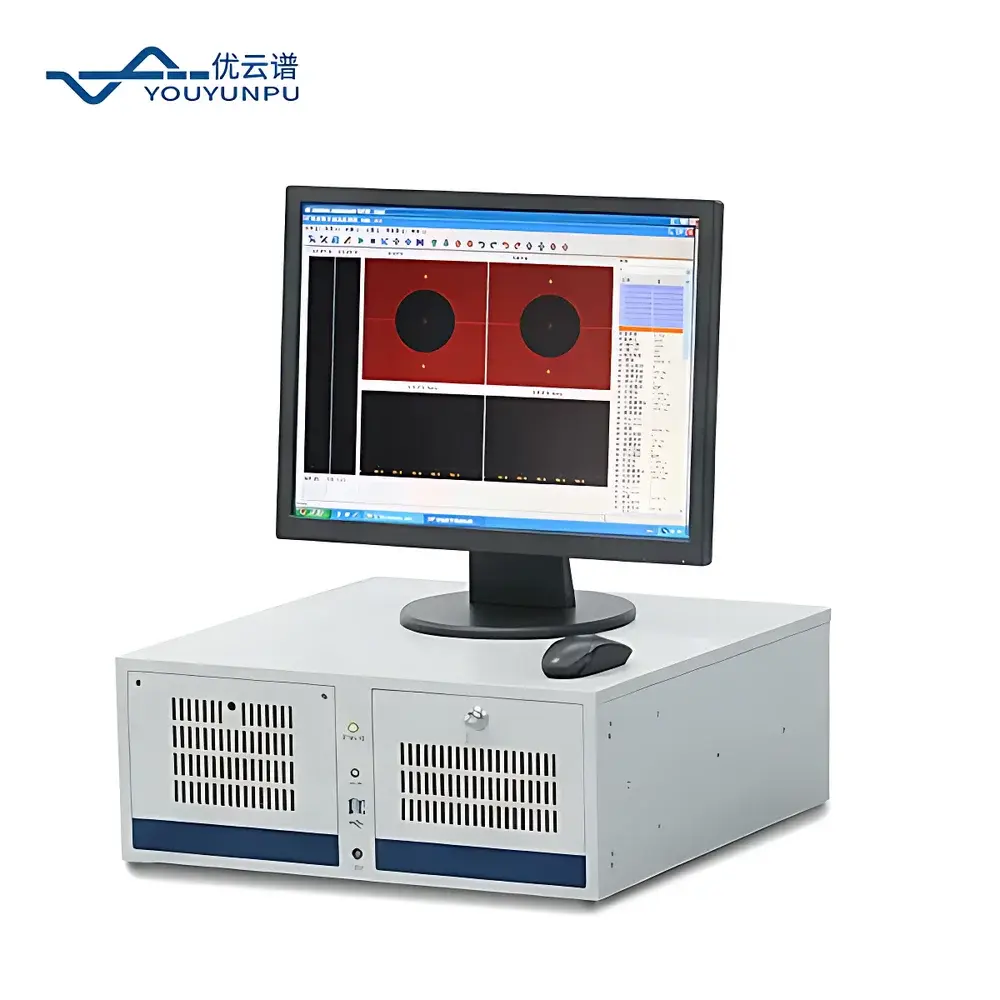
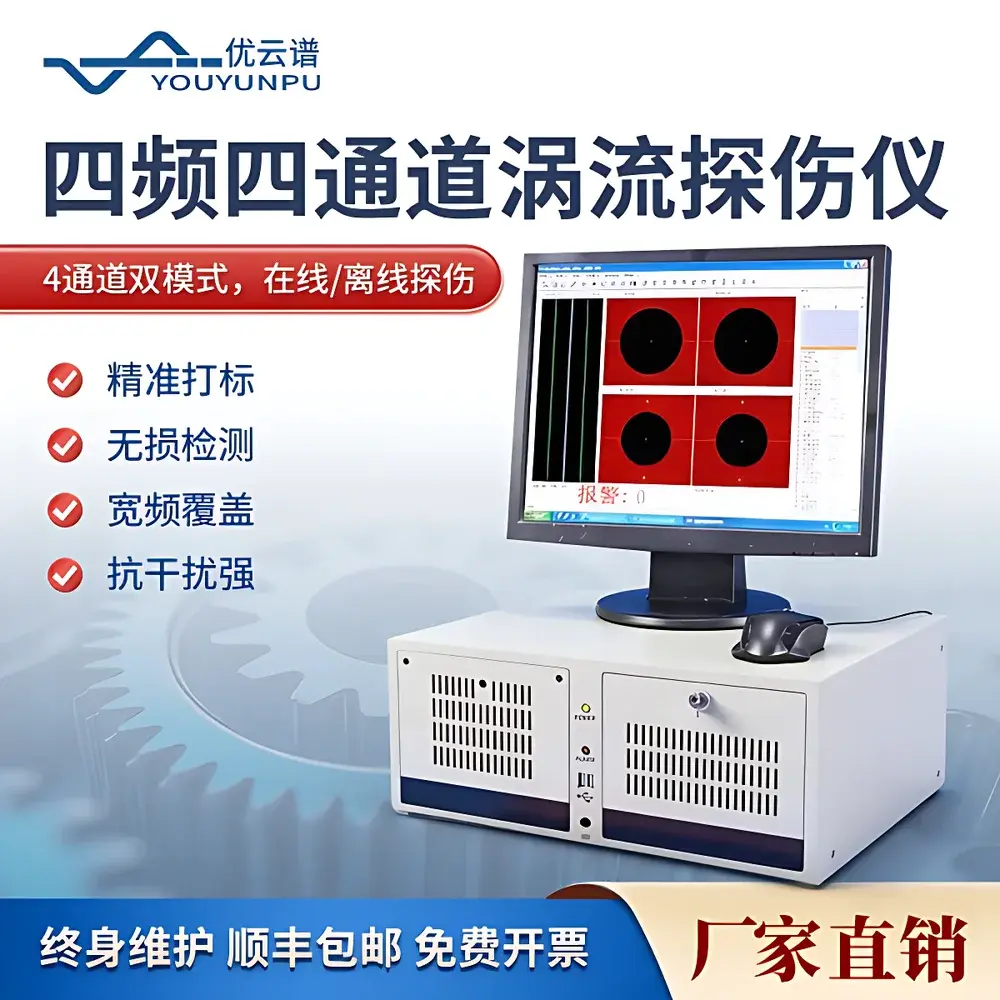
The Youyunpu YP-41 Quad-Frequency Quad-Channel Automated Eddy Current Testing System is an industrial-grade benchtop NDT instrument engineered for high-speed, high-reliability electromagnetic inspection of rotationally symmetric metallic components—particularly bearing rings, seamless/welded tubes, rods, wires, and critical mechanical parts. It operates on the principle of electromagnetic induction: alternating current in a probe coil generates a time-varying magnetic field, inducing eddy currents in conductive test materials; disruptions caused by subsurface or surface discontinuities (e.g., cracks, inclusions, wall thinning, heat treatment variations) alter the impedance response of the coil, which is quantified in real time across four independent detection channels. The system’s quad-frequency architecture enables simultaneous excitation at four distinct frequencies—each independently configurable between 50 Hz and 10 MHz—allowing concurrent optimization for depth penetration (low-frequency), surface resolution (high-frequency), noise rejection (interference suppression), and material property differentiation (e.g., conductivity, permeability). This multi-dimensional signal acquisition supports advanced defect characterization without mechanical repositioning or manual frequency switching.
Key Features
- Four fully independent, synchronized eddy current channels with individual gain (0–99.0 dB, 0.1 dB steps), phase rotation (0–359°, 1° steps), and frequency control (50 Hz–10 MHz, digitally entered)
- Dual-probe mode support: differential channel for abrupt defects (e.g., transverse cracks), absolute channel for gradual anomalies (e.g., wall loss, metallurgical gradients)
- Configurable probe drive level (1–8) and matching level (0–3) to optimize signal-to-noise ratio across diverse probe types and part geometries
- Real-time hardware-based alarm generation with up to eight isolated relay outputs (safety-rated switch signals), plus serial (RS232/485), USB, and parallel port interfaces for PLC integration
- Advanced digital filtering: selectable 0–2 kHz bandpass filter with up to 10-stage FIR/IIR configuration to suppress lift-off noise, support plate interference, vibration artifacts, and deposition-induced signals
- Automated end-trim function (configurable multi-segment start/end blanking) and precision marking trigger (±0.015 mm positional accuracy per 1 mm travel)
- Onboard real-time balancing (1–100 levels, adaptive feedback loop) and dual clock source selection (internal oscillator or external encoder sync)
- Multi-format display: impedance plane (polar and Cartesian), time-based A-scan, crosshair cursor, variable blanking coefficient (1–400), and real-time defect amplitude/phase/digital value readout
Sample Compatibility & Compliance
The YP-41 is validated for ferrous and non-ferrous alloys including carbon steel, stainless steel, titanium, copper, aluminum, and zirconium—making it suitable for tubing in power generation (boiler tubes, condenser tubes), oil & gas (well casing, flowlines), aerospace (turbine blades, bolt holes), and automotive (bearing races, shafts). Its quad-frequency capability meets requirements outlined in ASTM E309 (standard practice for eddy current examination of steel tubular products), ISO 15549 (eddy current testing — general principles), and EN 1711 (non-destructive testing — eddy current testing of welds). The system supports GLP/GMP-aligned workflows via timestamped audit trails, user-access-controlled parameter logging, and exportable raw impedance data compliant with FDA 21 CFR Part 11 readiness when integrated with validated software environments.
Software & Data Management
Embedded firmware provides bilingual (English/Chinese) GUI with context-sensitive help, real-time waveform replay, and post-inspection analysis tools—including defect amplitude mapping, phase-angle clustering, and statistical trend tracking across batches. All inspection programs (frequency sets, gain profiles, alarm thresholds, filter settings) are stored internally with timestamped version control. Detected anomalies are automatically logged with position coordinates, signal magnitude, phase angle, and channel ID. Final reports—generated on-device or exported via USB—include summary metrics (total inspected length, pass/fail counts, defect density per meter), annotated impedance plots, and customizable CSV/XML data exports compatible with LIMS and MES platforms. Optional PC-based analysis suite enables spectral decomposition, PCA-based noise separation, and comparative benchmarking against reference standards.
Applications
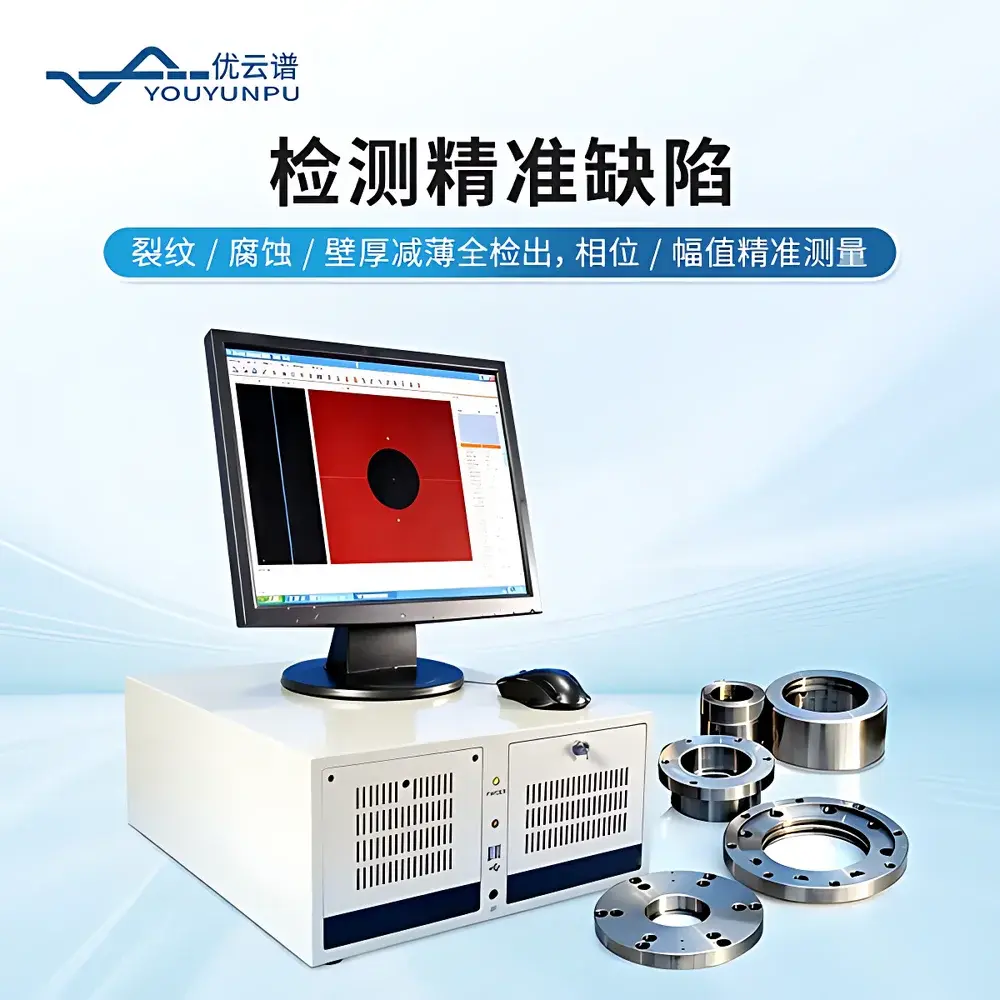
- Online and offline inspection of bearing inner/outer rings for grinding burns, micro-cracks, and heat treatment inconsistencies
- In-service and pre-service inspection of heat exchanger tubes, boiler tubes, and nuclear steam generator tubing
- Material verification: alloy sorting (e.g., 304 vs. 316 stainless), case depth estimation (carburized layers), hardness correlation, and cold-work assessment
- Surface and subsurface crack detection in turbine discs, rotor bores, fastener holes, and aircraft landing gear components
- Wall thickness monitoring and corrosion mapping in pipelines and pressure vessels using low-frequency through-transmission modes
- High-speed wire and bar inspection (>200 m/min) with automatic defect classification and marking trigger output
FAQ
What types of probes are compatible with the YP-41?
The system supports standard absolute, differential, reflection, and transmit-receive probe configurations—including pencil, surface, encircling, and array probes—with configurable drive/match settings for optimal coupling.
Can the YP-41 be integrated into an automated production line?
Yes. It features programmable I/O (8 alarm relays, encoder input, PLC handshake signals), real-time analog/digital outputs, and deterministic latency (<10 ms) for closed-loop feedback control in high-throughput environments.
Does the instrument support calibration traceability?
It accepts certified reference standards (e.g., ASTM E1316 notch blocks, ISO 12718 artificial flaws) and records calibration parameters—including date, operator ID, and environmental conditions—with tamper-evident logs.
Is remote diagnostics or firmware update possible?
Firmware updates are performed via USB flash drive; remote diagnostic access requires optional Ethernet module and secure VPN-configured network deployment.
What is the typical measurement repeatability under controlled conditions?
When operated with matched probes and stabilized temperature (±2°C), the system achieves amplitude repeatability of ±1.5% and phase repeatability of ±1.2° over 8-hour continuous operation.



