
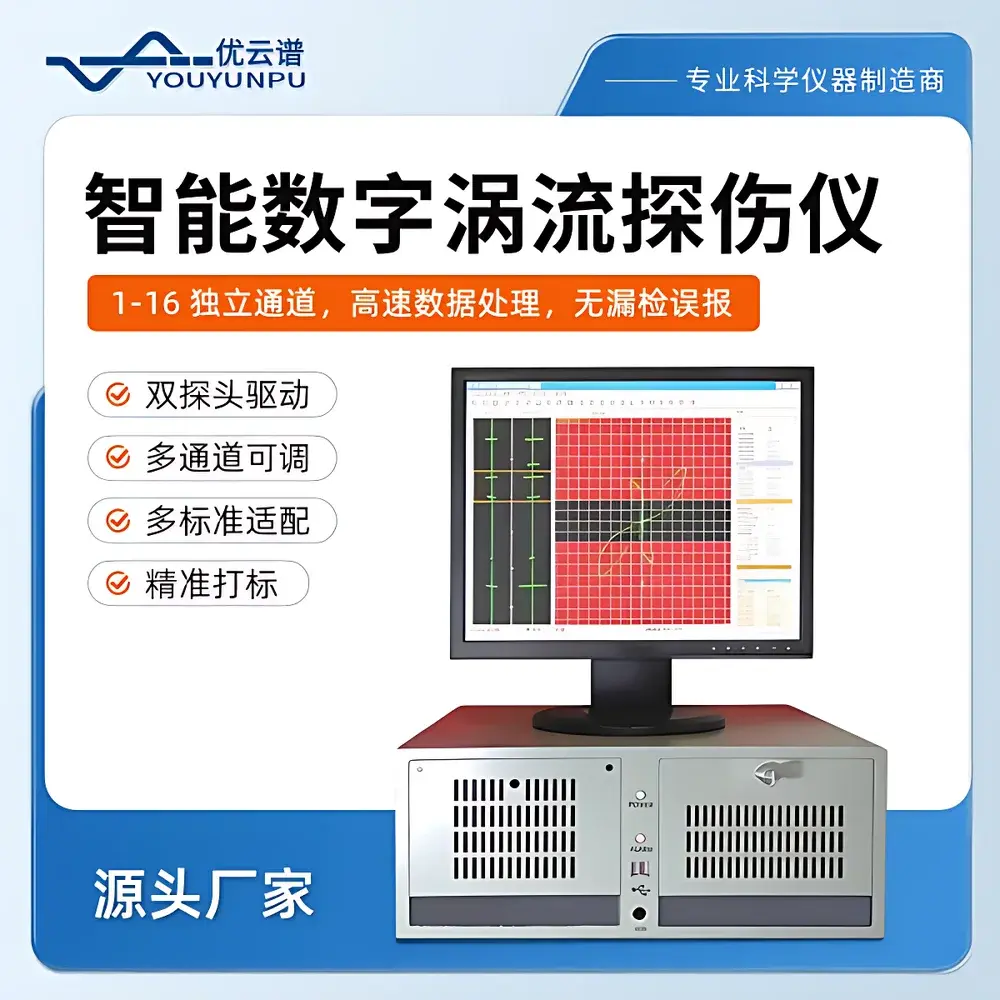
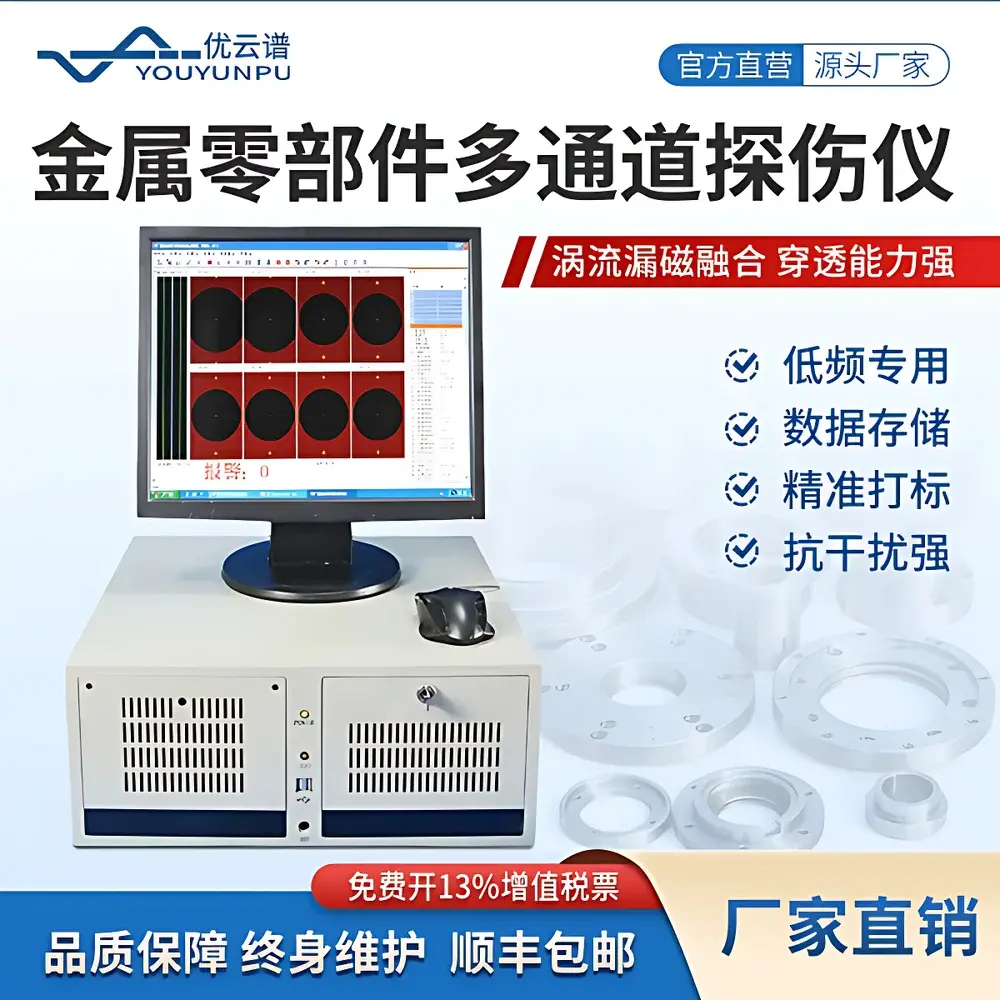
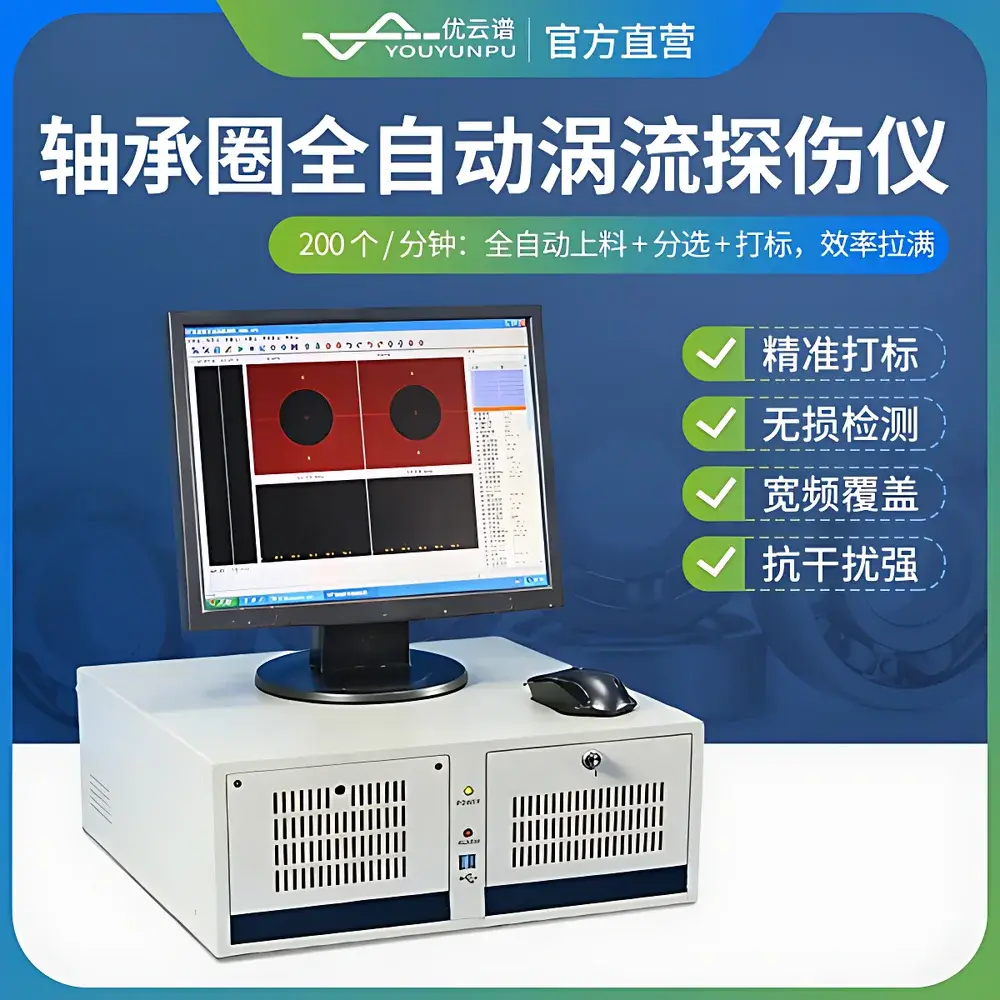
Youyunpu YP-66S Benchtop Eddy Current Testing System for Online Weld Pipe Inspection
| Brand | Youyunpu |
|---|---|
| Origin | Shandong, China |
| Manufacturer Type | Direct Manufacturer |
| Country of Origin | China |
| Model | YP-66S |
| Detection Mode | Automated In-Line Inspection |
| Form Factor | Benchtop |
| Frequency Range | 50 Hz – 10 MHz |
| Gain Adjustment | 0–99 dB (wide-range, continuous) |
| Phase Rotation | 0°–359° (continuous) |
| X/Y Gain Ratio | 0.1–10.0 |
| Phase Amplification Factor | 1–10 (patented) |
| Probe Drive Level | 1–8 (adjustable) |
| Probe Matching Level | 0–3 (adjustable) |
| Maximum Scan Speed | 10 m/s |
| Operating Temperature (Probe) | −20 °C to +50 °C |
| Operating Temperature (Instrument) | −10 °C to +50 °C |
| Enclosure | Sealed Plastic Housing with Protective Sleeve |
| Weight (with battery) | 2.3 kg |
| Battery Runtime | Up to 6 hours |
| Charging Time | 2–4 hours (on-screen status indicator) |
| Power Supply | Universal AC 100–240 V, 50–60 Hz |
| Power Consumption | 20 W |
| Dimensions | 240 mm × 150 mm × 70 mm |
| Data Management | Auto-storage & playback capability |
Overview
The Youyunpu YP-66S is a benchtop eddy current testing (ECT) system engineered for high-reliability, automated in-line inspection of welded steel and non-ferrous pipes during manufacturing or post-production quality control. It operates on the principle of electromagnetic induction: an alternating current applied to a probe coil generates a time-varying magnetic field, inducing eddy currents in conductive test materials; disruptions caused by surface or near-surface discontinuities—including cracks, lack-of-fusion, porosity, and wall-thinning—alter the impedance response of the coil, which is detected, digitized, and analyzed in real time. Designed specifically for weld integrity verification, the YP-66S supports both absolute and differential probe configurations, enabling detection of longitudinal and transverse flaws across pipe OD/ID surfaces, heat-affected zones (HAZ), and weld caps. Its compact architecture integrates dual-mixer circuitry for multi-frequency signal conditioning, allowing simultaneous suppression of lift-off noise, temperature drift, and material property variations—critical for stable operation in dynamic production environments.
Key Features
- Benchtop form factor optimized for integration into pipe mill inspection stations or QC labs—no floor mounting required; modular design allows rapid deployment alongside conveyors or rotary fixtures.
- Dual independent mixing units enable real-time signal subtraction and phase-sensitive filtering, significantly improving signal-to-noise ratio (SNR) in noisy industrial settings.
- Patented phase amplification (1×–10×) enhances resolution of subtle impedance vector shifts—particularly effective for detecting tight fatigue cracks in stainless steel or aluminum welds.
- Eight-level adjustable probe drive ensures optimal excitation across diverse probe types (pancake, pencil, encircling, array) and material conductivity ranges (e.g., austenitic vs. ferritic steels).
- Three-tier probe matching adjustment improves coupling efficiency and minimizes reflection losses—essential for consistent performance with custom or high-frequency probes.
- Real-time scan speed up to 10 m/s accommodates high-throughput pipe lines (e.g., ERW or HFI welded tubes at >30 m/min line speeds).
- Sealed IP65-rated enclosure with shock-absorbing protective sleeve ensures operational integrity in dusty, humid, or vibration-prone factory floors.
- Internal rechargeable Li-ion battery (6 h runtime) supports portable use during commissioning, maintenance checks, or offline validation without AC dependency.
Sample Compatibility & Compliance
The YP-66S is validated for non-ferromagnetic and weakly ferromagnetic tubular products, including seamless and welded carbon steel, stainless steel (304, 316), aluminum alloys (6061, 7075), titanium (Grade 2, Grade 5), and copper-nickel alloys. It complies with fundamental requirements of ASTM E309 (Standard Practice for Eddy Current Examination of Steel Tubular Products), ISO 15549 (Eddy Current Testing — General Principles), and EN 1711 (Non-destructive testing — Eddy current testing of welds in metallic materials). While not inherently 21 CFR Part 11 compliant, its auto-storage and timestamped playback functionality supports GLP/GMP-aligned documentation when integrated with external audit-trail software. All stored data files are saved in binary format with embedded metadata (date/time, operator ID, parameter set name, probe ID), facilitating traceability per ISO 9001:2015 clause 8.5.2.
Software & Data Management
The instrument embeds firmware-based acquisition logic with no external PC dependency for basic operation. Parameter sets—including frequency, gain, phase, mixing coefficients, and alarm thresholds—are preconfigured by qualified NDT Level II personnel and saved as named profiles (e.g., “ERW-SS-2.5mm”, “Al-Tube-OD-Scan”). Operators select profiles via intuitive menu navigation and initiate inspection with one-button start. Raw impedance data (real/imaginary components) and envelope-detected flaw signals are automatically logged to internal flash memory with cycle-accurate timestamps. Playback mode permits frame-by-frame review, zoom, and manual gating—supporting root-cause analysis of false calls or marginal indications. Export options include CSV (for spreadsheet-based trending) and proprietary .ECT binary (for third-party analysis tools compatible with ASTM E2884-compliant formats).
Applications
- In-line weld seam inspection of electric resistance welded (ERW), high-frequency induction (HFI), and laser-welded tubes (diameters 12–219 mm, wall thicknesses 0.5–12 mm).
- Surface-breaking crack detection on turbine blades, compressor disks, and aerospace fasteners—especially where geometry limits access for conventional probes.
- Non-conductive coating thickness measurement on aluminum or copper substrates (e.g., anodized layers, polymer coatings) using lift-off compensation algorithms.
- Corrosion mapping of non-ferrous tubing in heat exchangers, condensers, and nuclear steam generator applications.
- Material sorting and conductivity verification for alloy verification (e.g., distinguishing 304 from 316 stainless, or 6061 from 2024 aluminum).
- Multi-layer structure assessment in aircraft fuselage skins and wing spar joints—detecting disbonds, interlaminar corrosion, and moisture ingress beneath clad layers.
FAQ
Is the YP-66S suitable for inspecting ferromagnetic welds?
Yes—with appropriate probe selection and low-frequency operation (≤500 kHz), it can detect surface-breaking defects in low-carbon steel welds. However, deep subsurface flaw detection in highly permeable materials remains limited due to skin depth constraints.
Can the instrument interface with PLC-controlled production lines?
It features isolated digital I/O (TTL-compatible) for external trigger input and pass/fail output signaling, enabling synchronization with conveyor encoders or reject mechanisms.
Does it support array probe configurations?
Yes—the adjustable drive level and matching circuitry accommodate linear and circular ECT arrays for circumferential coverage without mechanical rotation.
What calibration standards are recommended?
ASTM E1004-compliant conductivity standards and EDM-notched reference tubes (e.g., ASME Section V Article 8) should be used for daily system verification prior to inspection.
Is firmware upgrade supported remotely?
Firmware updates require USB connection to a Windows PC using Youyunpu’s certified configuration utility; no over-the-air or network-based update capability is provided.



