
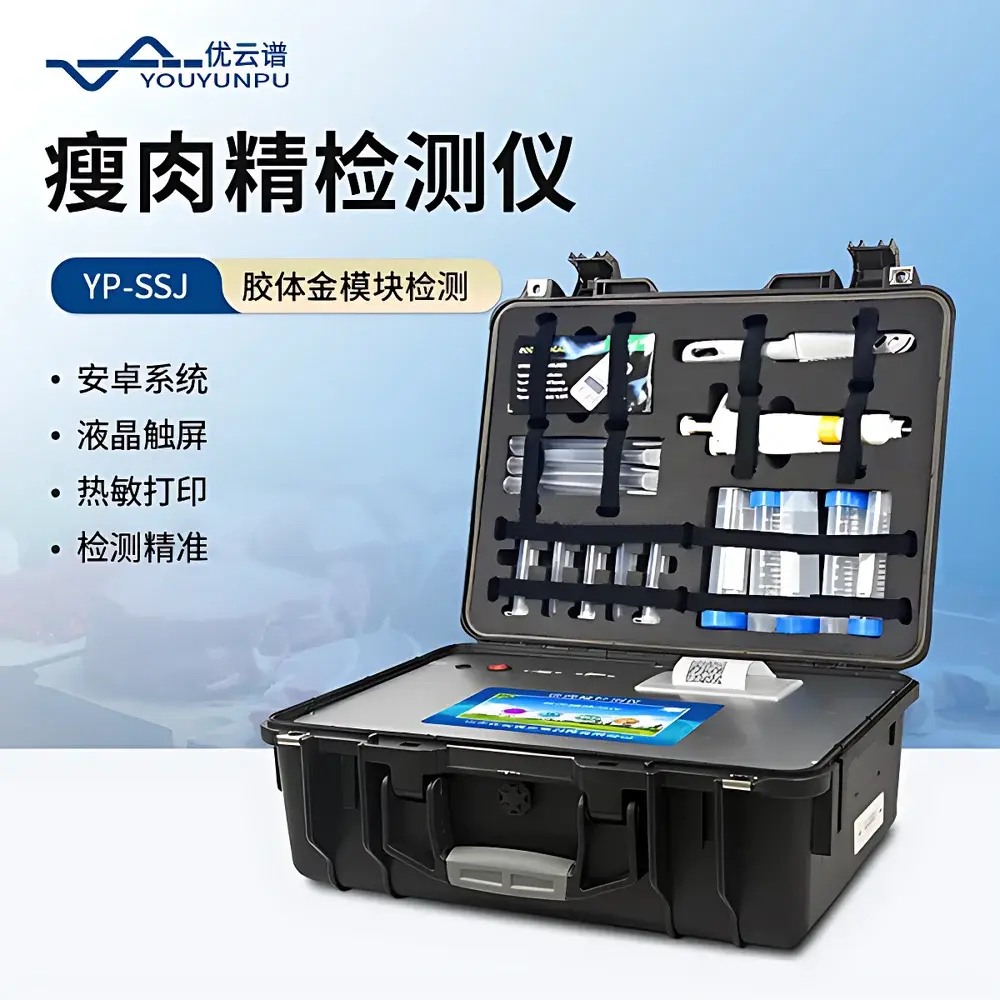
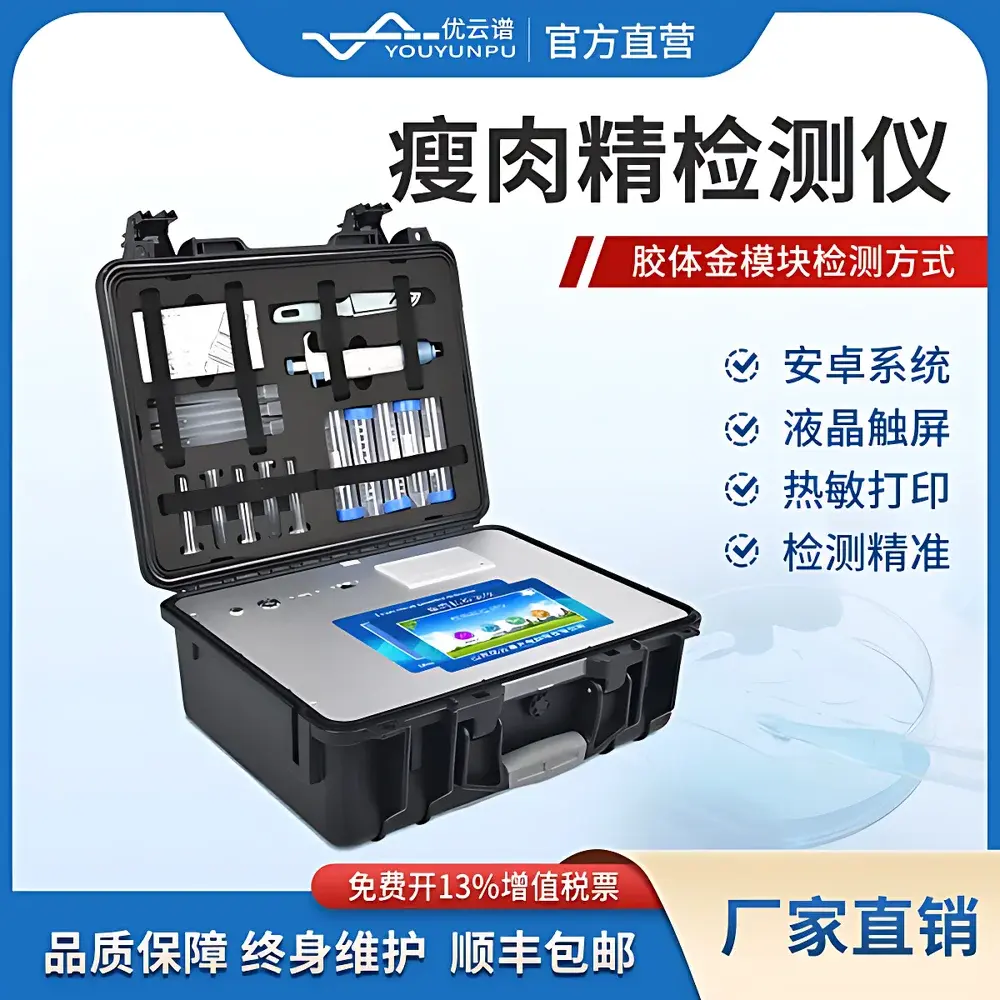
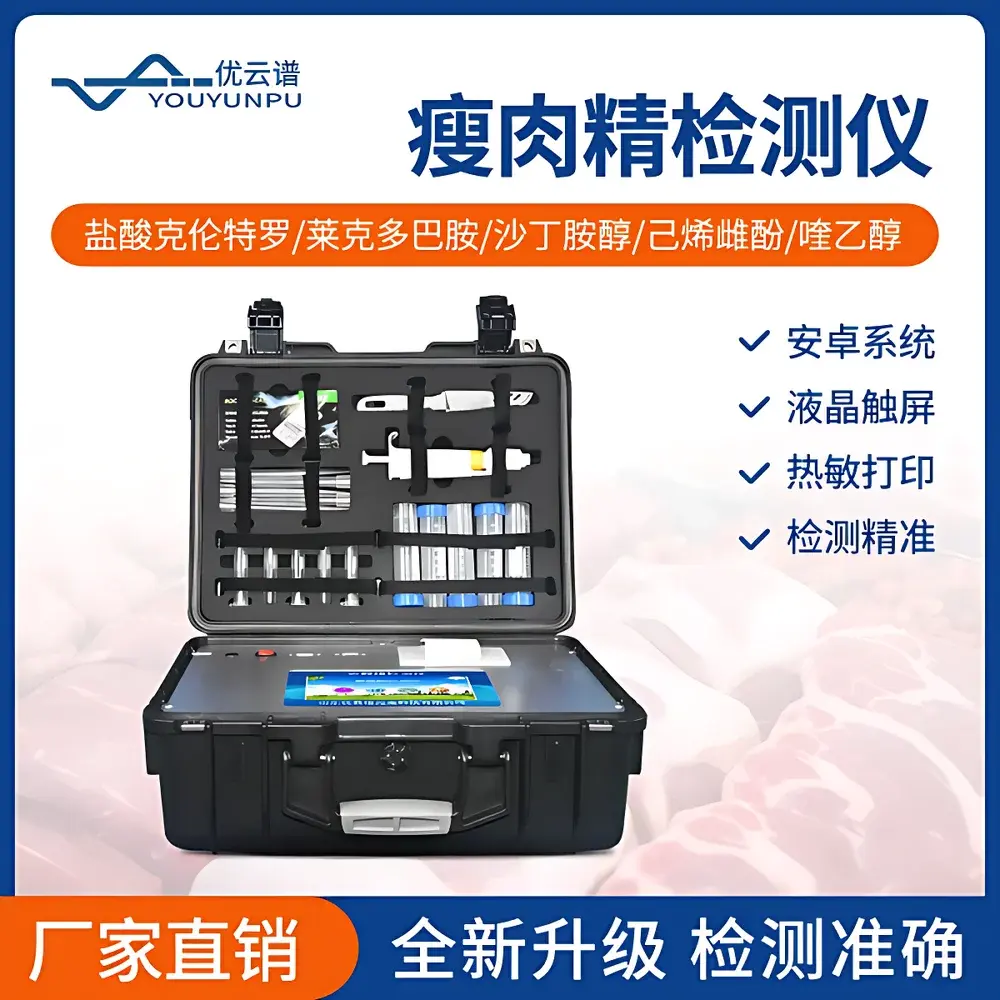
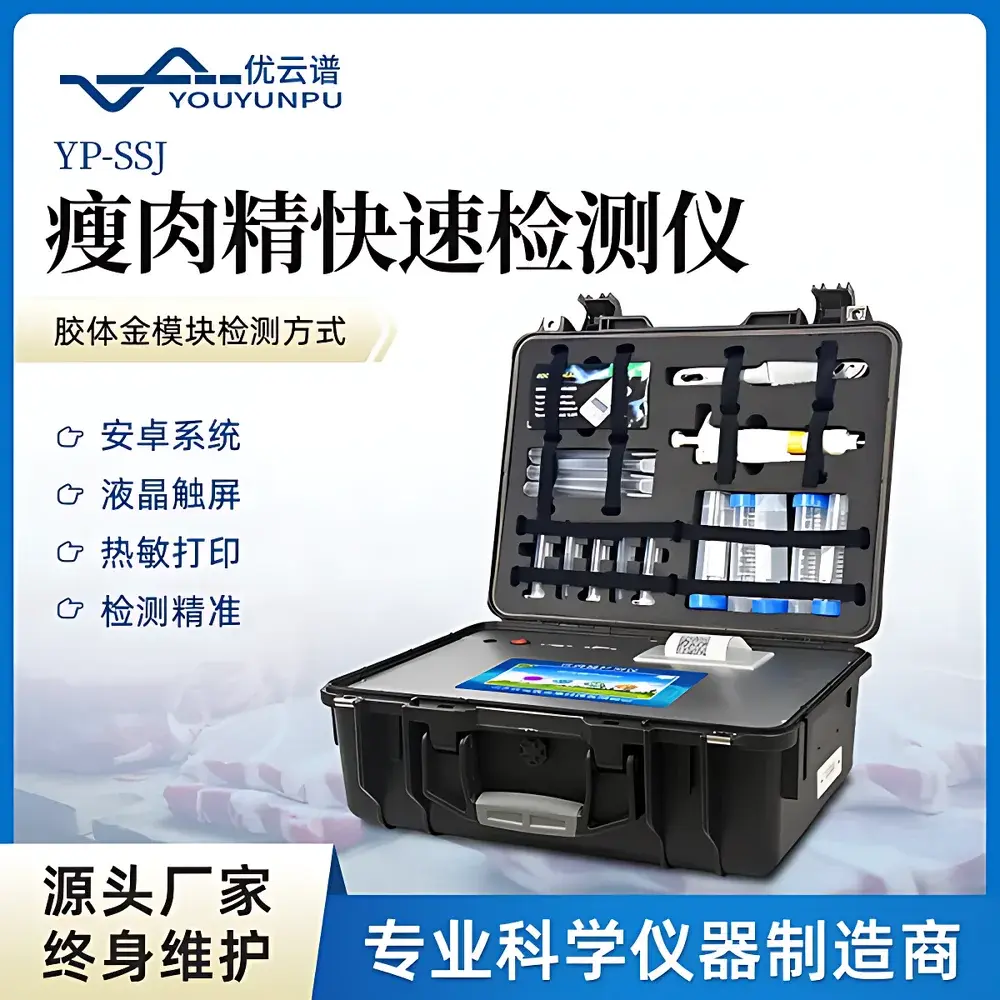
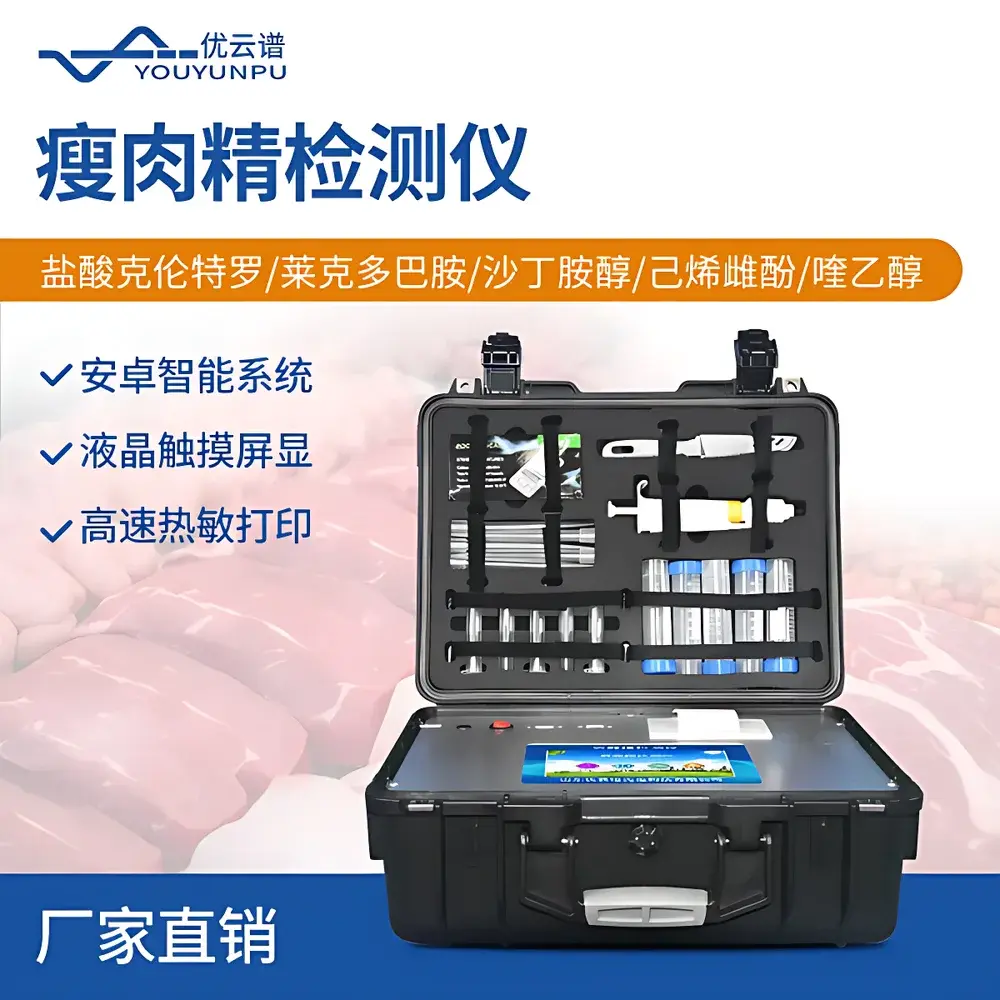
Youyunpu YP-SSJ Clenbuterol and Multi-Residue Rapid Immunoassay Analyzer
| Brand | Youyunpu |
|---|---|
| Origin | Shandong, China |
| Manufacturer Type | OEM Manufacturer |
| Region of Manufacture | Domestic (China) |
| Model | YP-SSJ |
| Weight | 6.8 kg |
| Data Storage Capacity | 200,000 records |
Overview
The Youyunpu YP-SSJ is a portable, integrated rapid immunoassay analyzer engineered for on-site and mobile detection of β-agonist veterinary drug residues—including clenbuterol hydrochloride, ractopamine, salbutamol, diethylstilbestrol, and quinolone antibiotics—in meat and animal-derived food matrices. It operates on the colloidal gold immunochromatographic assay (GICA) principle, leveraging optical scanning and digital image analysis to quantify test line (T) and control line (C) signal intensities. The system delivers semi-quantitative results in accordance with national food safety standards (e.g., GB 29693–2013, GB/T 22286–2008), supporting regulatory compliance in food safety surveillance, slaughterhouse quality control, and farm-to-fork traceability programs.
Key Features
- ARM Cortex-A7 RK3288 quad-core processor (1.88 GHz) enabling real-time image capture, CT curve generation, and automated T/C ratio calculation with high repeatability.
- 7-inch capacitive touchscreen interface with intuitive Chinese/English bilingual UI; supports offline operation and local data management without cloud dependency.
- Multi-mode connectivity: Wi-Fi, 4G LTE, GPRS, and Ethernet—enabling secure transmission of encrypted result files to centralized food safety monitoring platforms (e.g., provincial SFDA dashboards).
- Integrated thermal printer with QR code generation for immediate hard-copy reporting; all reports include sample ID, test date, operator ID, and threshold-compliant pass/fail interpretation.
- Auto-calibrating optical module with intelligent constant-current LED illumination and automatic brightness compensation—ensuring stable photometric performance across ambient temperature fluctuations (10–35°C operating range).
- Modular assay compatibility: accepts all commercially available colloidal gold lateral flow strips without proprietary lock-in; supports future expansion to antibiotic, sulfonamide, and mycotoxin detection via firmware update.
- Built-in camera captures high-resolution strip images pre- and post-scanning; software performs edge-aware ROI detection and eliminates manual line positioning errors.
- On-device database stores up to 200,000 test records with searchable metadata (sample name, analyte, batch number, submitting unit); supports USB export to CSV/Excel format.
- Power-flexible architecture: operates on 12 V DC input (compatible with vehicle power systems) or optional 6 Ah rechargeable Li-ion battery—rated for ≥8 hours continuous use in field conditions.
Sample Compatibility & Compliance
The YP-SSJ is validated for use with homogenized muscle tissue, liver, kidney, urine, and feed extracts prepared according to standard AOAC and GB/T extraction protocols. Sample preparation requires minimal centrifugation and dilution steps—no organic solvent handling or skilled technician intervention. All assay interpretations align with China’s National Food Safety Standard limits (e.g., ≤0.1 μg/kg for clenbuterol in pork). While not certified under ISO/IEC 17025, the instrument meets functional requirements specified in GB/T 27404–2008 (Laboratory Quality Control Guidelines for Food Microbiology and Residue Testing) and supports GLP-aligned documentation workflows, including user authentication, audit trail logging, and result encryption prior to upload.
Software & Data Management
Firmware v3.2+ includes embedded regulatory databases updated quarterly via OTA or USB import. Each test record contains timestamped raw image data, CT intensity values, calculated concentration (ng/mL), and compliance status relative to configurable MRL thresholds. Data synchronization uses TLS 1.2–secured HTTP POST to designated RESTful endpoints; local storage retains full audit logs—including login attempts, calibration events, and parameter modifications—for internal QA review. Export formats comply with FAO/WHO Codex Alimentarius Annex VII metadata conventions, facilitating interoperability with national food safety information systems (e.g., China’s “Food Safety Traceability Platform”).
Applications
- Routine screening at abattoirs and cold-chain distribution hubs to verify absence of prohibited β-agonists prior to market release.
- Field deployment by municipal food and drug administration (CFDA) inspectors during unannounced audits of wet markets and processing facilities.
- Academic research in veterinary pharmacokinetics—supporting validation studies of new rapid assays under controlled laboratory conditions.
- Quality assurance labs in meat processing plants performing lot-release testing per HACCP Plan Annex A requirements.
- Mobile veterinary service units conducting on-farm residue surveillance in swine and cattle operations.
FAQ
Does the YP-SSJ require external calibration standards for daily operation?
No—built-in self-diagnostic routines perform automatic zero-point adjustment and optical baseline correction before each test cycle.
Can test results be integrated into enterprise LIMS environments?
Yes—via configurable API endpoints or flat-file exports (UTF-8 CSV) with standardized field headers compliant with ASTM E1467–05 data exchange conventions.
Is the device suitable for ISO 17025-accredited laboratories?
While the instrument itself is not accredited, its output data—when used within a documented SOP including operator training, environmental controls, and reference material verification—may support method validation under ISO/IEC 17025:2017 Clause 7.2.
What is the minimum detectable concentration for clenbuterol using this system?
Detection sensitivity is method-dependent and varies with sample matrix and extraction efficiency; typical LOD ranges from 0.05–0.2 μg/kg when paired with validated GB/T 22286–2008 sample prep.
How frequently must firmware updates be applied to maintain regulatory alignment?
Critical updates (e.g., new MRL tables or reporting templates) are issued biannually; non-critical enhancements follow a quarterly release schedule—both distributed via Youyunpu’s authorized support portal.




