
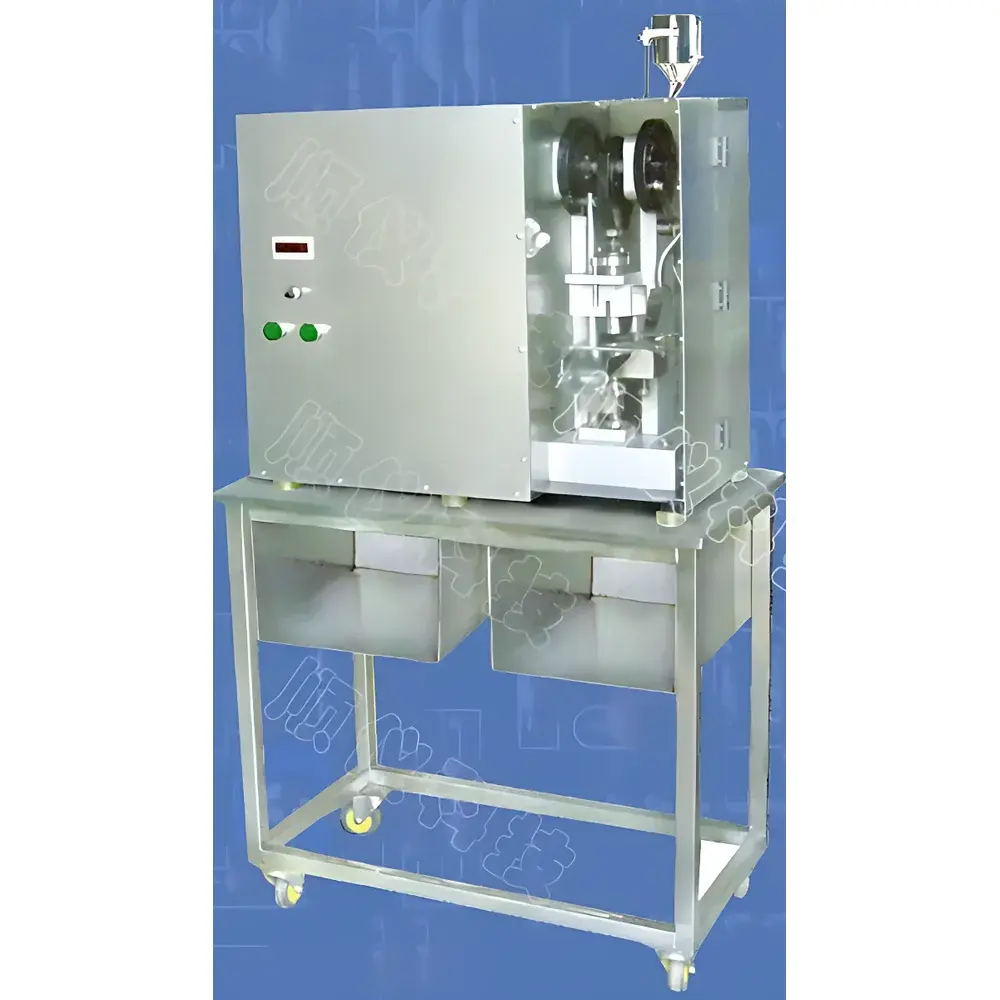
YP-1400 Laboratory-Scale Single-Station Tablet Press
| Origin | Shanghai, China |
|---|---|
| Manufacturer Type | Authorized Distributor |
| Origin Category | Domestic (China) |
| Model | YP-1400 |
| Pricing | Upon Request |
| Production Speed | 10–140 tablets/min |
| Maximum Compression Force | 4000 kgf |
| Tooling Compatibility | Interchangeable Punches (3–20 mm diameter) |
| Motor Power | 1.2 kW |
| Electrical Supply | Single-phase, 220/240 V, 50/60 Hz |
| Dimensions (L×W×H) | 650 × 400 × 650 mm |
| Net Weight | 150 kg |
| Construction | 304 stainless steel frame |
| Control System | Fully automated, stepless speed regulation with jog-reverse function |
| GMP Compliance | Designed to meet core requirements of WHO-GMP and ISO 9001 for laboratory-scale pharmaceutical processing |
Overview
The YP-1400 Laboratory-Scale Single-Station Tablet Press is an electromechanically actuated, benchtop compression system engineered for precision formulation development and small-batch tablet manufacturing in regulated R&D environments. It operates on the principle of uniaxial mechanical compression—applying controlled force between upper and lower punches within a die cavity—to consolidate powder blends into mechanically stable solid dosage forms. Unlike industrial rotary presses, the YP-1400 employs a single-station architecture optimized for iterative process parameter screening (e.g., dwell time, compression force, fill depth), making it indispensable for preformulation studies, excipient compatibility testing, and early-stage bioavailability assessment. Its compact footprint and self-contained design eliminate dependency on external vacuum, air, or hydraulic utilities—enabling immediate deployment in ISO Class 7 clean benches, QC laboratories, or university teaching labs.
Key Features
- Stepless speed control (10–140 tablets per minute) enables precise correlation between compression dwell time and tablet tensile strength.
- Interchangeable punch-and-die sets (3–20 mm diameter) support rapid evaluation of geometry-dependent compaction behavior—including round, oblong, and custom-shaped tablets.
- Jog-reverse function allows real-time manual correction of punch positioning during tooling setup or jam recovery—minimizing material waste and downtime.
- Full 316 stainless steel contact surfaces comply with USP <801> and EP 5.1.8 requirements for non-reactive, corrosion-resistant pharmaceutical equipment wetted parts.
- Integrated drive motor (1.2 kW) delivers consistent torque across the full speed range, ensuring reproducible compression profiles under variable load conditions.
- Modular hopper assembly (optional) facilitates continuous feeding during extended trials while maintaining operator accessibility for manual dosing verification.
Sample Compatibility & Compliance
The YP-1400 accommodates free-flowing to moderately cohesive powders typical of direct compression formulations (e.g., microcrystalline cellulose, lactose monohydrate, mannitol), as well as dry granules produced via roller compaction or high-shear mixing. It has been validated for use with APIs exhibiting low melting points (<120°C), hygroscopic compounds (when operated under nitrogen purge), and high-potency substances (when coupled with containment adapters). The unit meets fundamental design criteria outlined in Annex 15 (Qualification and Validation) of the EU GMP Guidelines and supports IQ/OQ documentation packages aligned with FDA 21 CFR Part 11 data integrity expectations. All structural welds conform to ASME BPE-2022 surface finish standards (Ra ≤ 0.8 µm for product-contact zones).
Software & Data Management
While the YP-1400 operates via embedded PLC-based logic (no proprietary software required), its analog I/O interface supports integration with third-party SCADA systems (e.g., Ignition, Siemens WinCC) for time-stamped logging of compression force, cycle count, and motor current. Optional digital load cell retrofitting enables real-time force profiling—critical for identifying capping propensity and elastic recovery behavior. Audit trails are maintained locally via non-volatile memory, retaining ≥10,000 cycles of timestamped operational metadata (start/stop times, speed setpoints, emergency stops) in compliance with ALCOA+ principles.
Applications
- Formulation optimization: Screening binder concentration, lubricant levels, and disintegrant types via hardness/disintegration correlation studies.
- GMP-aligned pilot batches: Producing clinical trial supplies (Phase I–II) under documented SOPs traceable to master batch records.
- Teaching & training: Demonstrating fundamental powder metallurgy concepts—Heckel analysis, Kawakita modeling, and tablet friability mechanics—in academic pharmacology curricula.
- Taste-masking validation: Fabricating placebo-controlled taste-assessment tablets with identical geometry and mass to active formulations.
- Medical device prototyping: Compressing ceramic or polymer composites for dental implant preforms or diagnostic sensor substrates.
FAQ
Does the YP-1400 support regulatory submission data packages?
Yes—its mechanical repeatability (±1.2% force variation over 500-cycle runs) and material traceability features enable generation of data suitable for inclusion in CMC sections of IND/IMPD dossiers.
Can it be integrated into a contained isolator system?
Absolutely—the unit’s front-access layout, absence of top-mounted controls, and optional glove-port mounting brackets allow seamless installation in Class III isolators per ISO 14644-7.
Is calibration certification included with delivery?
A factory-issued calibration report (traceable to NIM China) covering force transducer linearity and speed encoder accuracy is provided standard; UKAS-accredited field recalibration services are available upon request.
What maintenance intervals are recommended for GMP operation?
Daily visual inspection of punch alignment and die bore cleanliness; biweekly lubrication of cam follower assemblies using ISO VG 68 food-grade grease; annual torque verification of all structural fasteners per ASTM F2671.




