
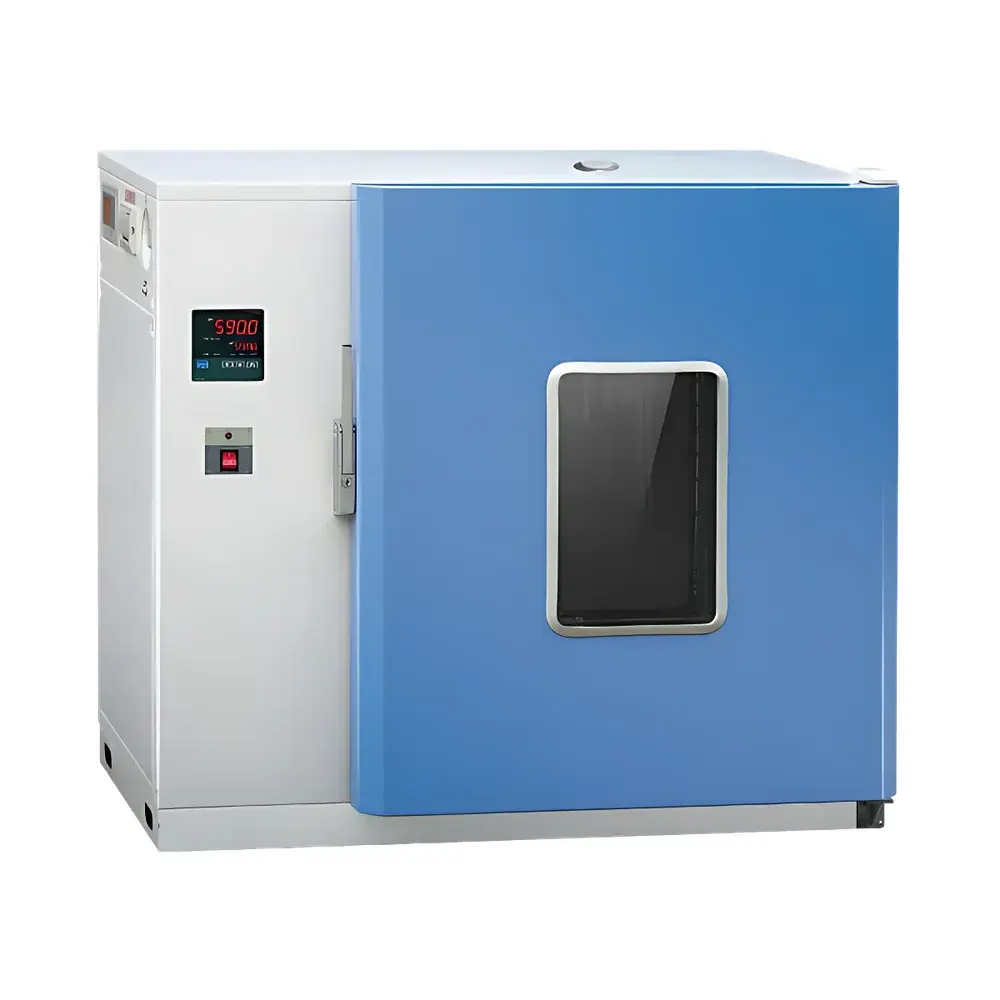
YSEI DGF-3006B Forced-Air Laboratory Drying Oven
| Brand | YSEI |
|---|---|
| Origin | Chongqing, China |
| Manufacturer Type | Direct Manufacturer |
| Product Category | Domestic |
| Model | DGF-3006B |
| Instrument Type | High-Temperature Forced-Air Oven |
| Temperature Range | Ambient +20 °C to 250 °C (max. 300 °C) |
| Temperature Uniformity | ±2.5 °C |
| Temperature Fluctuation | ±1 °C |
| External Dimensions (W×D×H) | 1110×1300×1280 mm |
| Internal Chamber Dimensions (W×D×H) | 800×800×1000 mm |
| Operating Ambient Temperature | 5–35 °C |
| Chamber Material | Mirror-Finish SUS304 Stainless Steel |
| Heating Method | Electric Resistance Heating System |
| Power Rating | 4500 W |
| Load Capacity | 2 Adjustable Stainless Steel Shelves |
| Relative Humidity Limit | ≤85% RH |
Overview
The YSEI DGF-3006B Forced-Air Laboratory Drying Oven is a precision-engineered thermal processing instrument designed for consistent, repeatable drying, baking, sterilization, and temperature-stabilized testing in regulated laboratory environments. Built upon the principles of convective heat transfer, the unit employs a high-efficiency axial fan system to circulate heated air uniformly across the chamber volume—minimizing thermal gradients and ensuring reliable process control. Its operational range extends from ambient +20 °C up to 250 °C (with short-term capability to 300 °C), making it suitable for applications requiring elevated thermal stability without vacuum or inert atmosphere constraints. The oven’s robust architecture—including full SUS304 mirror-finish stainless steel interior—ensures long-term corrosion resistance, ease of cleaning, and compliance with basic hygiene standards common in pharmaceutical QC labs, academic research facilities, and clinical diagnostics settings.
Key Features
- Forced-air convection system with rear-mounted centrifugal blower for enhanced airflow distribution and improved temperature uniformity (±2.5 °C across chamber volume)
- Precision digital PID temperature controller with real-time display, adjustable ramp/soak profiles, and over-temperature safety cutoff independent of main control circuitry
- Double-layer insulated chamber walls with high-density mineral wool insulation to minimize thermal loss and maintain energy efficiency
- Two adjustable, load-rated stainless steel shelves (SUS304, 3 mm thick) supporting up to 25 kg per shelf under static load conditions
- Front-access double-glazed observation window with internal LED lighting for non-intrusive sample monitoring during operation
- Comprehensive safety suite including door-interlocked power cutoff, ground-fault circuit interrupter (GFCI)-compatible input, and Class H insulation-rated heating elements
Sample Compatibility & Compliance
The DGF-3006B accommodates a broad spectrum of sample formats—including Petri dishes, glassware, metal trays, polymer substrates, and bulk powder containers—within its 640 L internal chamber volume. Its chamber geometry supports standardized rack configurations used in GLP-compliant stability studies (e.g., ICH Q1A–Q1E). While not certified to ISO 17025 or ASTM E145 as a standalone metrological device, the oven meets essential functional requirements outlined in USP (Sterility Assurance), ISO 14644-1 (cleanroom-compatible surface finish), and EN 61000-6-3 (EMC emissions). The SUS304 interior complies with FDA-recommended materials for non-contact equipment surfaces in pharmaceutical manufacturing support areas. All electrical components conform to IEC 61010-1 safety standards for laboratory equipment.
Software & Data Management
The DGF-3006B operates via an embedded microcontroller-based interface with no external software dependency. However, optional RS485 Modbus RTU communication port enables integration into centralized lab monitoring systems (e.g., LabVantage, Siemens Desigo, or custom SCADA platforms) for remote parameter logging and alarm event capture. When paired with compliant data acquisition hardware, the unit supports 21 CFR Part 11–aligned audit trails—including operator ID tagging, timestamped setpoint changes, and deviation alerts—provided the host system implements appropriate electronic signature and access control protocols. Calibration records may be maintained manually or imported into LIMS via CSV export functionality available on connected controllers.
Applications
- Drying of moisture-sensitive reagents, filter papers, and ceramic precursors in materials science laboratories
- Baking of coated substrates and printed circuit board assemblies prior to soldering or coating adhesion testing
- Thermal conditioning of calibration standards (e.g., reference thermistors, RTDs) before metrological verification
- Pre-sterilization holding of glassware and stainless steel tools in microbiology and cell culture suites
- Accelerated aging studies for packaging materials and medical device components per ISO 11607-1
- Residual solvent removal from synthesized organic compounds in synthetic chemistry workflows
FAQ
What is the maximum continuous operating temperature?
The DGF-3006B is rated for continuous operation up to 250 °C; brief excursions to 300 °C are permissible for ≤30 minutes per cycle, provided chamber loading does not exceed 70% volume capacity.
Does the unit include validation documentation?
Factory-installed temperature mapping reports (IQ/OQ templates) are supplied with each unit; PQ execution requires user-defined test protocols aligned with ISO/IEC 17025-accredited third-party verification.
Can the oven be used for sterilization of surgical instruments?
No—this model lacks validated biological indicator cycles, steam generation, or vacuum-assisted air removal required for sterility assurance per ISO 17665; it is intended for dry-heat decontamination only.
Is the internal chamber accessible for third-party calibration?
Yes—the chamber features four calibrated PT100 sensor ports (two fixed, two user-accessible) compatible with NIST-traceable probe insertion for field verification of temperature uniformity and accuracy.
What maintenance intervals are recommended?
Blower motor lubrication every 12 months, door gasket inspection quarterly, and full thermal calibration annually—or after any impact event affecting chamber integrity.



