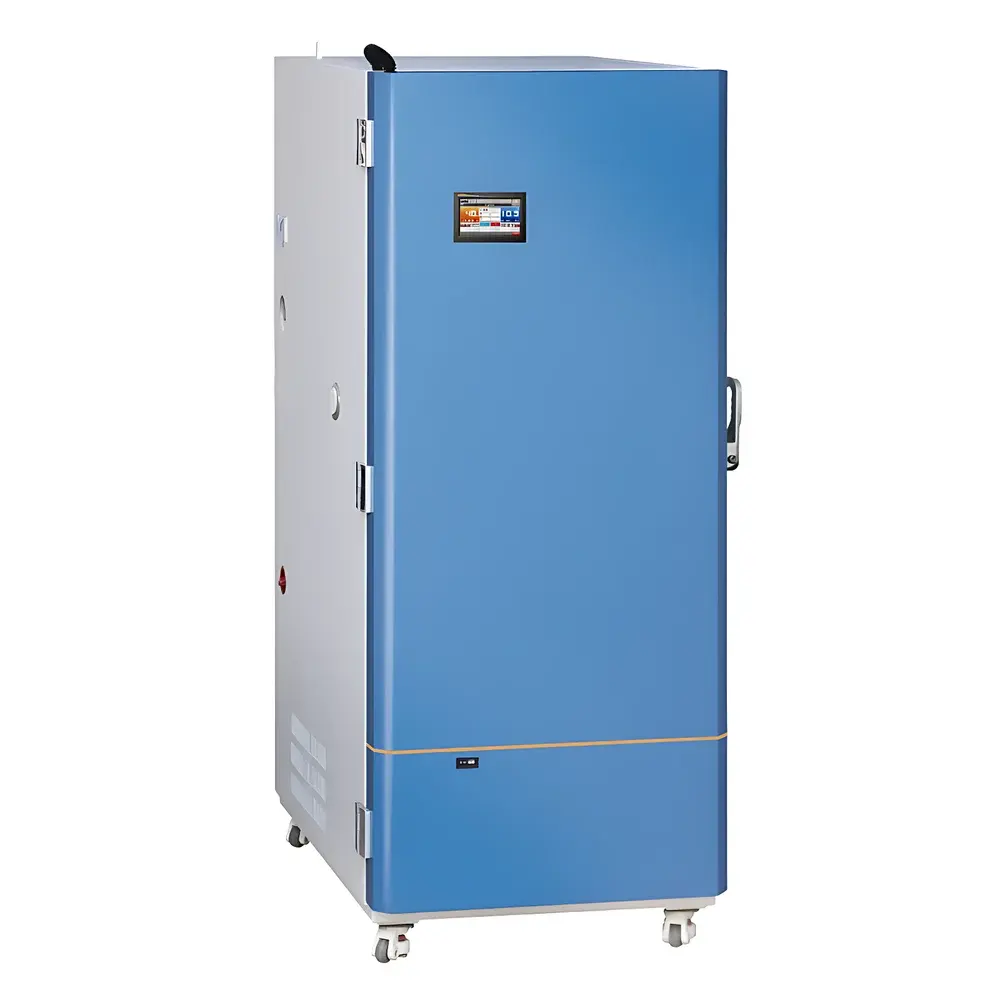
YSEI SHH-1000SD-2T Drug Stability Testing Chamber
| Brand | YSEI |
|---|---|
| Origin | Chongqing, China |
| Manufacturer Type | Direct Manufacturer |
| Product Origin | Domestic (China) |
| Model | SHH-1000SD-2T |
| Price Range | USD 7,000 – 11,200 |
Overview
The YSEI SHH-1000SD-2T Drug Stability Testing Chamber is an ISO/ICH-compliant environmental simulation system engineered for long-term, accelerated, and intermediate stability studies of pharmaceutical products in accordance with ICH Q1A(R3), Q5C, and relevant chapters of the United States Pharmacopeia (USP <1150>), European Pharmacopoeia (Ph. Eur. 2.2.40), and Chinese Pharmacopoeia (ChP 9001). It operates on a dual-temperature/humidity control architecture utilizing independent refrigeration, heating, and humidification subsystems to maintain precise, traceable, and reproducible test conditions across defined climatic zones—including stringent low-humidity protocols such as 40 °C / 20 % RH required for large-volume parenterals and hygroscopic formulations. The chamber’s structural integrity, thermal uniformity (±0.5 °C at setpoint, ±3 % RH), and dynamic response time (<30 min to recover setpoint after door opening) are validated per ASTM E2582–23 and GB/T 10586–2025 technical specifications.
Key Features
- Touchscreen HMI controller with 64 MB internal cyclic memory and removable SD card slot—stores timestamped setpoints, real-time sensor readings (temperature, relative humidity), and system status logs
- Electronic data recording compliant with FDA 21 CFR Part 11: audit-trail-enabled, user-authenticated access, electronic signatures, and immutable record retention
- Configurable logging intervals (1 min to 24 h); supports ≥10 years of continuous data at 1-min resolution or ≥3 years at 15-min resolution
- Dual-door design with tempered glass inner door minimizes thermal/hygrometric disturbance during visual inspection; outer door equipped with keyed mechanical lock for GMP-aligned access control
- RS485 Modbus RTU interface enables centralized monitoring and control via dedicated pharmaceutical SCADA platforms; up to 30 units addressable on a single bus
- Remote diagnostics and parameter adjustment via secure internet connection using YSEI Sims software (TLS 1.2 encrypted, role-based permissions)
- Energy-optimized refrigeration cycle and ultra-low-noise fan array ensure <45 dB(A) operational sound pressure level and ≤2.8 kW average power consumption under 40 °C / 75 % RH continuous operation
- Redundant safety architecture: independent overtemperature cutoff, humidifier dry-run protection, compressor overload relay, and optional GSM-based SMS alerting for power failure or excursion events
Sample Compatibility & Compliance
The SHH-1000SD-2T accommodates standard stability storage configurations including open trays, sealed aluminum foil pouches, blister packs, vials, and IV bags mounted on stainless-steel racks. Its interior chamber volume (1000 L net) and uniform airflow distribution meet ICH Q5C requirements for spatial homogeneity. All materials in contact with the test environment—stainless-steel 304 chamber walls, silicone gaskets, and non-outgassing insulation—are certified non-reactive per USP <661.1>. Full IQ/OQ documentation packages—including calibration certificates traceable to NIM (National Institute of Metrology, China) and uncertainty budgets—are provided pre-installation. Validation support includes protocol development, execution services, and deviation reporting aligned with Annex 15 and EU GMP Guideline Part I.
Software & Data Management
YSEI’s proprietary Sims software (v4.2+) delivers full lifecycle data governance: automated report generation (PDF/CSV), configurable alarm escalation trees, version-controlled method templates, and electronic batch record integration. Raw sensor data is stored in encrypted SQLite databases with SHA-256 hashing; export functions comply with ALCOA+ principles (Attributable, Legible, Contemporaneous, Original, Accurate, Complete, Consistent, Enduring, Available). Audit trails record all user actions—including parameter changes, log exports, and account modifications—with timestamps and operator IDs. Software validation kits include installation qualification (IQ), operational qualification (OQ), and performance qualification (PQ) test scripts compliant with GAMP 5 Category 3 standards.
Applications
- ICH Q1A(R3)-mandated long-term studies (25 °C / 60 % RH, 30 °C / 65 % RH) and accelerated testing (40 °C / 75 % RH)
- Intermediate condition assessments (30 °C / 65 % RH) for tropical climates per ICH Q5C
- Low-humidity stress testing (40 °C / 20 % RH) for lyophilized products and moisture-sensitive APIs
- Photostability pre-screening when integrated with optional ICH Q1B-compliant UV/visible light modules
- Stability-indicating method development support through controlled degradation profiling
- QC release testing under cGMP Annex 1 environmental monitoring frameworks
FAQ
Does the SHH-1000SD-2T support 21 CFR Part 11 compliance out-of-the-box?
Yes—the system ships with pre-validated Sims software, role-based access controls, electronic signatures, and immutable audit trails meeting all technical and procedural requirements of FDA 21 CFR Part 11 Subpart B.
Can data be exported in formats compatible with LIMS or ERP systems?
Yes—CSV, PDF, and XML exports are natively supported; API endpoints (RESTful JSON) are available under enterprise licensing for direct integration with LabVantage, STARLIMS, or SAP QM modules.
What is the recommended calibration frequency and traceability standard?
Annual calibration against NIST-traceable reference probes (±0.1 °C, ±1.5 % RH) is recommended; YSEI provides accredited calibration services with ISO/IEC 17025-certified certificates.
Is IQ/OQ documentation included with purchase?
Yes—fully editable IQ/OQ protocols, executed reports, and supporting evidence (e.g., uniformity mapping, recovery tests, alarm verification) are delivered digitally and on USB prior to commissioning.
How does the chamber handle power interruption recovery?
Upon power restoration, the controller resumes operation from last known state; all logged data remains intact due to non-volatile memory and SD card write-caching with journaling.
Related Products