
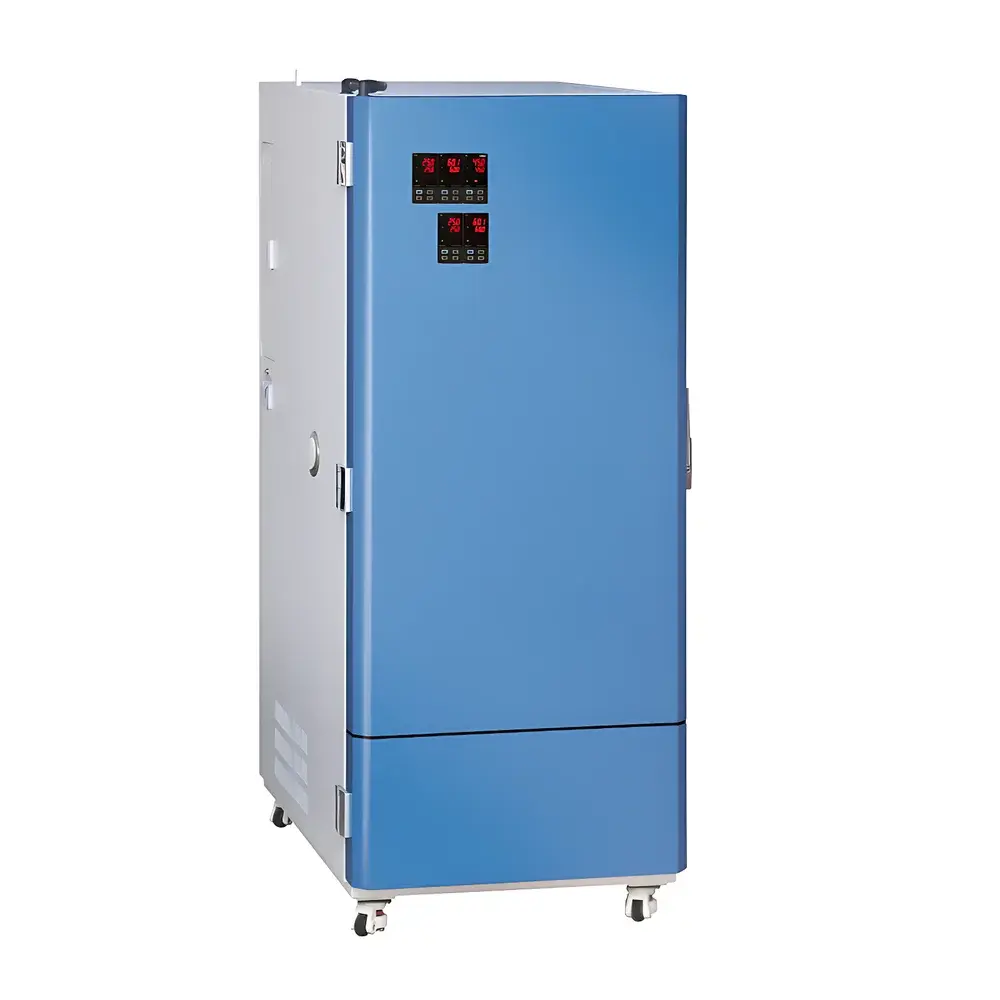
YSEI SHH-100GD-2F Drug Photostability Testing Chamber
| Brand | YSEI |
|---|---|
| Origin | Chongqing, China |
| Manufacturer Type | Direct Manufacturer |
| Country of Origin | China |
| Model | SHH-100GD-2F |
| Pricing | Upon Request |
| Dimensions (D×W×H) | Not specified in input |
| Illuminance Compliance | ≥1.2×10⁶ lux·hr (total visible), ≥200 W·hr/m² (near-UV) |
| Control Architecture | Centralized PC-based control supporting up to 30 units |
| Data Logging | Dual-mode — thermal printer (adjustable interval) + real-time digital recording via RS485 |
| Safety Protections | Independent chamber overtemperature cutoff, refrigeration compressor overload protection |
| Environmental Operating Range | 5–35°C ambient temperature, ≤85% RH |
| Warranty | 12 months from commissioning, lifetime technical support |
| Qualification Support | IQ/OQ documentation and execution services available |
Overview
The YSEI SHH-100GD-2F Drug Photostability Testing Chamber is a purpose-engineered environmental simulation system designed exclusively for photostability assessment of pharmaceutical substances and products in compliance with international regulatory frameworks. It operates on the principle of controlled, high-intensity illumination under defined spectral distribution (visible and near-ultraviolet), enabling quantitative evaluation of light-induced degradation pathways—such as oxidation, hydrolysis, or isomerization—that compromise drug identity, potency, purity, or safety. The chamber integrates a calibrated xenon arc lamp array with precision optical filters to replicate the solar spectrum relevant to ICH Q1B guidelines, delivering reproducible irradiance profiles across the 320–400 nm near-UV band and 400–800 nm visible range. Its thermally stabilized chamber design maintains setpoint temperature (typically 25°C ±2°C) independent of radiant heating effects, ensuring decoupled thermal and photochemical stress conditions—a critical requirement for orthogonal stability testing per ICH Q5C and Q1A(R2).
Key Features
- Regulatory-aligned illumination delivery: Achieves ≥1.2×10⁶ lux·hr total visible exposure and ≥200 W·hr/m² near-UV (320–400 nm) energy density within a single test cycle, fully satisfying ICH Q1B Option 1 and USP <1191> photostability protocol requirements.
- Dual-spectrum fidelity: Xenon arc source with broadband output and integrated optical filtering ensures spectral match to CIE standard illuminant D65, minimizing non-physiological photolysis artifacts.
- Centralized multi-unit control architecture: A single Windows-based host PC can monitor and configure up to 30 SHH-GD series chambers simultaneously via RS485 daisy-chain topology, reducing lab footprint and operational overhead.
- Redundant data integrity system: Real-time digital logging (timestamped, ISO/IEC 17025-compliant metadata tagging) coexists with optional thermal printer output—both independently configurable for audit-ready traceability.
- Fail-safe thermal management: Dual-stage cooling (hermetic refrigeration compressor + PID-controlled air circulation) maintains chamber uniformity (±1.5°C) while active overtemperature cutoff isolates heater circuits if internal sensor exceeds user-defined limit.
- Validation-ready platform: Prequalified IQ/OQ protocols—including sensor calibration certificates (NIST-traceable lux and UV radiometers), alarm response verification, and chamber mapping reports—are provided upon request to support FDA 21 CFR Part 11 and EU Annex 11 compliance.
Sample Compatibility & Compliance
The SHH-100GD-2F accommodates standard pharmaceutical packaging configurations—including open petri dishes, amber vials, blister packs, and secondary cartons—within its vertically stacked dual-shelf chamber (two independent light-exposure zones). Each shelf incorporates removable, UV-transmissive acrylic diffusers to ensure irradiance homogeneity (±5% across 90% of shelf area per ASTM E2652). The system meets essential regulatory benchmarks: ICH Q1B (Photostability Testing of New Drug Substances and Products), FDA Guidance for Industry: Photosensitivity Testing, USP <1191> Photostability Testing, and Chinese Pharmacopoeia 2015 Volume IV General Chapter 9001. All firmware and software modules are developed under GLP-aligned design controls, with full revision history, change logs, and electronic signature capability for 21 CFR Part 11 adherence.
Software & Data Management
YSEI’s proprietary PhotostabControl™ software provides role-based access (administrator, operator, reviewer), automated test sequencing, and real-time deviation alerts (e.g., irradiance drift >3%, temperature excursion >±2°C). Raw sensor data—including lux, UV-W/m², chamber temperature, and runtime—are stored in encrypted SQLite databases with SHA-256 hashing. Export functions support CSV, PDF summary reports, and XML formats compatible with LIMS integration. Audit trails record all user actions (login/logout, parameter changes, manual overrides) with immutable timestamps—fully compliant with ALCOA+ principles. Remote diagnostics and firmware updates may be performed securely over TLS 1.2-encrypted internet connections, subject to customer-configured firewall policies.
Applications
- ICH Q1B Option 1 photostability screening of new chemical entities (NCEs) and biologics under forced degradation conditions.
- Comparative photostability profiling of generic drug products against reference listed drugs (RLDs) per FDA Orange Book requirements.
- Light exposure validation for primary packaging materials (e.g., HDPE vials, PVC blisters) per ISO 11607-1.
- Stability-indicating method development support—correlating photodegradant formation rates with HPLC/UPLC analytical outputs.
- Environmental stress testing during formulation development to identify excipient-mediated photoreactivity (e.g., riboflavin-catalyzed oxidation).
FAQ
Does the SHH-100GD-2F include NIST-traceable irradiance calibration?
Yes—each unit ships with factory calibration certificates for both visible (lux) and near-UV (W/m²) sensors, verified annually against NIST SRM 2222 and 2223 reference standards.
Can the chamber operate continuously for extended photostability cycles (e.g., 10-day studies)?
Yes—the refrigeration system and lamp power supply are rated for uninterrupted operation at 25°C setpoint for ≥240 hours; mean time between failures (MTBF) exceeds 15,000 hours per IEC 61508 reliability modeling.
Is remote validation support available for IQ/OQ execution?
Yes—YSEI offers on-site or virtual qualification support by certified validation engineers, including protocol review, evidence collection, and final report sign-off aligned with PIC/S TR 13 and WHO Technical Report Series No. 992.
How is data integrity ensured during power interruption?
Non-volatile memory retains all active test parameters and logged values for ≥72 hours; upon recovery, the system resumes logging without data gap and flags any interruption event in the audit trail.
What maintenance intervals are recommended for lamp and filter replacement?
Xenon lamps require replacement every 1,200 hours of cumulative operation; UV-cut filters must be renewed every 6 months or after 500 hours of use—both tracked automatically in software and flagged via maintenance alert.




