
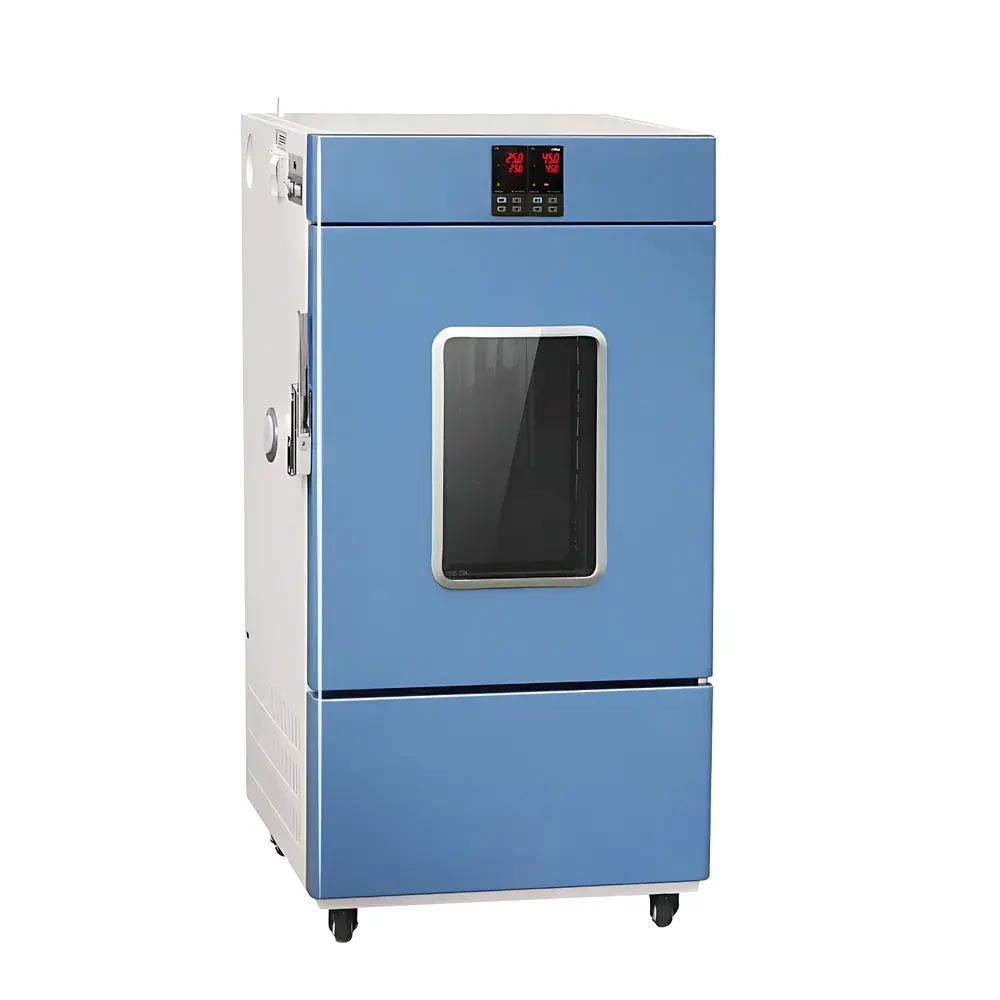
YSEI SHH-100GD Drug Photostability Testing Chamber
| Brand | YSEI |
|---|---|
| Origin | Chongqing, China |
| Manufacturer Type | Direct Manufacturer |
| Country of Origin | China |
| Model | SHH-100GD |
| Pricing | Available Upon Request |
| Light Intensity | 4500 ± 500 lux (compliant with ChP 2020 <9001>) |
| Light Source | High-Efficiency LED Array |
| Noise Level | ≤35 dB(A) |
| Data Recording | Built-in thermal printer with adjustable print interval |
| Temperature Range | Ambient +5°C to 60°C |
| Humidity Range | 10–85% RH |
| Chamber Volume | 100 L |
| Dimensions (D×W×H) | 500 × 500 × 400 mm |
| Safety Features | Independent overtemperature protection, compressor overload protection |
| Environmental Operating Conditions | Ambient temperature 5–35°C, ambient humidity ≤85% RH |
| Validation Support | IQ/OQ documentation and execution services available |
Overview
The YSEI SHH-100GD Drug Photostability Testing Chamber is an engineered environmental test system designed specifically for photostability assessment of pharmaceutical substances and products in accordance with the Chinese Pharmacopoeia (ChP) 2020 Edition, General Chapter <9001> “Stability Testing of Active Pharmaceutical Ingredients and Products.” It implements controlled irradiation exposure under standardized visible light conditions—maintaining a stable illuminance of 4500 ± 500 lux—as mandated for forced degradation studies during ICH Q1B-compliant photostability testing. Unlike conventional xenon or fluorescent lamp-based systems, the SHH-100GD employs a calibrated, spectrally stable LED array optimized for consistent photon flux output across the 320–800 nm visible range, minimizing UV-induced artifacts while ensuring long-term radiometric stability (>10,000 hours nominal lifetime). Its thermally managed optical architecture prevents localized heating of samples, preserving integrity during extended exposure cycles. The chamber integrates precise temperature and humidity control (±0.5°C, ±3% RH typical) to decouple photolytic effects from concurrent thermal or hygroscopic stress—a critical requirement for regulatory-grade stability protocol execution.
Key Features
- LED-based illumination system delivering 4500 ± 500 lux at sample level, traceable to NIM-calibrated photometers and compliant with ChP <9001> and ICH Q1B Annex I criteria;
- Quiet operation with acoustic emission ≤35 dB(A) at 1 m distance, enabling placement in shared laboratory environments without disruption;
- Integrated thermal printer providing real-time, tamper-evident hardcopy records of temperature, relative humidity, and illuminance values at user-defined intervals (1 min to 24 h);
- Dual-channel data logging with on-device storage of ≥30 days’ continuous history, exportable via USB for audit-ready reporting;
- Independent overtemperature cutoff circuitry with dedicated sensor—fully isolated from main controller—to prevent thermal runaway during extended tests;
- Hermetically sealed refrigeration loop with scroll-type compressor, rated for continuous operation at 40°C / 75% RH (measured power draw: 380 W);
- Front-accessible single-shelf design (500 × 500 mm usable area) accommodating standard ICH-compliant sample trays and amber/glass vials without obstruction.
Sample Compatibility & Compliance
The SHH-100GD accommodates solid dosage forms (tablets, capsules), lyophilized powders, solutions in glass ampoules or scintillation vials, and topical formulations in opaque or transparent containers—provided they fit within the 100 L internal volume and do not obstruct airflow or light uniformity. Illuminance uniformity across the shelf surface meets ChP <9001> requirements (±15% deviation from mean), verified per ISO/IEC 17025-accredited calibration procedures. All electronic subsystems—including lighting driver, PID controllers, and data logger—are designed to support 21 CFR Part 11-compliant workflows when paired with validated software extensions. The system conforms to IEC 61000-6-3 (EMC emissions) and IEC 61010-1 (safety for laboratory equipment), and its mechanical construction adheres to GMP-aligned cleanroom-compatible materials (304 stainless steel interior, powder-coated steel exterior).
Software & Data Management
While the SHH-100GD operates as a standalone instrument with embedded firmware, optional PC-based software (YSEI DataLink v3.2) enables remote monitoring, configurable alarm thresholds, electronic signature capture, and automated PDF report generation. Raw time-series datasets are stored in CSV format with ISO 8601 timestamps and include metadata fields (operator ID, protocol number, chamber serial number). Audit trail functionality logs all parameter changes, print events, and user logins with immutable timestamps—supporting GLP and GMP inspection readiness. IQ/OQ validation packages—including test protocols, acceptance criteria, and completed execution records—are provided upon request and align with ASTM E2500-13 and EU Annex 15 guidance.
Applications
- ICH Q1B photostability screening of new drug substances (NDS) and products (NDPs);
- Forced degradation studies to identify photolytic impurities per ICH Q5C and Q3B;
- Comparative evaluation of packaging light-barrier efficacy (e.g., amber vs. clear vials, aluminum foil wraps);
- Stability protocol development for registration dossiers submitted to NMPA, FDA, EMA, and PMDA;
- In-process monitoring of light-sensitive biologics, antibiotics, and ophthalmic solutions;
- Internal quality assurance audits verifying compliance with pharmacopoeial monographs requiring photostability data.
FAQ
Does the SHH-100GD meet ICH Q1B requirements for photostability testing?
Yes—the 4500 ± 500 lux output, spectral distribution, and spatial uniformity are validated against ICH Q1B Annex I specifications and ChP 2020 <9001>.
Can the chamber operate continuously for 24-hour exposure cycles?
Yes; the LED array and refrigeration system are rated for uninterrupted operation up to 30 days at 40°C / 75% RH, with built-in thermal derating logic.
Is printer output compliant with ALCOA+ data integrity principles?
Yes—each printed record includes date/time stamp, chamber ID, operator code, and unique batch identifier; paper logs are retained as primary records per GMP Annex 11.
What validation documentation is included with delivery?
Factory-issued FAT report, calibration certificates for illuminance/temperature/humidity sensors, and optional IQ/OQ protocol templates with execution support.
How is light intensity calibrated and maintained over time?
An integrated silicon photodiode sensor performs continuous closed-loop feedback; annual recalibration using NIM-traceable reference meters is recommended.




