
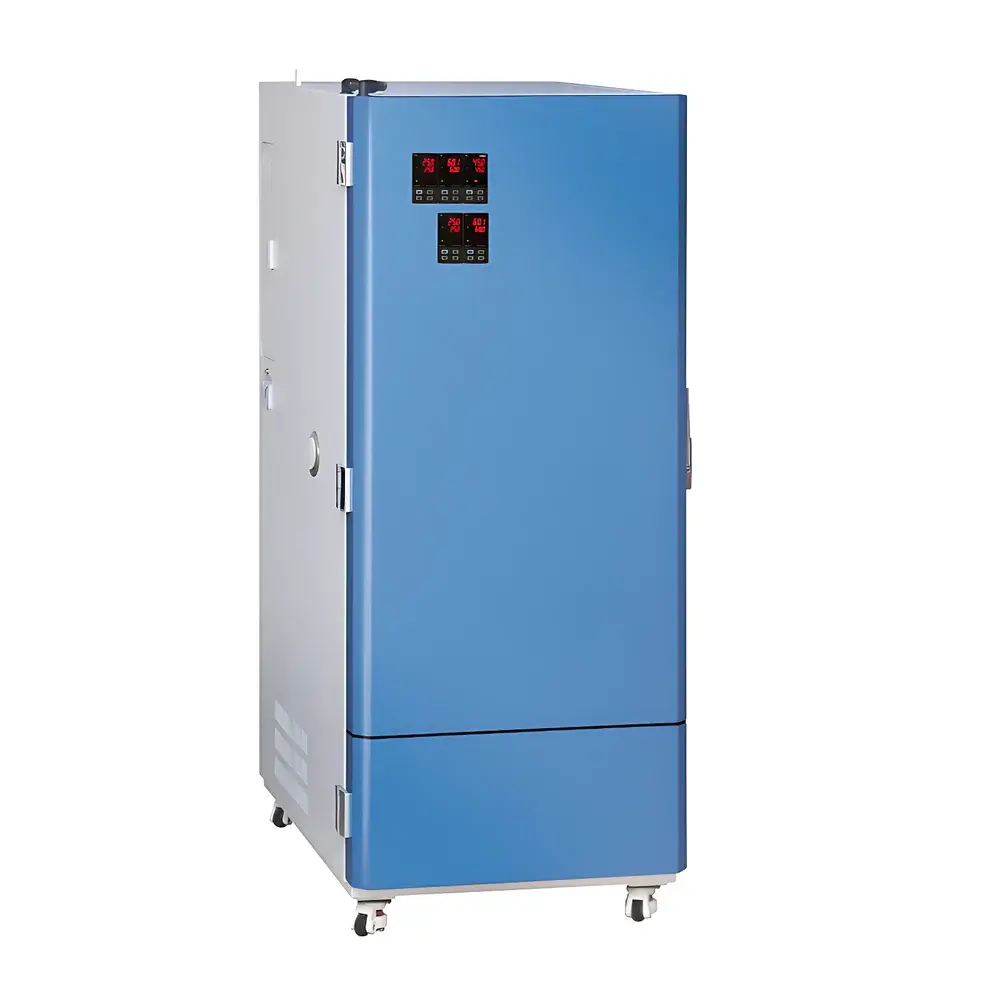
YSEI SHH-200GD-2 Drug Photostability Testing Chamber
| Brand | YSEI |
|---|---|
| Origin | Chongqing, China |
| Manufacturer Type | Direct Manufacturer |
| Country of Origin | China |
| Model | SHH-200GD-2 |
| Pricing | Upon Request |
| Dimensions (D×W×H) | 600 × 750 × 1800 mm |
| Illumination Uniformity | ±10% across chamber volume |
| Light Source | UV-A + visible spectrum fluorescent lamps (320–400 nm & 400–800 nm) |
| Total Illuminance Requirement | ≥1.2 × 10⁶ lux·h (per ICH Q1B) |
| Near-UV Energy Dose | ≥200 W·h/m² (320–400 nm) |
| Photometric Control | Digital irradiance sensor with real-time feedback loop |
| Temperature Setpoint Range | 15–30°C (typical photostability test condition: 25°C ± 2°C) |
| Humidity Control | Non-controlled (open-air design per ICH Q1B) |
| Cooling System | Air-cooled hermetic compressor with over-load protection |
| Safety Protections | Independent chamber over-temperature cutoff, compressor thermal overload relay, door interlock switch |
| Data Logging | Dual-channel — RS485-modbus RTU to PC (continuous .csv export), built-in thermal printer (adjustable print interval: 1–60 min) |
| Remote Monitoring | TCP/IP Ethernet interface |
| Compliance | ICH Q1B, USP <115>, Chinese Pharmacopoeia 2015 Ed. General Chapter 9001, FDA Guidance for Industry: Photosensitivity Testing (2022), ISO/IEC 17025-aligned validation support (IQ/OQ documentation provided) |
Overview
The YSEI SHH-200GD-2 Drug Photostability Testing Chamber is an engineered environmental simulation system designed explicitly for regulatory-compliant photostability assessment of pharmaceutical substances and products in accordance with ICH Q1B, USP , and the Chinese Pharmacopoeia (2015 Edition, General Chapter 9001). It operates on the principle of controlled, high-intensity illumination using calibrated broad-spectrum fluorescent lamps that deliver defined spectral power distribution—specifically optimized to replicate near-ultraviolet (320–400 nm) and visible (400–800 nm) irradiance profiles mandated by international guidelines. Unlike general-purpose climate chambers, the SHH-200GD-2 is configured as a non-humidified, temperature-stabilized irradiation environment, ensuring strict adherence to ICH Q1B’s stipulation that photostability testing be conducted under “dry” conditions at 25°C ± 2°C. Its chamber geometry, lamp array layout, and real-time irradiance monitoring architecture are validated to maintain ≤±10% spatial uniformity of illuminance across the entire sample zone—critical for reproducible degradation kinetics and comparative batch evaluation.
Key Features
- Regulatory-grade optical architecture: Dual-band lamp configuration (UV-A + white light) with traceable NIST-calibrated irradiance sensors providing closed-loop intensity control.
- Dual-path data integrity: Simultaneous real-time digital logging via RS485 Modbus RTU (exportable as time-stamped CSV) and physical hard-copy output via integrated thermal printer (print interval configurable from 1 to 60 minutes).
- Scalable networked operation: Ethernet-enabled remote supervision supporting centralized management of up to 30 SHH-series units on a single local or cloud-hosted server—enabling cross-site protocol harmonization and audit-ready session archiving.
- Thermal safety redundancy: Independent over-temperature cut-off circuitry (separate from main controller), compressor thermal overload protection, and electromechanical door interlock preventing operation when access panel is open.
- Validation-ready platform: Delivered with full IQ/OQ documentation package compliant with ISO/IEC 17025 and aligned with FDA 21 CFR Part 11 expectations for electronic records and signatures.
Sample Compatibility & Compliance
The SHH-200GD-2 accommodates standard pharmaceutical packaging formats—including glass vials (10–50 mL), blister cards, HDPE bottles, and aluminum-fold pouches—mounted on removable, light-diffusing acrylic shelves (one shelf included as standard; optional multi-tier configurations available). All internal surfaces are matte-white PTFE-coated to minimize specular reflection and ensure Lambertian scattering. The system satisfies the core photostability acceptance criteria defined in ICH Q1B: cumulative total illuminance ≥1.2 × 10⁶ lux·h and near-UV energy dose ≥200 W·h/m² (integrated over 320–400 nm). It further meets the Chinese Pharmacopoeia’s requirement for initial exposure at 4500 ± 500 lux (measured at sample plane), with automated ramping to target cumulative doses. No humidity control is implemented—consistent with ICH guidance prohibiting active humidification during photostability studies.
Software & Data Management
The embedded controller firmware supports Modbus RTU communication over RS485 for integration into LIMS or MES environments. A dedicated Windows-based configuration utility enables setup of test profiles (duration, setpoint temperature, print interval), alarm thresholds, and user-access levels. All operational parameters—including chamber temperature, lamp voltage, irradiance integral, and elapsed runtime—are timestamped and stored locally in non-volatile memory for minimum 30 days. Data export conforms to ALCOA+ principles: attributable, legible, contemporaneous, original, accurate, complete, consistent, enduring, and available. Audit trails record user logins, parameter modifications, and alarm events—fully compliant with GLP/GMP data integrity expectations.
Applications
- ICH Q1B photostability stress testing of new drug substances (NDS) and drug products (NDP).
- Comparative photodegradation profiling across formulation variants (e.g., coated vs. uncoated tablets, different excipient matrices).
- Light-induced impurity identification support for ICH Q5C and Q3B submissions.
- Stability-indicating method development and validation under forced degradation conditions.
- Supplier qualification of light-sensitive packaging components (e.g., amber vials, opaque blisters).
FAQ
Does the SHH-200GD-2 comply with FDA 21 CFR Part 11 requirements for electronic records?
Yes—when used with the validated software suite and configured with role-based user accounts, electronic signatures, and enabled audit trail logging, it meets predicate rule requirements for record retention and integrity.
Can the chamber accommodate multiple shelf layers for higher throughput?
Standard configuration includes one shelf; optional 2- and 3-tier shelf kits are available with recalibrated irradiance mapping reports.
Is calibration certification included with shipment?
Each unit ships with a factory-issued irradiance and temperature calibration certificate traceable to national standards; annual recalibration services are offered with NIST-traceable documentation.
What environmental conditions are required for proper installation?
Ambient operating range: 5–35°C ambient temperature, ≤85% RH, adequate ventilation for compressor heat dissipation, and stable AC power (220 V ±10%, 50 Hz).
How is lamp aging compensated during long-duration tests?
The integrated irradiance sensor continuously monitors spectral output and dynamically adjusts lamp drive current to maintain target irradiance—ensuring dose accuracy over 1,000+ hours of continuous operation.





